
Hunting with Africa’s Last Hunter-Gatherers: Our Experience With the Hadzabe
Alex and I have visited 4 tribes in East Africa and visiting the Hadzabe was by far the most authentic, engaging, and educational experience we had. We learned an immense amount about their culture and way of life, as well as what it must have looked like for our ancestors to sustain themselves by hunting and gathering. I advise anyone traveling through Tanzania to add a stop to visit the Hadzabe to your list.
TRIGGER WARNINGS
This article contains sensitive information that may be disturbing to some readers. I don’t get into any graphic details, but I do reference hunting and animal death. All photos and videos that are potentially disturbing are hidden behind warnings. There are no photos or videos of gore or blood, even behind trigger warnings.
WHO ARE THE HADZABE?
The Hadzabe are the last hunter-gatherers on the entire continent of Africa. There are between 1000-1300 Hadzabe left, spread out in different clans of about 20-40 members near Lake Eyasi, Tanzania. They have special permission from the government to hunt, as this has been their lifestyle for tens of thousands of years.
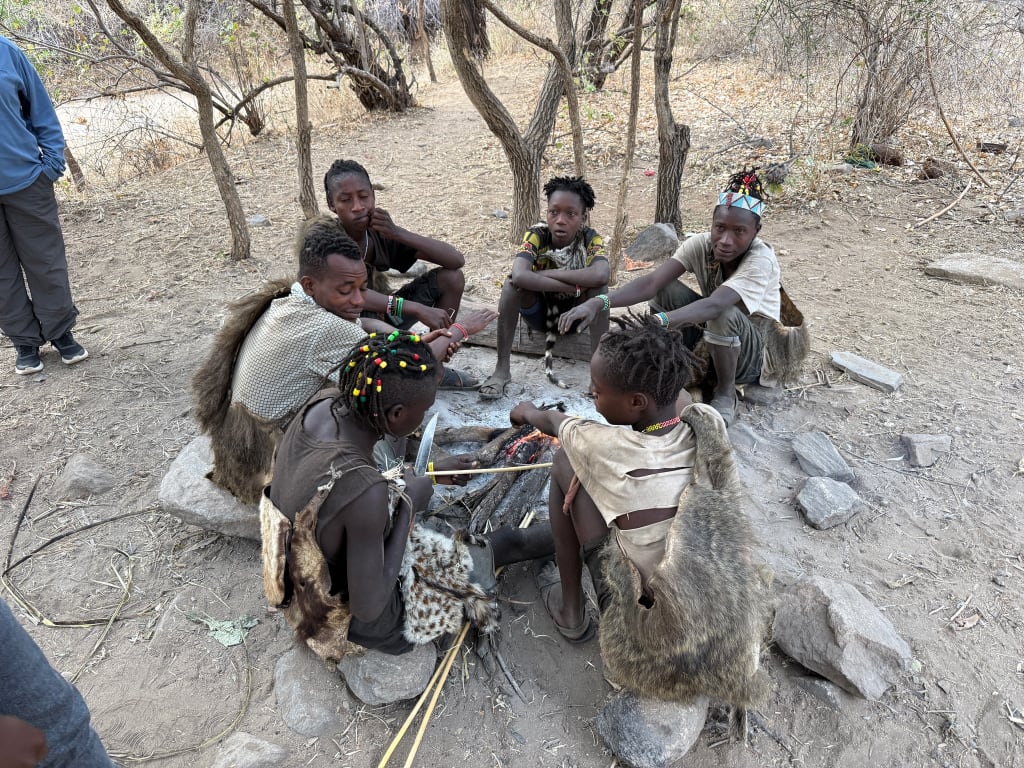
The Hadzabe sustain themselves primarily through hunting (done by the men) and gathering (done by the women). The men will hunt baboons, antelopes, pigs, and birds, among other things, and the women gather tubers, berries, and search for water. The elders retire from hunting and focus their attention on teaching the young their medical wisdom. The Hadzabe also trade their meat with the nearby Datoga tribe in exchange for arrowtips, and they engage with tourists as a way to make extra income as well.
The Hadzabe are famous for their “clicking language,” which combines clicking and other sounds to form their basis for communication. It’s absolutely fascinating to hear.
IS VISITING THE HADZABE ETHICAL?
In my mind, there are two different angles to this question.
First, is supporting hunting ethical?
That’s a question I grappled with as someone who hasn’t eaten meat in 6 years and has spent a lot of time thinking about the ethical concerns with eating meat. The truth is, the majority of humans around the world consume animals and animal products. One could argue that this form of hunting is more ethical than farming, as animals do not suffer in inhumane conditions throughout their entire life and have a swift end. Also, while visiting the Hadzabe, you will not participate in the hunt and will serve as a witness only, so you will not be directly responsible for any deaths. Hunting and gathering has been how humans sustained themselves for millions of years (not an exaggeration). With that rationale, I personally felt comfortable coming along for the hunt, but it’s a very personal decision and you should decide for yourself.
Second, is this exploitative to the Hadzabe? Does this feel like a human zoo?
My answer is a resounding no. The Hadzabe aren’t putting on a performance. They are inviting tourists into their lives as a way to supplement their income and support their way of life. In my experience, neither side was judging the other. I learned a lot from the Hadzabe and felt privileged to get to witness a snippet of their daily lives.
WHERE TO STAY?
We stayed for one night at the Kisima Ngeda Lodge right on Lake Eyasi. The lodge had a gorgeous view of the lake and a watchtower for observing the various bird species that call the lake home. The rooms were spacious, the food was solid, and the owners were very friendly.
DO YOU NEED A GUIDE?
Yes, you’ll need a guide to communicate with the Hadzabe, as they do not speak English (or any other foreign language). We organized our visit through our safari tour operator, Easy Travel Tanzania, who set us up with a Datoga guide who grew up trading with the Hadzabe and can communicate with them.
WHAT I LEARNED ABOUT THE HADZABE
The most prized prey for the Hadzabe is the baboon, so much so that when a man wants to get married, he must offer the woman’s family 2 large baboons before he asks for her hand in marriage. As the Hadzabe don’t keep track of age, there is no other criteria to get married. If the man is skilled enough to hunt two baboons on his own, he can clearly provide for his family and he is ready. The Hadzabe are monogamous, unlike the neighboring Datoga tribe.
The Hadzabe eat many other animals in addition to baboons. They refuse to eat hyena, however. This is because the Hadzabe do not bury their dead and know that hyenas will likely feed on their remains. Therefore, they consider it wrong to feed on the creature that feeds on them.
OUR EXPERIENCE
We arrived to meet the Hadzabe early in the morning with our safari guide and Datoga guide in tow. The Hadzabe had set up camp in a spot in the woods. We scanned the area. There were a few campfires, some dwellings, and a collection of large bones saved as trophies for past hunting victories. I couldn’t believe the size of the kudu skulls.

We started a conversation with a young Hadzabe male who couldn’t have been more than 10 or 11 years old (but no one knows for sure; the Hadzabe don’t keep track of their age).
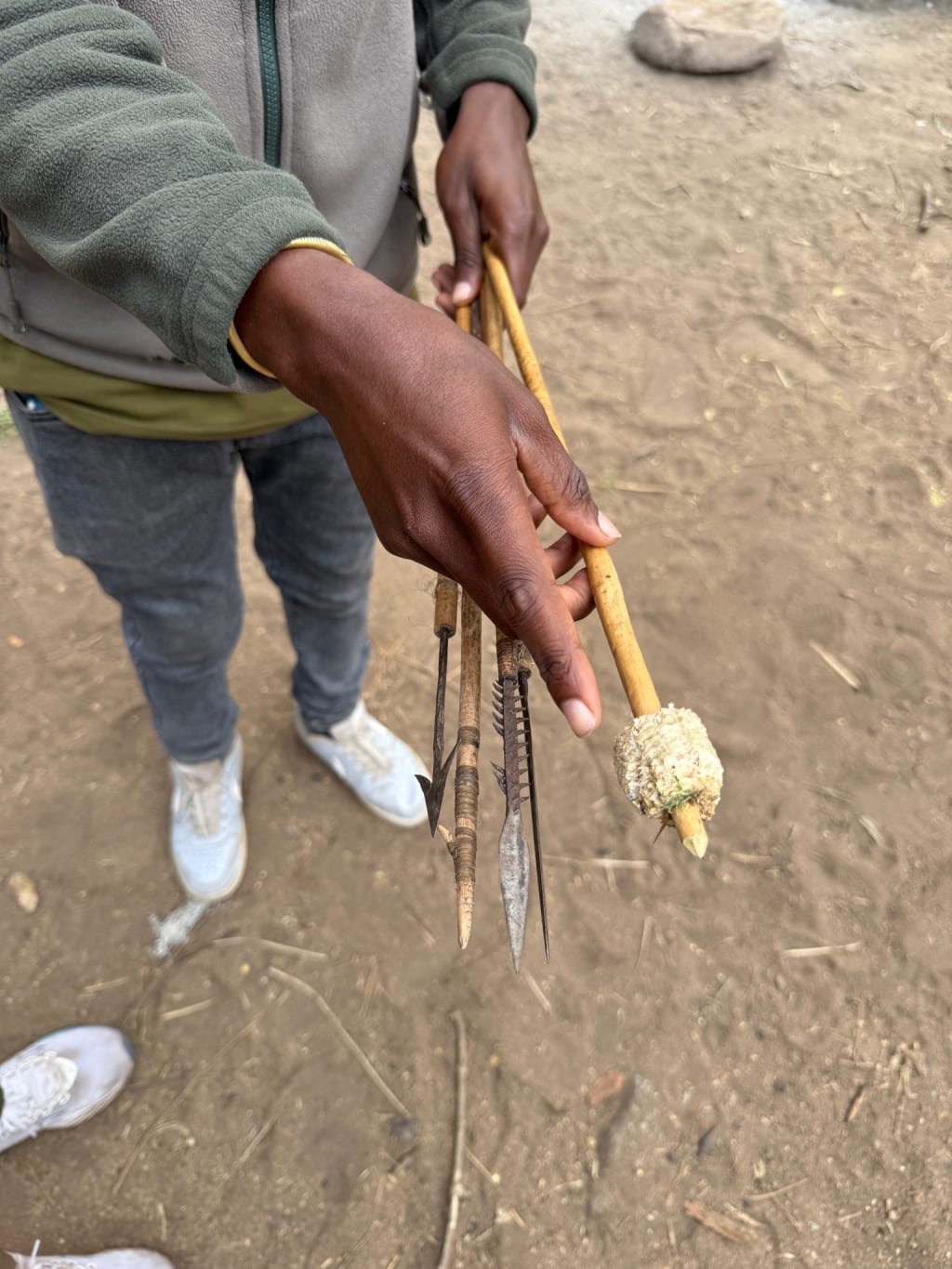
He started by explaining in his clicking language the 6 types of arrows they commonly use to hunt various species.
He showed us an arrow tip with a serrated edge that they use for baboons and monkeys, who are intelligent enough to try to pull the arrow tips out once they’re shot. For antelope such as kudu, they use poisonous arrows, as these animals are too large to be fatally wounded by a single shot. The poison takes 15 minutes to have an effect. They also have a special arrow just for small birds which has a piece of corn at the end. This ensures that the arrow doesn’t sail through the bird and continue flying upon impact so the arrows are easier to recover.
After that introduction, our safari guide, our Datoga guide, my husband, and I set off with this young boy and two others who were in their late teens by my estimations. The Hadzabe hunt in small groups of 3-4 individuals for safety, as they wouldn’t want to accidentally shoot one another and it’s difficult to track the location of everyone in a larger group. There were other tourists visiting the Hadzabe that morning, perhaps 10 total, but they went with other groups.
We didn’t travel far. Every other day the Hadzabe travel long distances to hunt the larger game, such as baboons and antelope. Today, they were resting up and hunting for birds locally. Tourists only accompany the Hadzabe on the shorter distance hunts.
We trailed the Hadzabe as they walked briskly through a sandy patch with a few sparse trees. We went at the Hadzabe’s pace (they are relying on this hunt to eat after all) but a relatively healthy person should have no trouble keeping up. Every few paces, they’d stop to take a shot at a bird in a tree.
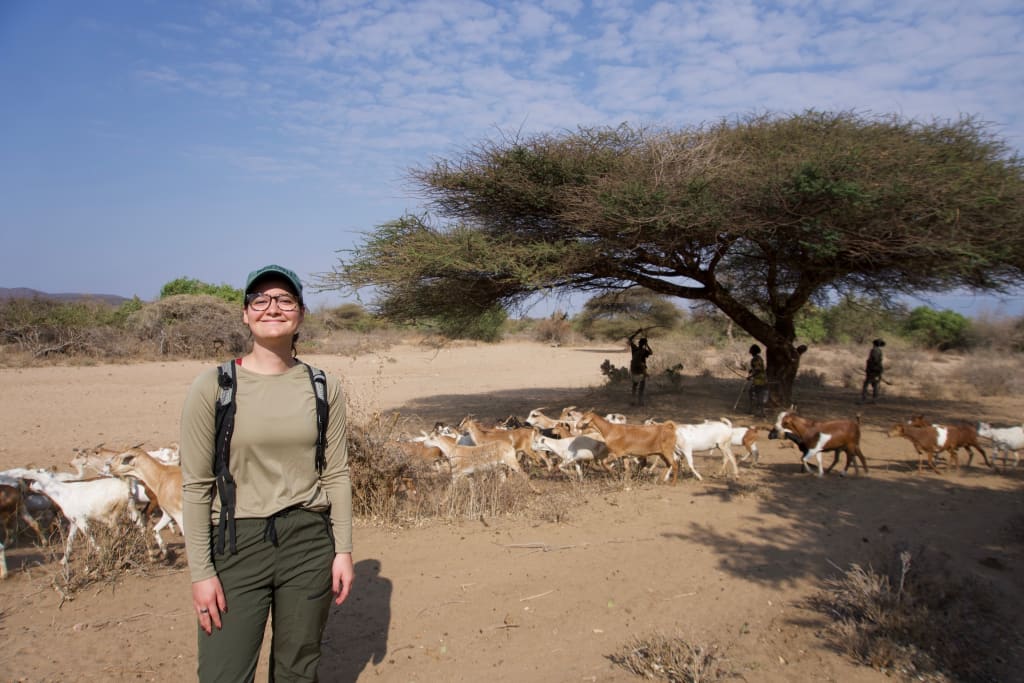

It didn’t take long for the first kill. I happened to be standing next to the hunter who shot the second bird out of the tree. It was still twitching when he went to retrieve it. He picked it up and handed it to me by the wing.
What came next had my jaw on the ground. The hunter indicated that I should bite the bird’s neck to make the kill. I’m sure it’ll come as no surprise that I refused those instructions. The hunter calmly carried out the mission on my behalf. He looked like Dracula with the little trail of blood dripping down his teeth! I couldn’t believe what I had witnessed!
That was nothing compared to what was to come. Just a few moments later there was a commotion up ahead, as the hunter’s comrades signalled they needed support. The hunter closest to me ran over. They were in the midst of a battle with an owl, which they shot a number of times. It took almost 10 arrows to bring him down. Even the Hadzabe were hesitant to approach the owl now; they have notoriously sharp talons that can do serious damage. They were able to grab him unharmed though. We all headed back to camp. The hunt had been a success! (In fact, our guide told us we were very fortunate to witness an owl being hunted, as it was not too common).
Trigger WarningClick to reveal hidden photos
Dead animal. No gore or blood.
Click to reveal hidden photos
Dead animal. No gore or blood.
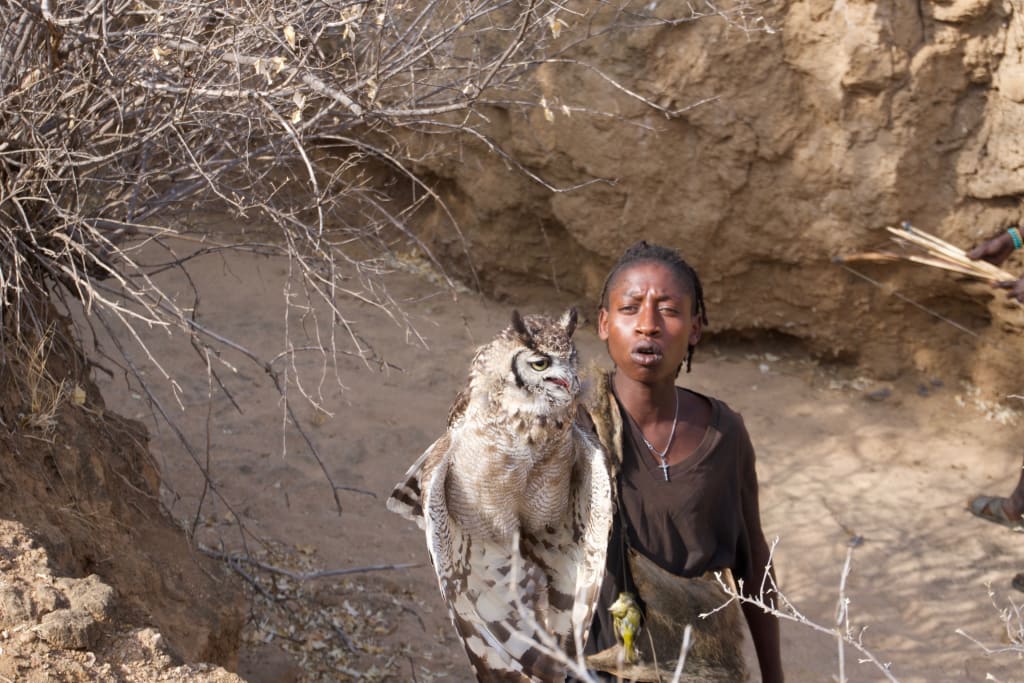
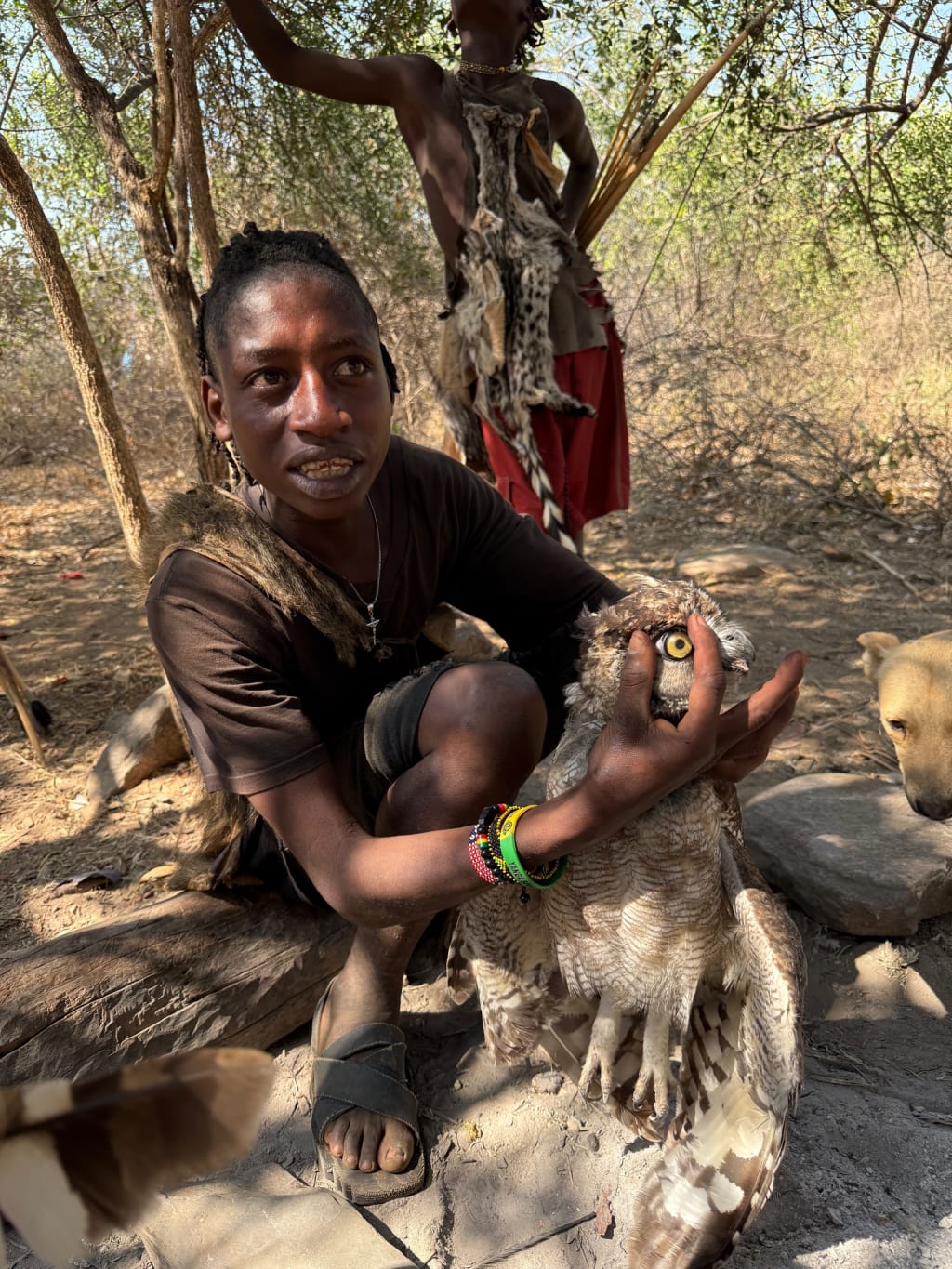
The youngest hunter immediately went to work de-feathering the owl. I was blown away at this young kid’s competency with hunting and preparing the meat, and tried to imagine my cousin (who’s a similar age) with this degree of independence and responsibility. (I couldn’t). He then roasted and boiled the meat. The Hadzabe’s dogs lingered nearby, hoping for a bite. The Hadzabe joked that if the dog ate their owl, they would just eat the dog! (Don’t worry, I did confirm they were just joking). The Hadzabe and their dogs happily feasted on the owl, but even the dog wouldn’t touch the owl intestines (yuck).
Trigger WarningClick to reveal hidden video
Dead animal and preparation of the body shown. No gore or blood.
Click to reveal hidden video
Dead animal and preparation of the body shown. No gore or blood.
The Hadzabe tend to be quite firm with their dogs and would repeatedly hit their dogs if they approached too close to the food. This, in addition to the hunt, might be disturbing for some people.
Here was a moment where I was thankful for my poor sense of smell. Alex said he started to feel a little queasy with the smell of the boiled meat, but it didn’t bother me!
Another group came back with a genet cat, which was about the size of a raccoon. They, too, began preparing a feast.
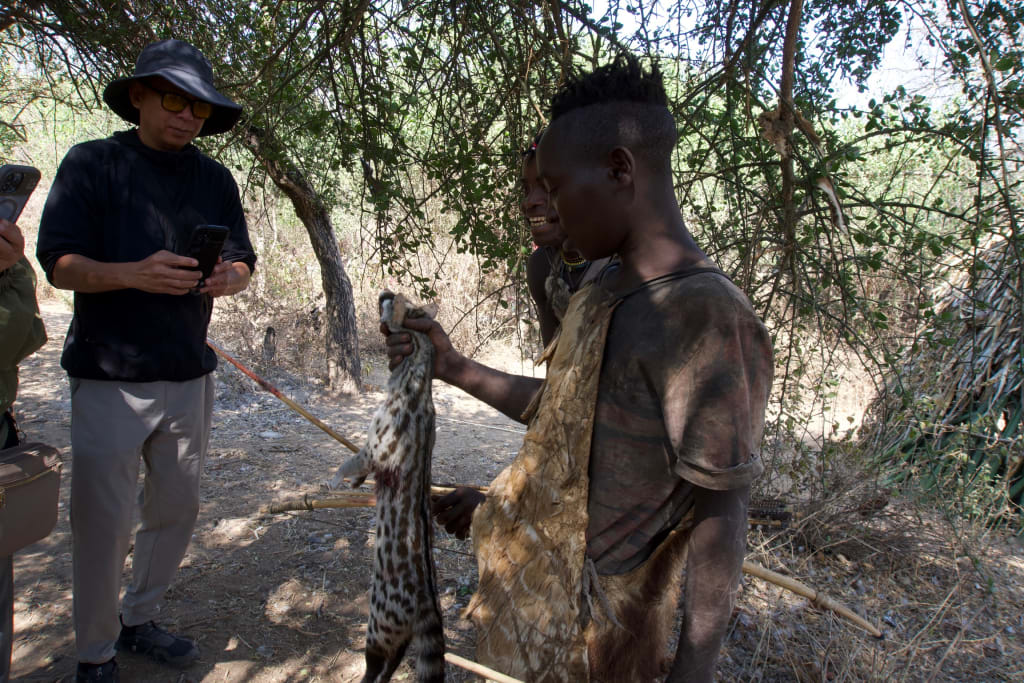
When it was time to eat, we were offered food, but there was no pressure whatsoever to accept. No tourist in my eyesight accepted (although Alex almost did). I was particularly thankful about this; as a pescatarian/primarily vegetarian who doesn’t eat meat, I was concerned I would offend the Hadzabe by refusing their food or feel the pressure to try it. This was not at all the case and they were very understanding.
The feast was now over and it was time to transition to the next activity: archery. I had experience with archery just 3 months prior on a trip to Saint Lucia and considered myself to be somewhat capable with a bow and arrow. But the Hadzabe use the tendon of a kudu (a type of antelope) to construct their bows and it was incredibly tough material. I had to summon all the strength I had just to pull the bow back a few inches. Despite this (and my general poor eyesight), I managed to be the only tourist to hit the target! For a moment I thought maybe I was cut out for this lifestyle after all, until I remembered I still don’t eat meat.
After practice with the bow and arrow, we watched the Hadzabe make fire and perform a dance. We then had a few moments to walk through a small area with trinkets to purchase if we so chose. We purchased a souvenir and gave them a tip out of gratitude for the time they spent teaching us about their lives.
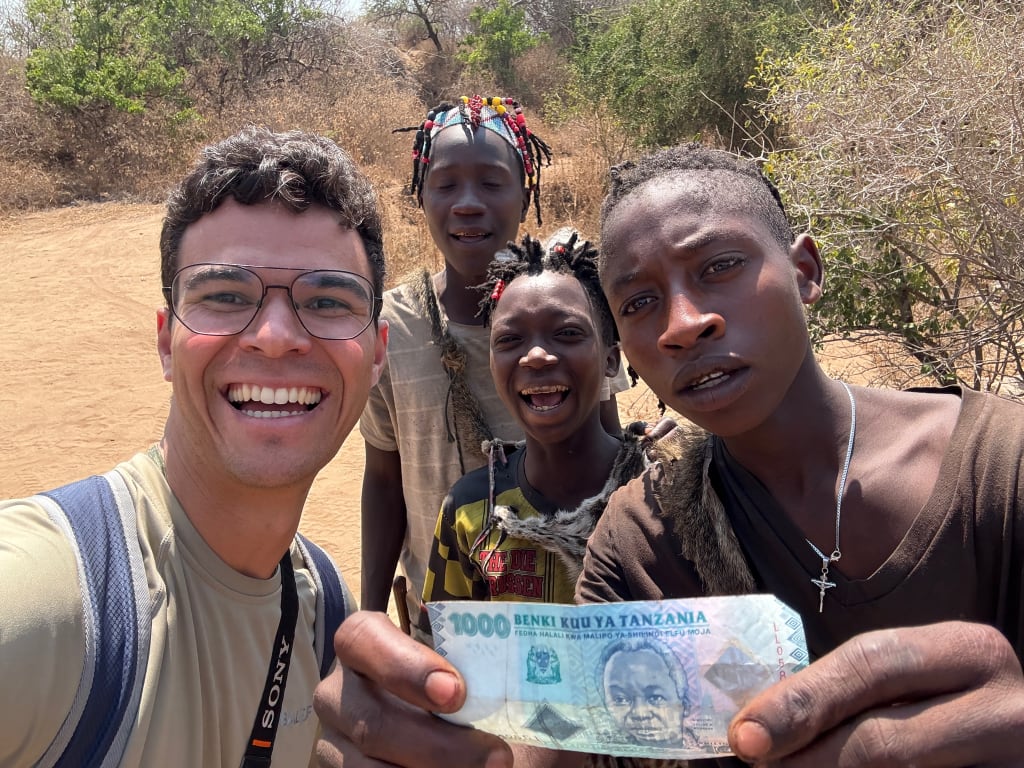
Then, just like that, our 3 hours with the Hadzabe came to an end.
IS IT WORTH IT?
Yes, without question. Visiting the Hadzabe was by far the best cultural experience we have had in our travels. For a direct comparison, we have visited 4 different tribes in East Africa alone. Typically, tribe visits last less than an hour, but we spent three with the Hadzabe, meaning we got to truly immerse ourselves in their way of life and learn much more.
Logistically, Lake Eyasi is quite accessible if you’re in Tanzania visiting either Ngorongoro Crater or Tarangire National Park, and it’s a great way to diversify your trip and take a momentary break from your safari. If you have at least a week in Tanzania, it’s worth carving out a day for.
Most importantly, the Hadzabe were warm and friendly and did not pressure us to hunt, eat their meat, or buy anything. (I have not had such a positive experience with all the tribe visits). They were eager to show us their way of life, and I’m very appreciative of the time we got to spend with them.
FAQS
Is it graphic or gory?
Yes, you will have an intimate view of a hunt and the preparation of meat after the fact.
Is it suitable for kids?
No, given the gory nature of the hunt, it is not recommended for children.
Do you have to participate in the hunt?
No, you won’t be invited to participate in the hunt. You will be a spectator.
Do you have to eat the meat?
No, you will be offered the meat, but there is no pressure whatsoever to eat it. This was my largest concern walking into this experience, as I do not eat meat and didn’t want to offend the Hadzabe or feel the pressure to eat the meat. However, they were so understanding and I felt completely comfortable declining. I sat with a small group of tourists, but none of us chose to eat the meat.
Is this suitable for vegetarians?
It’s just as suitable for vegetarians as it is for meat eaters given there is no pressure to eat the meat from the hunt. However, a comfort level with hunting and death is required.
Can you opt out of certain parts of the experience?
Yes, if you feel uncomfortable you can step away. You will be with a guide the entire time making sure you are safe and comfortable with the experience.
How intense is the experience emotionally?
While it is hard to witness death, I didn’t find the experience to be overwhelming emotionally.
Are the Hadzabe friendly?
They are friendly. They move at their own pace, but they offer ways you can participate in the experience and are open to conversation and answering questions (with help from translations from the guide).
Are the Hadzabe pushy about tips?
We did not find them to be pushy about money, but we offered them a tip at the end of the experience for their time. We recommend you also bring a tip.
What should I wear? What should I bring?
Wear comfortable clothing you can be active in. There’s a lot of walking on this tour through sandy areas. Bring closed toed shoes, water, a camera, sunscreen, and sunglasses. Bring toilet paper and hand sanitizer in case you need the bathroom. Pack light, as you’ll be carrying what you bring as you walk.
Can you take photos?
Yes, you’re encouraged to take photos and videos.
Do they speak English?
They do not, so you’ll need a guide who knows their language. Our guide was from the Datoga tribe. The Datoga trade with the Hadzabe and can understand their language.
Does the guide stay with you at all times?
Yes, your guide will stay with you at all times.
Do you have to be physically fit?
You have to be able to walk at a brisk pace for at least an hour. Anyone with a reasonable level of fitness should be able to keep up.
What’s the bathroom situation?
There are no restrooms around. There are plenty of places to step off to the side and do your business in the bush, but the visit is short enough that I would recommend a bathroom visit beforehand instead. You might want to bring toilet paper and hand sanitizer with you just in case though.
Is visiting the Hadzabe safe?
Yes, the hunts you’ll witness are for small creatures such as birds and the arrows are very small. They couldn’t do much damage to a human. You’ll also have a guide with you the entire time.