
The Reality of Maasai Village Visits: Here’s What Didn’t Sit Right
The Maasai are arguably one of the most famous tribes on the continent of Africa and are known for how well they have been able to preserve their cultural traditions in a modernizing society. Alex and I knew we couldn’t miss the opportunity to take a tour with the Maasai on our trip to Kenya and Tanzania.
The visit didn’t go exactly how we envisioned though, and in this article I’ll tell you why and give you my honest take on whether or not it was still worth it.
WHO ARE THE MAASAI?
The Maasai are a pastoral tribe found in southern Kenya and northern Tanzania. Cows play a central role in their lifestyle, as they provide sustenance and social status to their owners. In addition to their pastoral lifestyle, the Maasai are especially well known for their red shuka clothing, their traditional “jumping” dance, and their warrior traditions. Historically, young males would hunt lions to prove their independence and maturity, but the governments of Kenya and Tanzania have since forced them to move outside of lands protected for wildlife conservation and thus these traditions have been abandoned. To this day they have a very patriarchal society and the men can have multiple wives.
WHERE TO MEET THE MAASAI?
You can meet the Maasai in a number of places. The most convenient for tourists are Ngorongoro Crater (Tanzania), which is where we visited, and Maasai Mara National Reserve (Kenya), but these are also the most commercial. I’ve read that visiting the Maasai near Lake Eyasi offers more cultural depth than the other locations.
WHERE TO STAY?
We visited the Maasai on the drive from Serengeti National Park to Ngorongoro Crater. We stayed at Ngorongoro Lions Paw that night and visited the crater (technically a caldera!) bright and early the next morning.
DO I NEED A GUIDE?
You should organize the visit through your safari operator. You don’t need your own guide though; the Maasai we visited had an English speaking leader that guided us around the village.
AN ENCOUNTER BEFORE OUR TOUR
We had an encounter with the Maasai in Kenya before our formal tour in Tanzania. We were headed from Nairobi to Maasai Mara National Reserve when we saw a commotion on the road up ahead. We were on a single lane road, but cars were piled up 6 cars wide and as far up as the eye could see. There must have been 100 vehicles clustered on the road and in the dirt beside it. Our driver, Bosco, got out to investigate.
It turns out a safari vehicle had refused to slow down and had plowed into a herd of sheep and goats that the Maasai were guiding across the road, resulting in some animal fatalities. The Maasai were furious. Livestock are central to their lifestyles and they wanted to be compensated for their loss. They were blocking the road and requesting money from every single vehicle in order for them to pass.
We sat on the road for over an hour before the police arrived and forced the Maasai to get out of the street. It was quite a grotesque sight seeing the intestines of their poor animals splayed across the roadside.
OUR EXPERIENCE ON THE TOUR
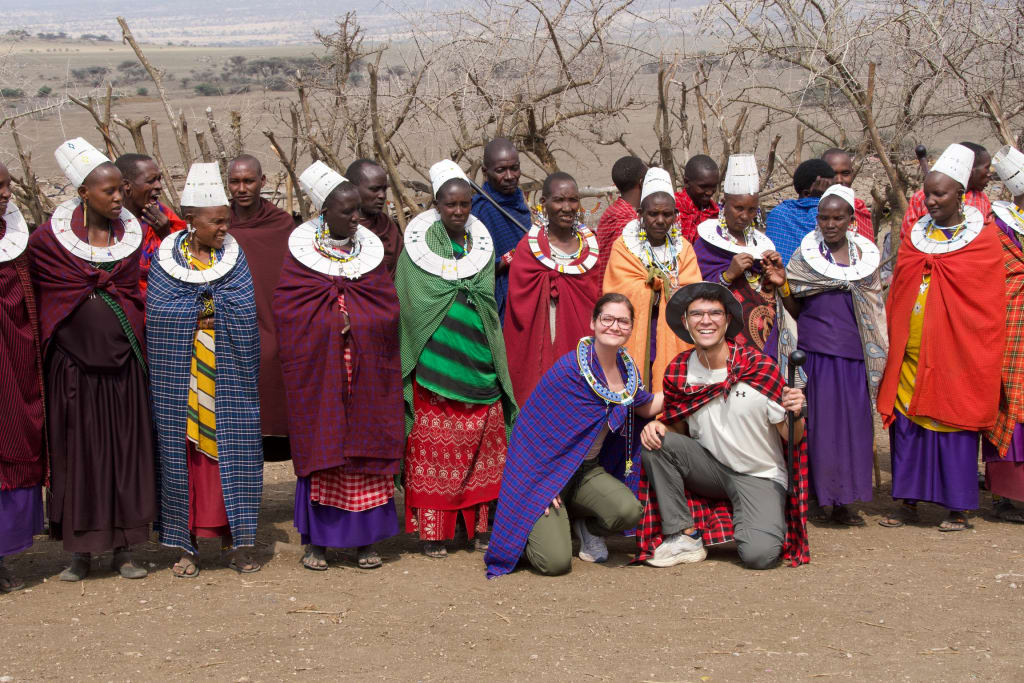
We pulled off the road just outside Ngorongoro Crater and entered a small village. A tall man dressed in traditional shuka clothing came out to greet us. He was the chief’s son, he spoke English, and was friendly and welcoming. He brought us traditional Maasai clothing to put on over our clothes and led us inside the gates to where a group of twenty or so Maasai stood gathered in a circle.
They started their traditional dance, which involved the men and women taking turns jumping as high as they could. A woman grabbed both my hands and guided me to the circle to dance with them, and a Maasai man did the same with my husband. I took in the scene around me as I jumped. The Maasai were unenthusiastic, with a look of disinterest painted on their face.
I quickly decided I didn’t want to be dancing anymore, but I put a smile on my face and just waited for their song to end. I wish I had felt less pressure to participate.
The dancing stopped and we were then ushered into a small schoolroom with dirt floors. 15 young children sat on a bench in the back and there was a single chalkboard with the alphabet in the front of the room. The children were asked to recite their ABCs in English in chorus. The children recited it perfectly, with some of them staring off into space as they did it. It was clear this was not their first time reciting the alphabet for tourists.
As soon as they finished, the Maasai chief’s son spoke up: “Here's the donation box.”
“Thank you,” we responded. What ensued was an awkward standoff. The chief’s son didn’t move or speak. The entire class of 15 children stared. We stood in excruciating silence for 30 long seconds until we pulled some cash out of our pockets and handed it over, to which the students applauded in unison.
Now let me just say this: this was not our first visit to an African tribe. We understood that there is an expectation to tip the people you meet and buy a trinket. We brought $50 we planned to spend. However, we were quite taken aback by the tactics the Maasai were using to get a donation. It felt manipulative, like they were using the children to guilt trip tourists into giving money. Children should be engaged in meaningful education, not placed in awkward spectacles multiple times a day to extract donations.
We were only halfway through the visit, so I tried to shake it off. We were then guided into a mud house that the Maasai live in. The guide spent less than 5 minutes explaining the Maasai’s reliance on cows. We learned that not only do the Maasai use the cow meat for sustenance, but they also drink the cow’s milk and blood. They also use cow dung for their roofs and cowhides for their mattresses. Cows are crucial to supporting their way of life.
The final stage of the visit was a stop at a stand they set up with a variety of souvenirs. After the experience we had in the school, we weren’t feeling very generous and decided not to purchase anything. The chief’s son’s demeanor changed immediately when we told him we weren’t going to buy anything. All pretense of warmth and welcoming went away and he was suddenly quite cold.
“You’ll have to take the clothes off then,” he replied. We complied and he hurried us back to our vehicle without another word.
We had spent only half an hour with the Maasai, if that.
IS IT WORTH IT?
Sadly, not at all. We left the visit feeling flustered and deflated. The visit felt rushed, inauthentic, and performative, like they were half-heartedly putting on a show for their visitors. I walked away not understanding much more about their culture than I knew going in.
We were also particularly annoyed that the Maasai put us in an uncomfortable position by getting us alone with a room full of children to guilt us into giving a donation. Their tactics were manipulative and we were annoyed that we paid for this tour and our hosts took advantage of us.
Our tour operator subtly warned us beforehand that “many travelers see this as an opportunity for the Maasai to sell their wares.” That was an understatement. It felt as if they didn’t care what kind of experience the tourists got as long as they got their cash. We should have heeded the warning and skipped the visit.
To be clear, I am not denouncing the Maasai people or their culture, but I have to give my honest opinions about my experience with their tours and I can say unequivocally that I wouldn’t recommend them.
If you’re curious about culture in Tanzania, skip the visit to the Maasai and add in a visit to the Hadzabe and the Datoga instead. You can thank me later.
FAQS
How long did you spend with the Maasai?
We spent ~30 minutes with the Maasai.
Are the Maasai friendly?
We didn’t find them to be friendly. They were kind until they asked for money and were cold thereafter.
Are you expected to make purchases?
Yes, we felt pressured to give donations and make purchases.
What should I wear?
You don’t have to wear any special clothing. Don’t wear anything too baggy, as you’ll be invited to wear the Maasai shuka over your clothes.
Can you take photos?
Yes, you’re encouraged to take photos and videos.
Do they speak English?
The Maasai chief’s son spoke English.