
Valley of the Kings: The Ultimate Guide to Egypt's Royal Tombs in Luxor
Name one pharaoh who ruled ancient Egypt. If your answer isn’t Cleopatra, I bet you’re thinking of King Tut.
I’m sure that answer would be quite surprising to the ancient Egyptians. King Tut is a household name today, but he was a relatively insignificant pharaoh during his lifetime. It was Howard Carter’s groundbreaking discovery of his tomb in 1922 that propelled this pharaoh’s name to international fame and reignited the world’s fascination with this enchanting ancient civilization.
Today, tourists can visit Tut’s infamous tomb, as well as a dozen or so others in the Valley of the Kings that are open to the public. This incredible archaeological site rivals the Pyramids as the number 1 must-see site in all of Egypt. It’s guaranteed to be one of the most memorable parts of your trip.
Below, I break down all the details you need to visit the Valley of the Kings, including which tombs to visit, which tickets are worth the extra price, and the fascinating history behind this extraordinary burial ground.
WHAT IS THE VALLEY OF THE KINGS?
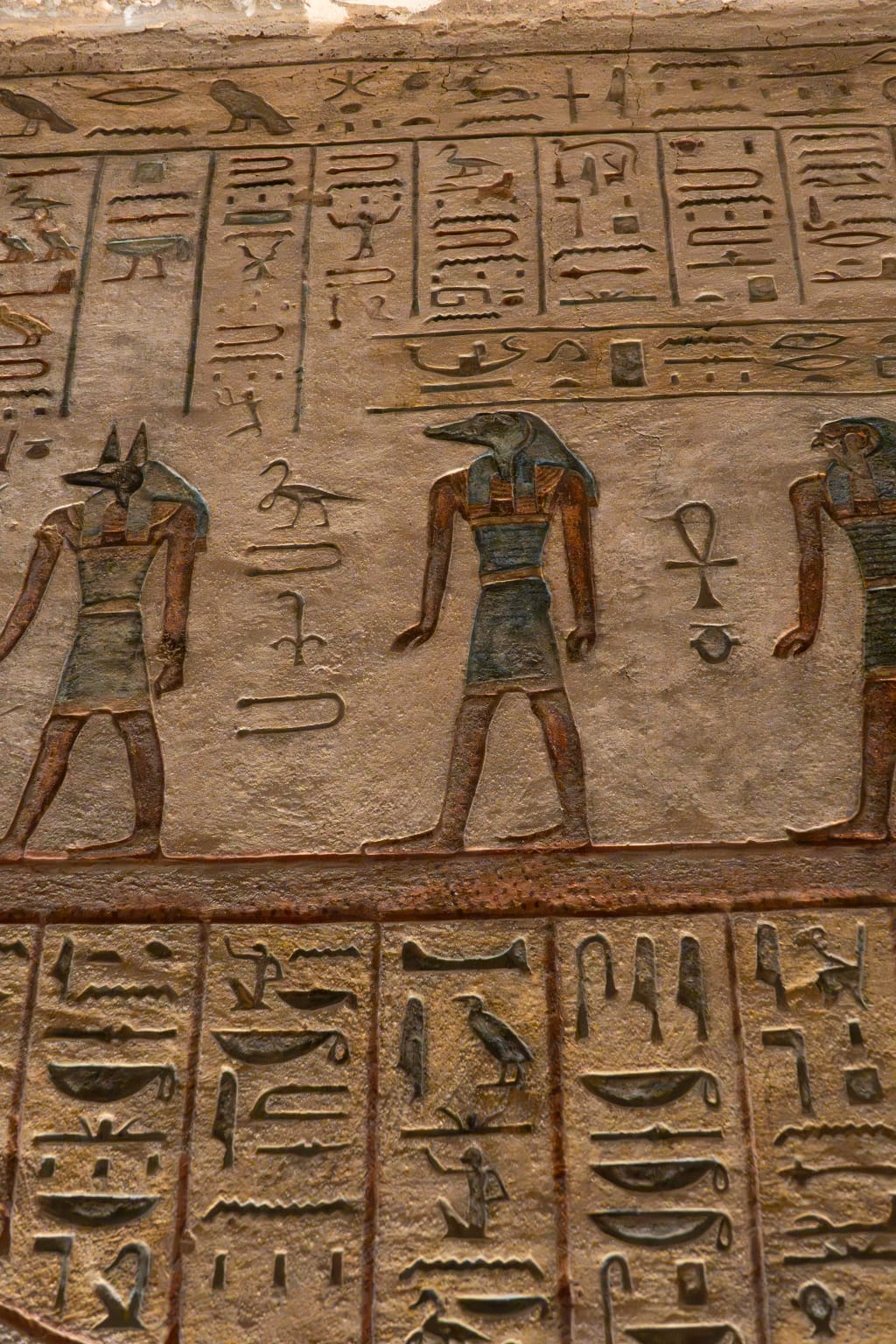
The Valley of the Kings is an ancient Egyptian burial ground containing tombs carved into rock for the New Kingdom pharaohs of the 18th, 19th, and 20th dynasties (1550–1070 BCE). Many of the tombs are elaborately decorated, with chambers featuring detailed reliefs, colorful paintings, and hieroglyphics.
More than 60 tombs have already been discovered and catalogued by Egyptologists in the Valley of the Kings. The most famous discovery was King Tut’s tomb by Howard Carter. Now, more than 100 years later, excavation work continues at the site. Just last year, in 2025, archaeologists announced that they had found a tomb in 2022: the tomb of Thutmose II, husband of Hatshepsut, who has her own giant mortuary temple nearby. The discovery of Thutmose II’s tomb was the first discovery of a pharaoh's tomb since Tutankhamun's, although it wasn’t in the Valley of the Kings, but rather ~2km west.
Interestingly, archaeologists believe that there are still tombs that have yet to be discovered in the Valley of the Kings. Some royal tombs remain unlocated, such as the tomb of Ramesses VIII. It’s very possible that within our lifetime, more tombs will be uncovered.
A BRIEF HISTORY OF PHARAOH BURIALS
Tombs cut into rock? But weren’t pharaohs buried in the pyramids?
The Old Kingdom pharaohs of the 3rd through 6th dynasties were buried in the pyramids. The Pyramids of Giza, for example, were built for the 4th dynasty pharaohs. But the Egyptians quickly discovered a few major problems with this plan.
First, the pyramids weren’t exactly subtle. They were essentially a giant billboard advertising stores of unguarded gold for tombrobbers to raid. As their civilization evolved, they opted for hidden, underground tombs in a secluded desert valley instead, although sadly that did little to deter the tombrobbers, who managed to loot the grand majority of tombs in the Valley of Kings anyway.
Second, the pyramids were expensive. They required a labor force of 20,000 workers and took decades to build. It was simply not sustainable to continue building these pyramids for every pharaoh. Later pharaohs decided to spend their resources building temples to worship the gods instead.
WHERE IS THE VALLEY OF THE KINGS?
The Valley of the Kings is located on the West Bank in Luxor (formerly known as Thebes) in Upper (Southern) Egypt.
The Valley of the Kings’ location on the West Bank was deeply symbolic. The Egyptians associated the west, the direction where the sun sets, with death and the east, where the sun rises, as the land of the living. Temples dedicated to the gods were located on the east bank and tombs for the dead were on the west. This same concept was applied in northern Egypt: Giza, home of the iconic pyramids and resting place for Old Kingdom pharaohs, is on the west bank of the Nile.
VALLEY OF THE KINGS TICKETS
There are two types of tickets for the Valley of the Kings: the standard ticket and the extra tickets.
The standard ticket includes access to three tombs of your choice picked from the list of tombs included in general admission. That ticket costs 750 EGP (~$13).
There are also four tombs that require a separate ticket to enter:
- Tomb of Aye: 200 EGP (~$3.50)
- Tomb of Ramesses V and VI: 220 EGP (~$4)
- Tomb of Tutankhamen: 700 EGP (~$12)
- Tomb of Seti I: 2000 EGP (~$36)
You can book tickets onsite or online. I recommend booking online to avoid standing in long lines in person.
DO YOU NEED A GUIDE?
I highly recommend hiring an Egyptologist for your visit to the Valley of the Kings. The Valley of the Kings is one of the most unique and impressive archaeological sites in the world, and you will get so much more out of your visit with the additional historical context you get from hiring a guide.
I personally joined the TBA Escapes Egypt group tour, which included an Egyptologist: Sagy Shafey (sagyshafey@gmail.com). I learned a lot from her and she was a delightful person to spend time with as well.
One thing worth noting, though: guides are not allowed inside the tombs in the Valley of the Kings. An Egyptologist can give you an overview before you enter the tomb and advise you on what to look for as you go in.
A NOTE ON THE TOMB NAMING CONVENTIONS
The tombs are each named in two ways: one for the name of the pharaoh (example: Seti I) and one for the order in which the tombs were catalogued by modern Egyptologists (example: KV17 or Kings Valley 17, the 17th tomb documented). I use both names in this post.
A BRIEF HISTORY OF KING TUT’S TOMB
Millions if not billions of people around the world have heard of King Tut and Howard Carter’s historic discovery of his tomb in 1922.
What most people don’t know, however, is that Tutankhamun was a relatively minor pharaoh and his tomb is one of the smallest and least impressive artistically in the Valley of the Kings. King Tut died unexpectedly somewhere between the age of 18 and 20, which meant that artisans didn’t have the time to design an elaborate resting place for their king.
So why is his tomb so famous?
The reason is that, of the 60+ tombs discovered in the Valley of the Kings, King Tut’s was the only one found intact and undisturbed by grave robbers. More than 5,000 ancient artifacts were discovered inside his tomb. Through Carter’s discovery, Egyptologists were able to learn tons about the ancient Egyptians and their burial practices.
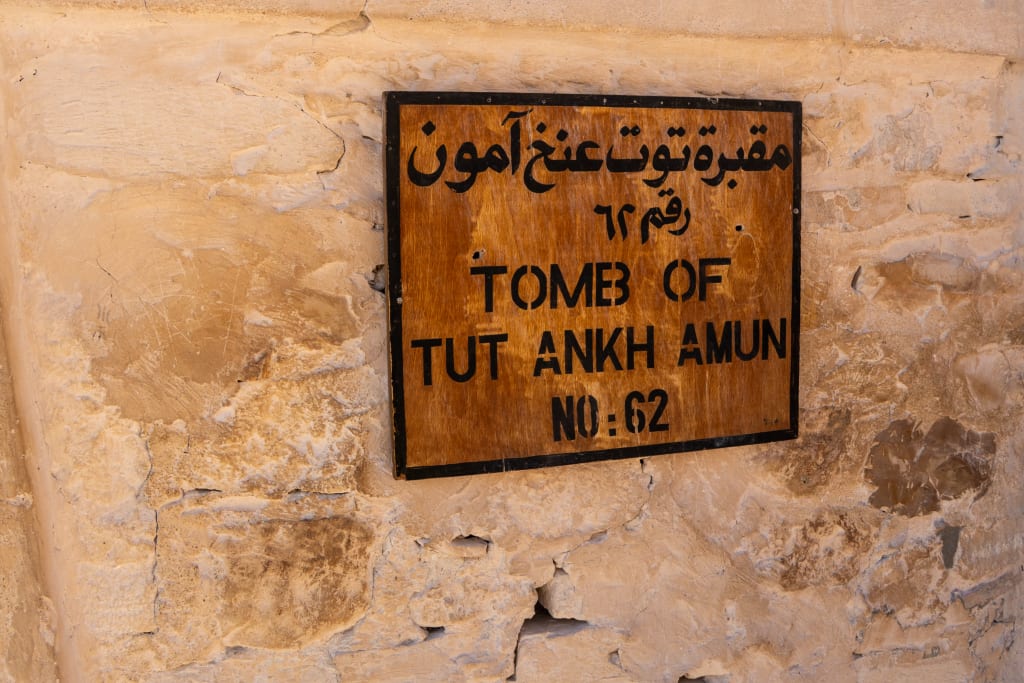
Interestingly, King Tut’s tomb is smack in the middle of the Valley of Kings, yet it was the 62nd (nearly the last) tomb documented by Egyptologists. This is because, when excavating a nearby tomb, archaeologists accidentally blocked Tut’s tomb with leftover stones, making it hard to find.
MY EXPERIENCE
This will come as no surprise, but my visit to the Valley of the Kings was a major highlight of my trip to Egypt. I spent an hour and a half exploring 3 tombs. It was certainly not enough time, but that’s just a tradeoff you make joining a group tour: less control over schedule and pacing.
Below, I’ll go into detail on each tomb I visited.
King Tut (KV 62)
Our first visit was to the most famous tomb: the tomb of the boy king Tutankhamun.
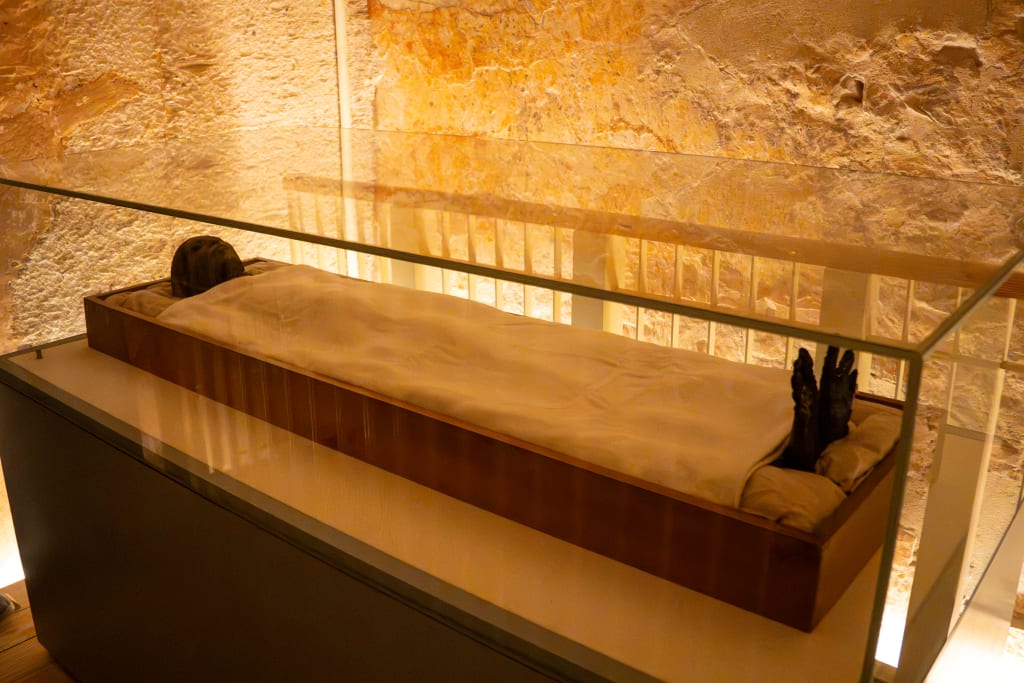
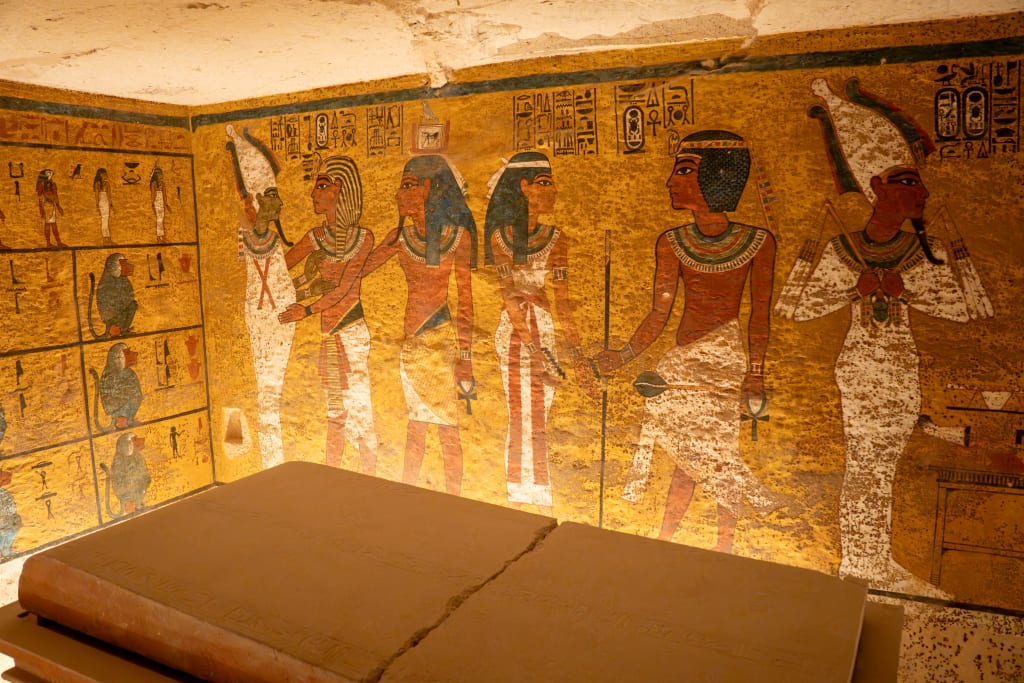
The room is very small, with room to accommodate only a few tourists at a time. We spent only a couple of minutes snapping photos of Tut’s mummy and the artwork decorating the opposite wall before heading back up to the valley.
Tomb of Seti I (KV 17)
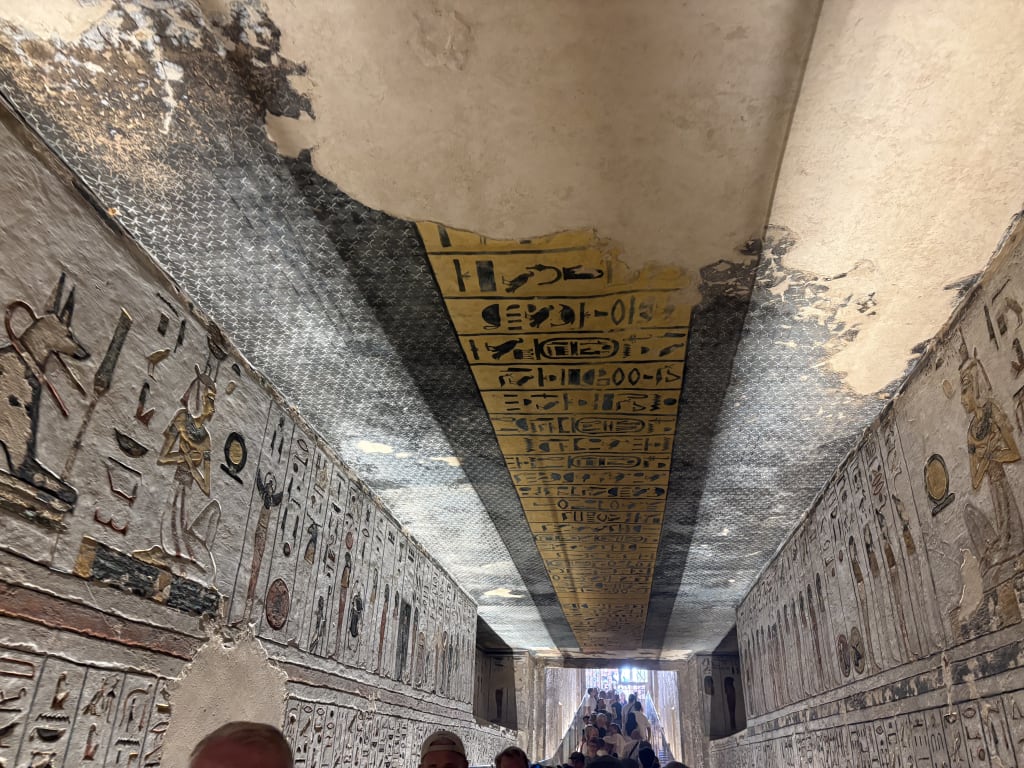
I was a little nervous about visiting the tomb of Seti I. I had read that it was the most magnificent tomb in the valley, but that it went deep into the ground and was very hot. I envisioned the sauna-like environment I experienced inside the Pyramid of Khufu in Giza, but this time with endless flights of stairs. Thankfully, it was just a few short flights of stairs and the heat wasn’t nearly as bad as I imagined.
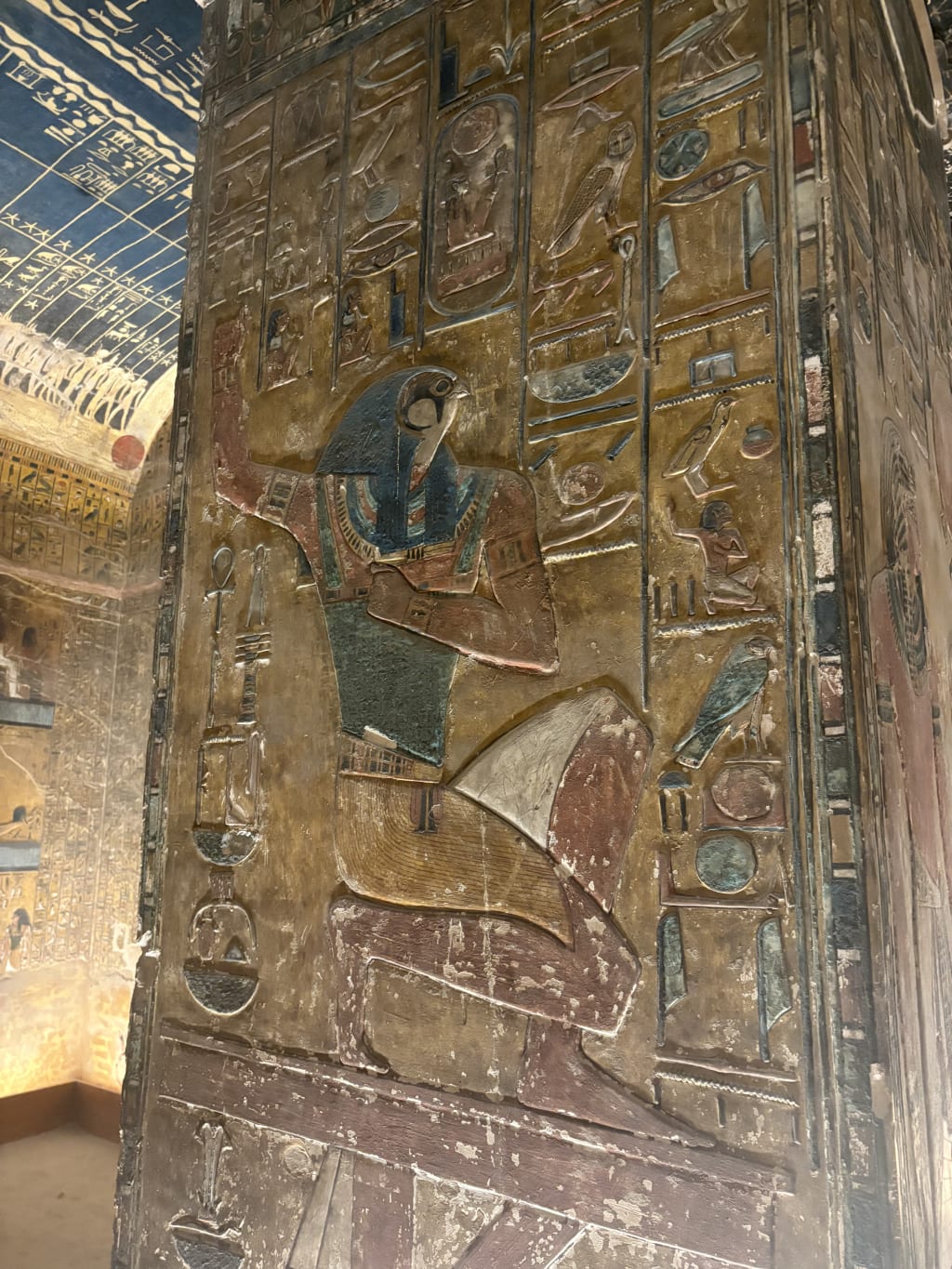
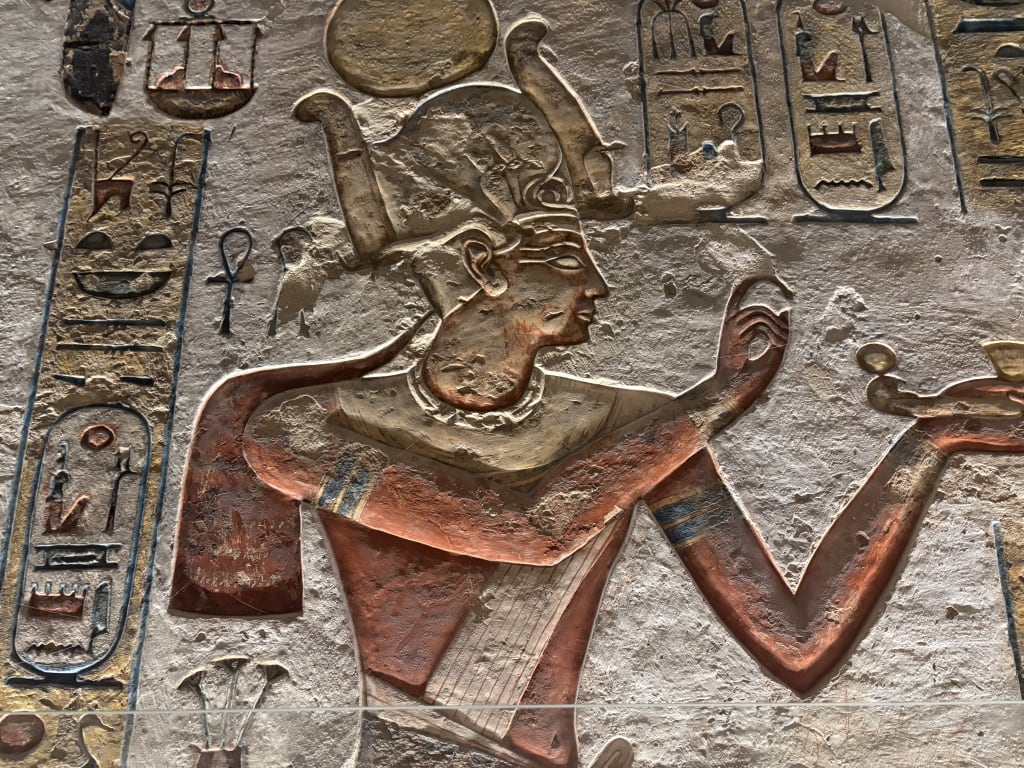
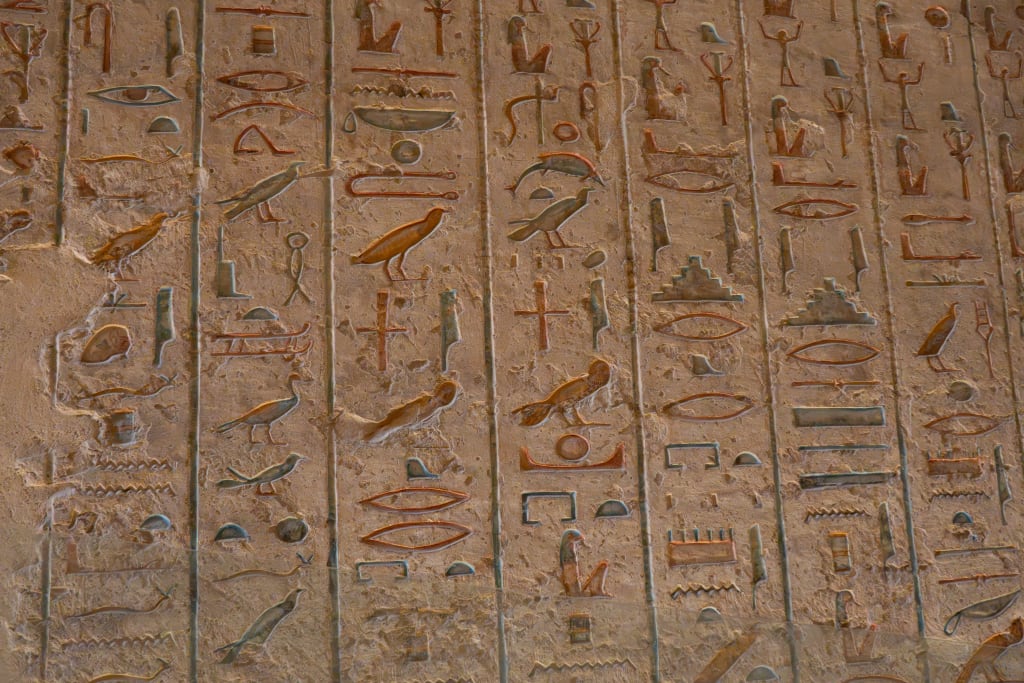
The tomb was indeed as incredible as I’d read about online, though. Rooms and rooms filled with intricate drawings of gods and goddesses. Perfectly carved hieroglyphics. A beautiful, arched ceiling decorated with celestial imagery. This tomb had it all.
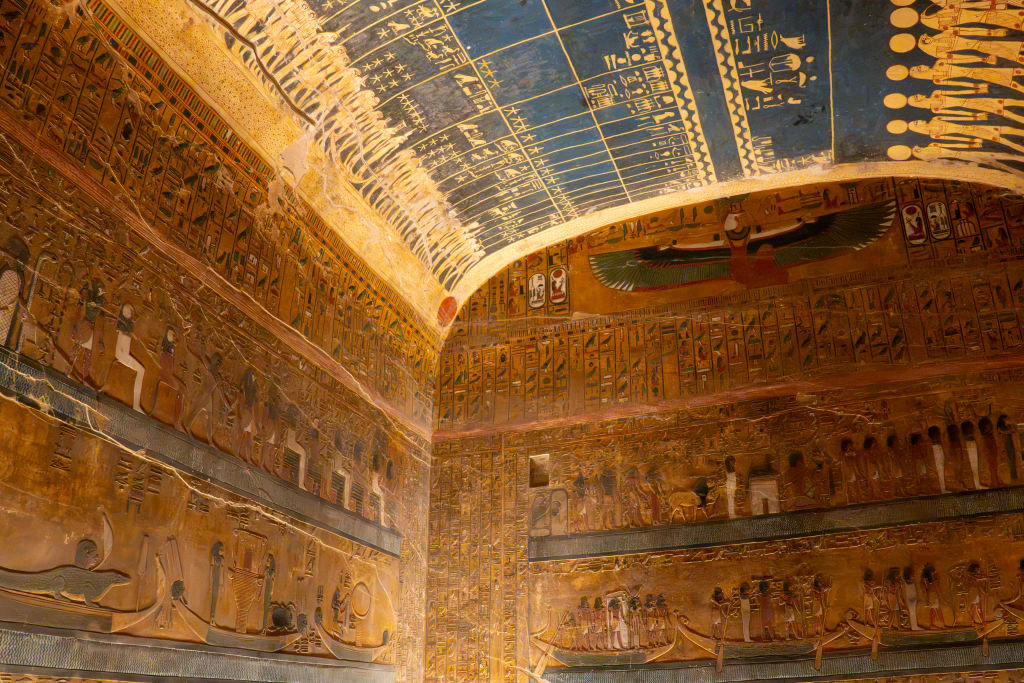
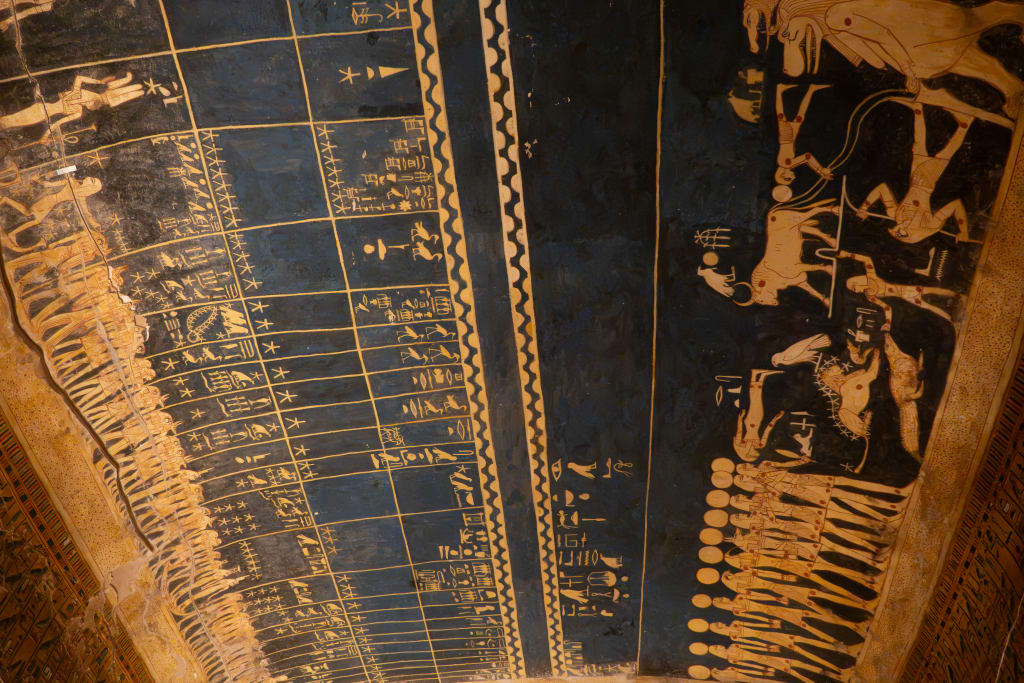
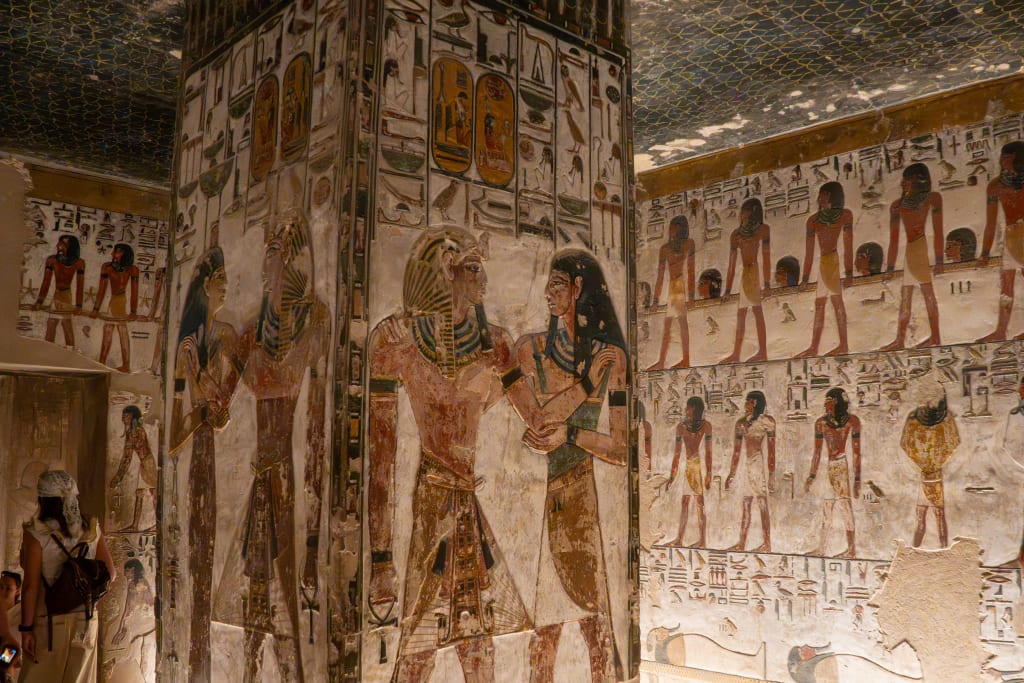
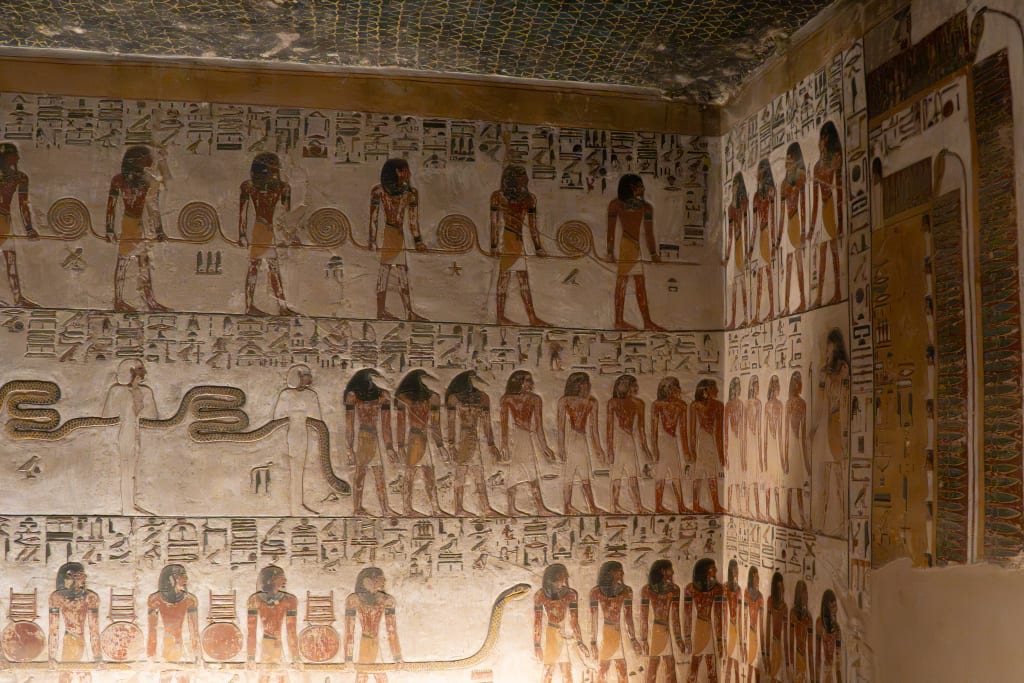
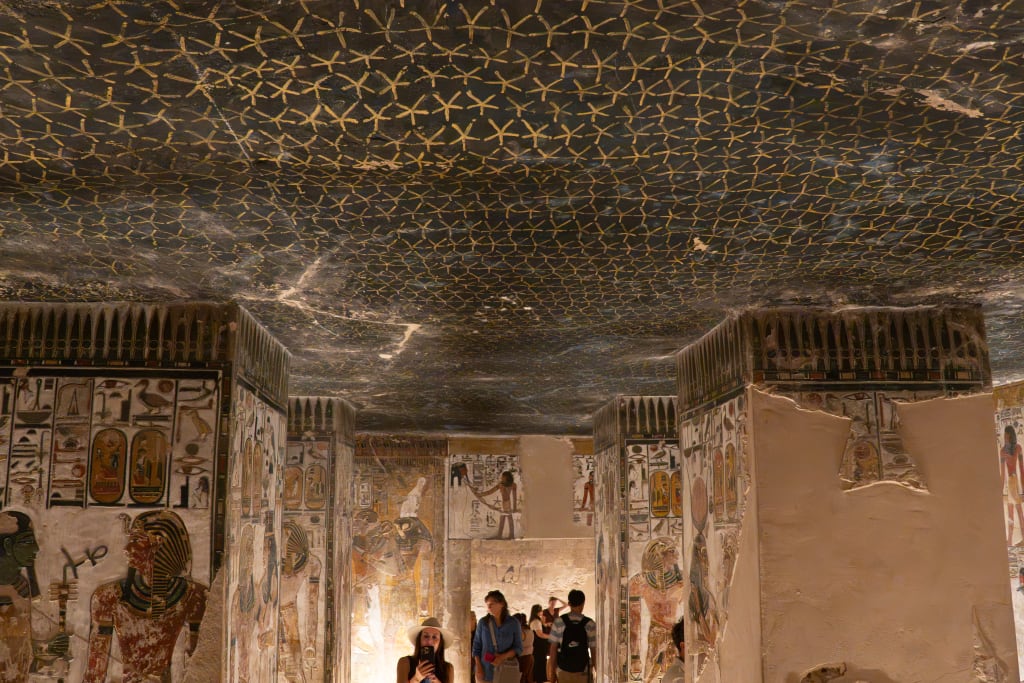
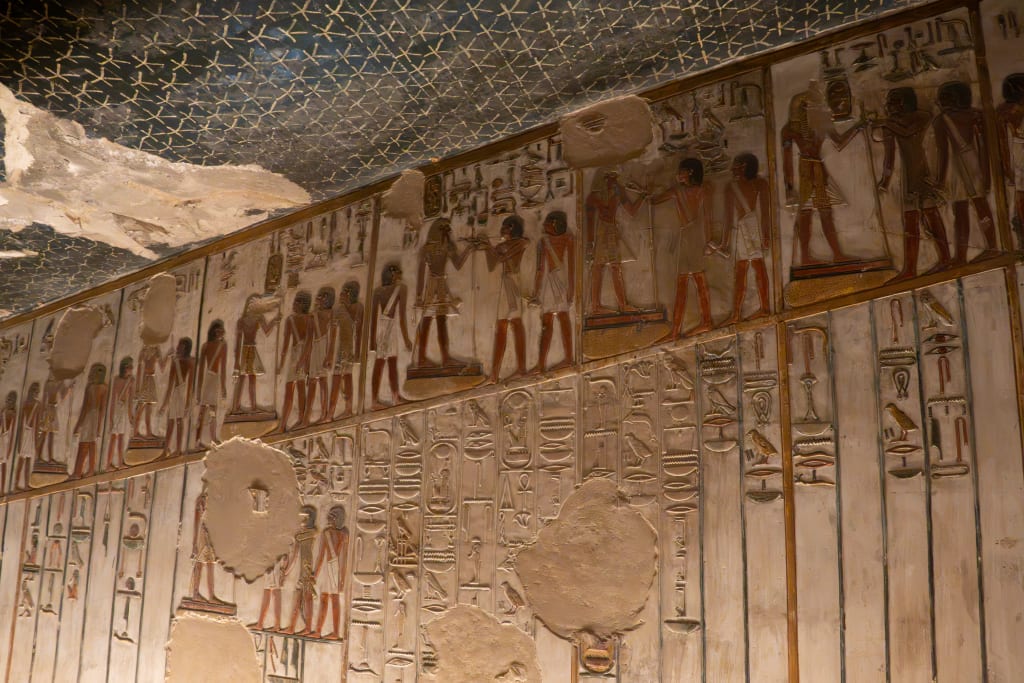
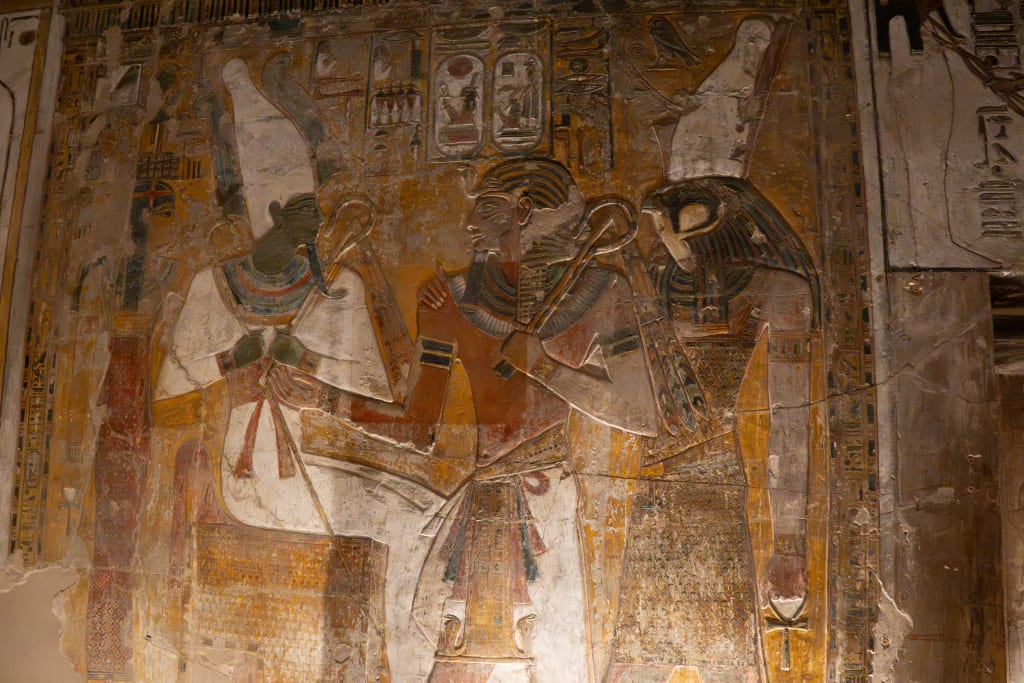
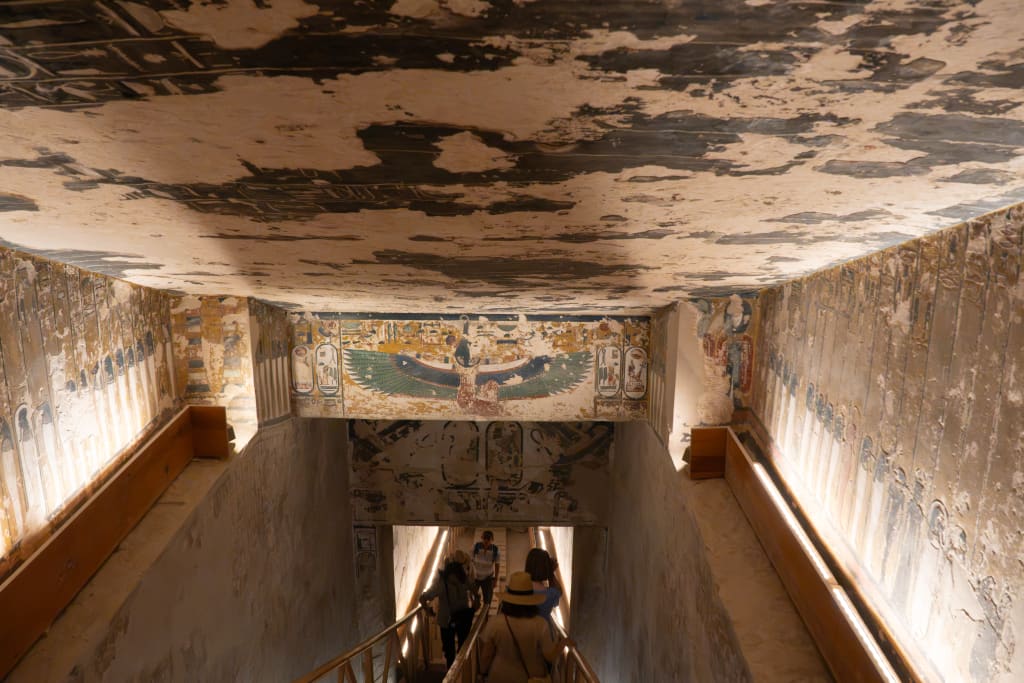
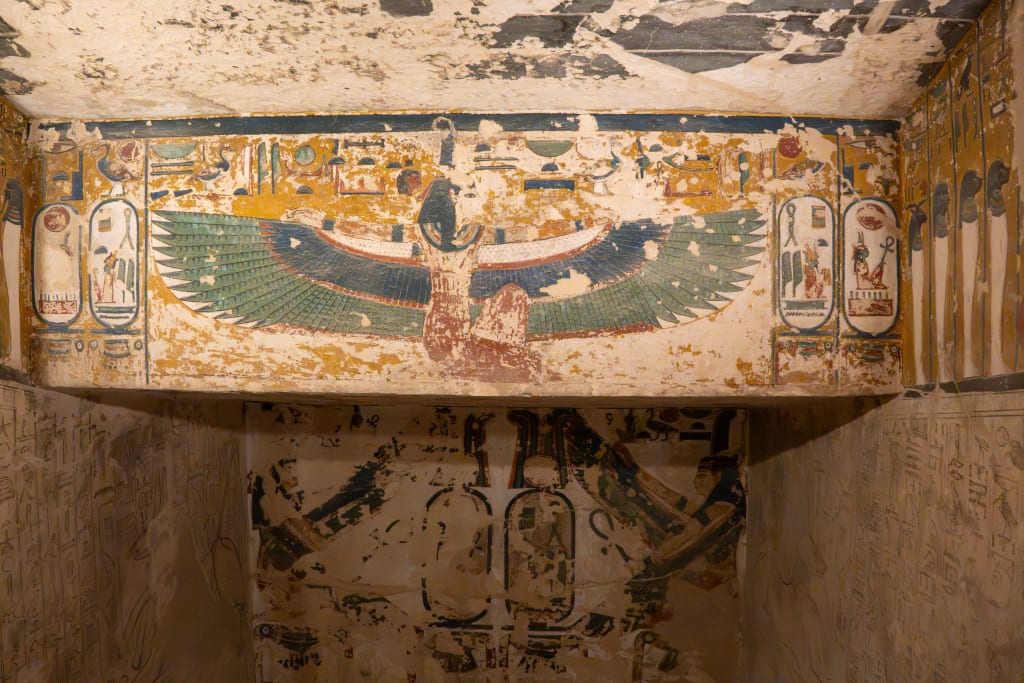
There was even a half-finished room which artisans had sketched out but abruptly halted work on as the pharaoh passed away.
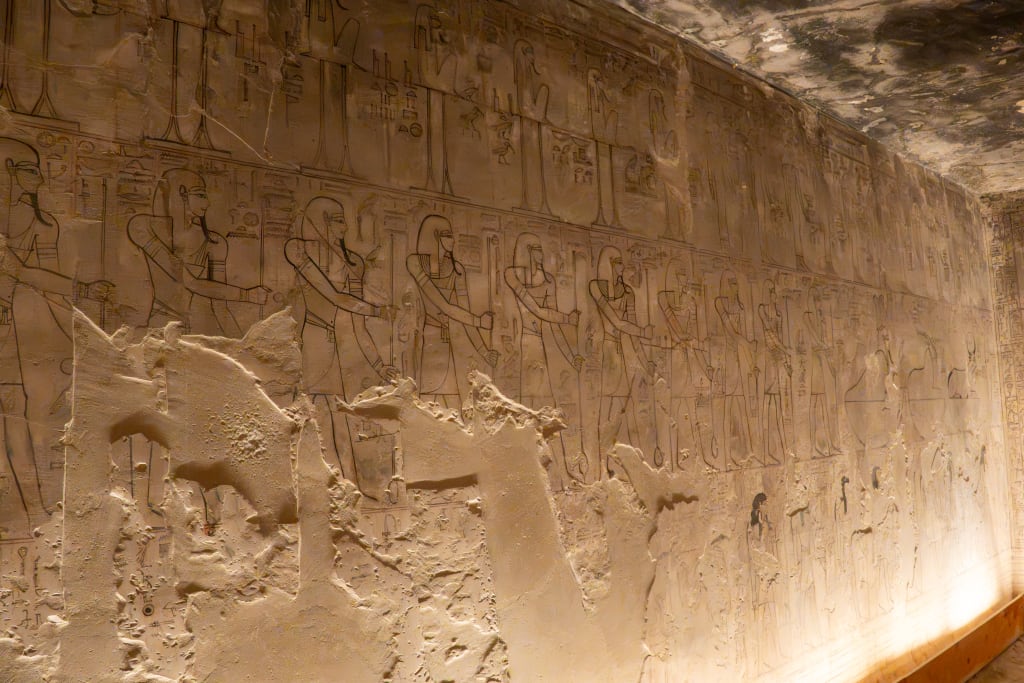
It was not only magnificent, but it was also the least crowded of the tombs we visited. I’m sure the high price tag scared a lot of tourists away.
We spent 10 to 15 minutes inside Seti I’s tomb admiring the artwork and snapping endless photos.
Ramesses III (KV 11)
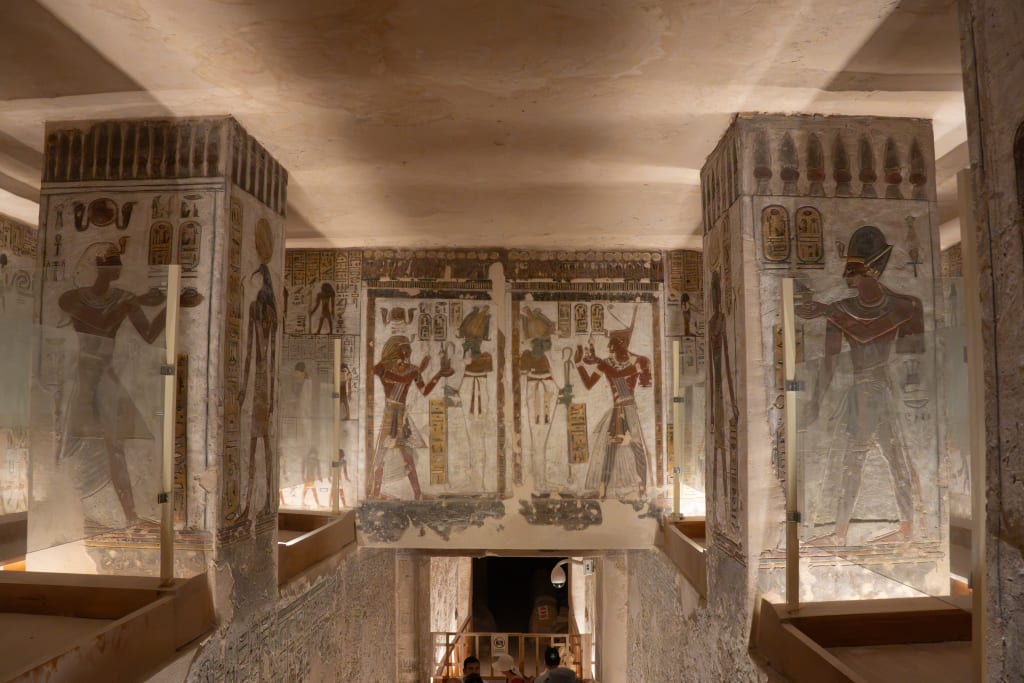
My visit to the tomb of Ramesses III was by far the most chaotic. The crowds were nuts and an attendant was yelling the entire time, hurrying us along.
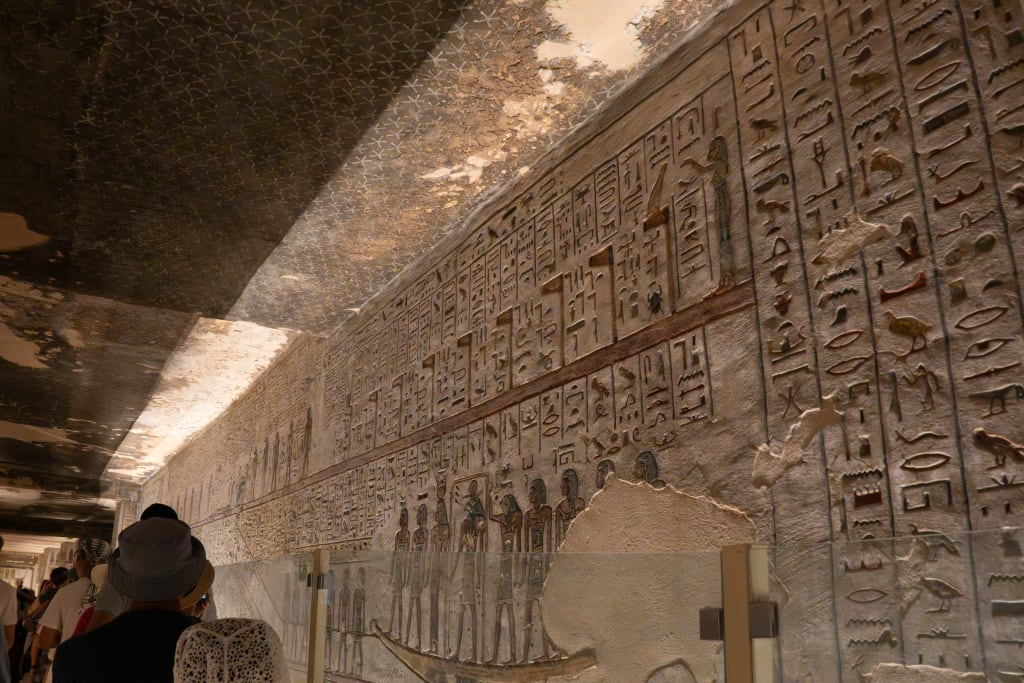
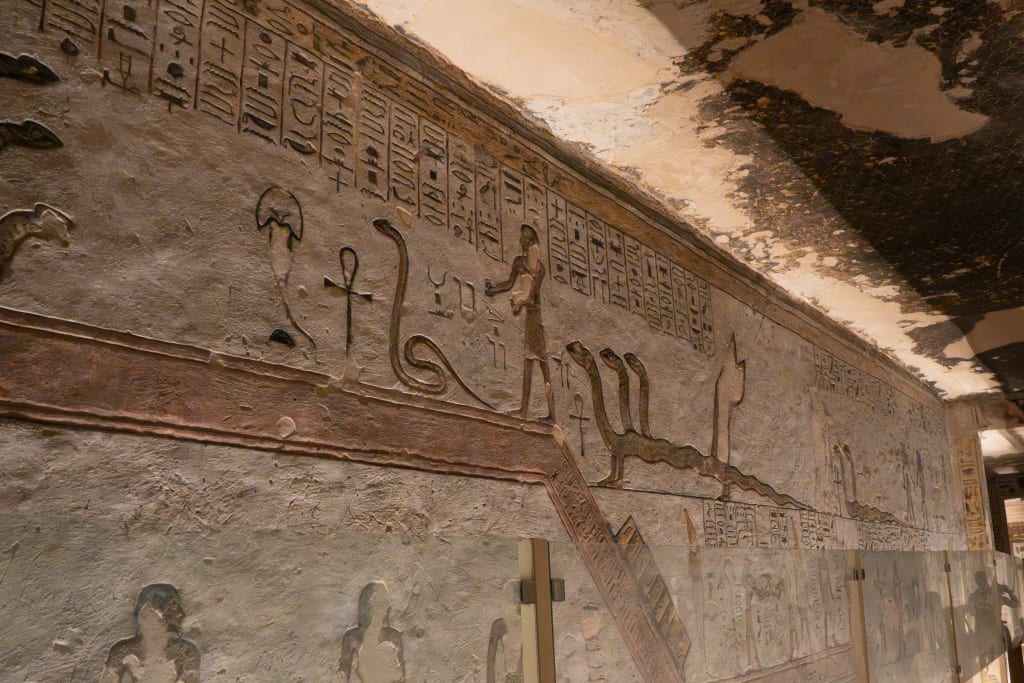
That being said, I also felt that this tomb was spectacular. In particular, I loved the colorful hieroglyphics and almost hallucinogenic depictions of three-headed snakes and other bizarre creatures. It was well worth battling the crowds to see.
WHAT TO EXPECT IN THE VALLEY OF THE KINGS
Heat
I had read online that the tombs in the Valley of the Kings were hot. This didn’t concern me too much until I climbed inside the Pyramid of Khufu in Giza. From then on I understood: when they say hot in Egypt, they mean hot. Very hot. It was like a sauna inside that pyramid and I was dripping with sweat by the time I left.
All that to say, I went into the Valley of the Kings prepared for the worst. Thankfully, while the tombs were hot, they weren’t nearly as oppressive as the pyramid. Bring a handheld fan (or even better, a fan like this that doesn’t require you to hold it) and some water, and you’ll be fine. You’re only in each tomb for 10 to 15 minutes max, so it’s pretty manageable.
Tipping Culture
Inside the tomb, there will be attendants ushering the crowds along and sometimes offering to take your photo for you. Remember, in Egypt especially, nothing is free. They will request a “tip” in exchange for the photo. Bring small bills with you, in USD or Egyptian pounds.
These small bills will also come in handy for the restrooms too. They charged me $1 to enter the restroom at the Valley of the Kings, which is quite common in Egypt, but they did provide some toilet paper in exchange.
Crowds
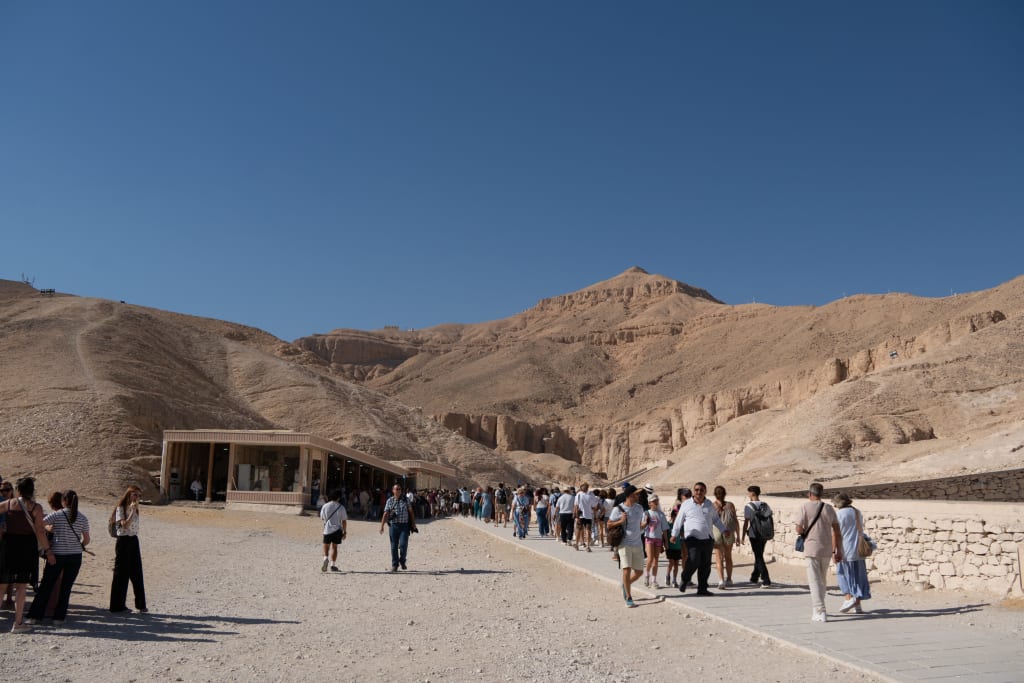
The crowds at the Valley of the Kings were among the worst we saw during our time in Egypt, as to be expected. The lines for the tombs that were included in the entry ticket were especially long, starting from 9am onwards.
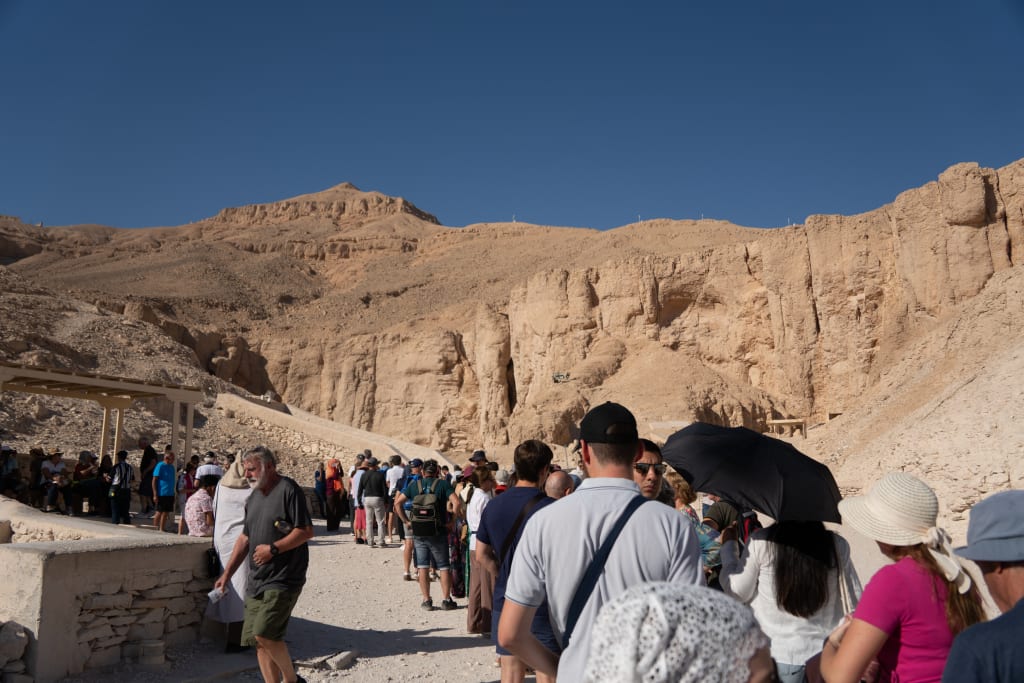
To avoid the crowds, I recommend arriving early, ideally right when the Valley of the Kings opens at 6am. We arrived at 8:30am and it was already teeming with people. I also read that the crowds tend to dissipate in the late afternoon, but keep in mind it will be hotter then and you might not have enough time to explore before closing.
You can also get a reprieve from the crowds inside the tombs that require an extra ticket to enter, with the exception of King Tut’s, which quite possibly had the longest line of all the tombs despite the extra cost to visit.
BEST TIME TO VISIT
To avoid the heat and the crowds, plan to arrive at the Valley of the Kings before 8am, ideally right when it opens at 6am.
The best time to visit Egypt in general is between the months of October and March, when the heat is not so oppressive. If possible, I would avoid traveling to Egypt during Ramadan, as restaurants and attractions can have shorter hours or be closed altogether during this time.
MY RECOMMENDATION ON TOMBS TO VISIT
If I were planning a return trip to Egypt, I would spend 3 hours in the Valley of the Kings and visit 5-6 tombs.
My personal opinion was that the extra tickets for the tombs of Tutankhamun (KV 62) and Seti I (KV 17) were well worth it. I’ve also heard that the tomb of Ramesses V and VI (KV 9: one tomb for two pharaohs) was worth it as well, especially at the more affordable price of 220 EGP (~$4 as of October 2026).
Then, with the standard admission ticket, you will have access to 3 more. I definitely recommend the one I visited: Ramesses III (KV 11). From my research, Ramesses IV (KV 2) and Tausert and Seknakht (KV 14) were also well reviewed, although with just an hour and a half at the Valley of Kings, I didn’t have time to visit them myself. They’re high on my list to visit the next time I’m in Egypt.
I wouldn’t recommend visiting more than 5 or 6 tombs. After a while, they’ll all blend together, and there are many more attractions in Luxor that deserve your time and attention as well, so one standard admission ticket plus any extras (Tut, Seti I, and/or Ramesses V and VI) will suffice.
GETTING TO THE VALLEY OF THE KINGS
The easiest way to visit the Valley of the Kings is with a guided tour or private driver. Since the Valley of the Kings is close to other major attractions on the West Bank, including the Temple of Hatshepsut, Medinet Habu, and the Colossi of Memnon, I recommend scheduling a tour of all these sites in one day. You can also hire a taxi, but it’s recommended to arrange a round-trip fare in advance, including waiting time, so you're not stranded at the Valley of the Kings.
Once you arrive at the valley, there's a small electric shuttle that transports visitors from the visitor center to the tomb area in approximately three minutes. It costs an additional 20 EGP (~$0.36) per person (round-trip), as of October 2026. You can also walk, but given the heat and lack of shade, I'd recommend taking the shuttle.
IS IT WORTH IT?
The Valley of the Kings
In the same way that a trip to Egypt would be incomplete without a visit to the Pyramids of Giza, a trip to Egypt would be incomplete without a visit to the Valley of the Kings. It’s one of the most important archaeological sites on Earth. Be sure not to miss it.
King Tut’s Tomb
My Egyptologist, Sagy, put it best: how can you travel all the way to Egypt and skip the infamous tomb of King Tut? It’s a must-visit for me.
Yes, it’s a quick visit. I spent about one minute inside King Tut’s tomb. It’s by far the smallest tomb I entered and the art is the least impressive.
But I had learned about Howard Carter’s expedition in school, and to stand in the exact spot where that discovery took place felt surreal. For the historical significance alone, a visit to King Tut’s tomb is worth it.
It was also pretty cool seeing a 3,300 year old mummy in real life!
Seti I’s Tomb
The price tag is steep, yes, but if you can afford it, I do recommend purchasing the extra ticket for Seti I’s tomb. I was very impressed. It is undoubtedly one of the most ornate tombs in the valley, if not the absolute most. Not to mention, the experience with far fewer people and less pressure from attendants ushering us along was a nice change of pace.
Ramesses III’s Tomb
For me, the tomb of Ramesses III rivaled that of Seti I. I was very impressed. Since it’s included in the general admission ticket, I definitely recommend adding this one to your list.
FAQS
How long should you spend at the Valley of the Kings?
It depends on how many tombs you plan to enter, but I would recommend between 2 and 3 hours at minimum for a first visit. I spent an hour and half here, visited three tombs, and felt like I barely scratched the surface of what there was to see. You also have to budget time to stand in line to enter each tomb if you arrive after 8am.
What are the hours for the Valley of the Kings?
The Valley of the Kings opens at 6am each day. Last entry is at 5pm during the summer and 4pm during the winter and during Ramadan.
Are photos allowed inside the tombs?
Yes, photos are allowed inside the tombs. On the website, it says that only photos with a mobile phone are permitted, but I brought my camera and was allowed to take photos with it.
Can you see the treasures found inside King Tut’s tomb?
No, most of his treasures have been moved to the Grand Egyptian Museum in Cairo.
What is the bathroom situation at the Valley of the Kings?
There are bathrooms at the visitor center and bathrooms at the entrance to the valley. I used the bathroom in the valley and was charged $1 to enter but was given toilet paper in exchange. I recommend bringing your own toilet paper and hand sanitizer with you as you travel throughout Egypt as I found availability to be spotty.
Are there drinks and snacks available to purchase in the Valley of the Kings?
There is a cafe at the entrance of the valley where you can purchase drinks and snacks.
