
Hiking Acatenango: Watching an Active Volcano Erupt Above the Clouds
Hiking Volcán Acatenango held the number 1 spot on my bucket list for years. I’m convinced I have watched every single YouTube video and read every blog article ever published about the hike. In the past, when I had done this much research on a particular subject, it took the magic out of the experience. Thankfully, that was not the case with this hike, and it somehow managed to exceed all expectations. The hike to Volcán Fuego, in particular, left me awestruck. I was standing above the clouds, hearing the rumbling of the volcano announcing the impending eruption, watching the red lava explode into the air and rain quietly back down on the slopes. It was truly the most otherworldly experience I have ever had, and I loved every second of it.
WHAT IS THE HIKE TO VOLCÁN ACATENANGO?
On this hike, you will climb a dormant volcano (Volcán Acatenango, which last erupted in 1972), which will give you the perfect vantage point to view the neighboring Volcán Fuego, a very active volcano that erupts every 10-15 minutes. You even have the option to hike to the base of Fuego to watch it erupt up close, which I highly recommend.
The eruptions are breathtaking. During the day, you see small puffs of black smoke, but at night, the eruptions are ferocious, with red lava spewing from the volcano’s tip, cascading back down on the slopes. A loud rumbling that shakes the ground beneath your feet will warn you that a particularly large eruption is imminent, but don’t worry, these too are nothing to worry about.

Elevation in Antigua: 5,000 feet
Elevation at start of hike: 8,000 feet
Elevation at base camp: 12,000 feet
Elevation at summit: 13,000 feet
WHERE IS VOLCAN ACATENANGO?
Acatenango and Fuego are two of Guatemala’s 43 volcanoes, only 3 of which are active (Fuego being one of them). They are located a short drive from Antigua, the ancient capital, and a UNESCO World Heritage site.
CAN YOU CLIMB OTHER VOLCANOES IN GUATEMALA?
There are many other volcanoes in Guatemala you can hike!
The most popular alternative to Acatenango is Volcán Pacaya, also located a short drive from Antigua. Pacaya does not have eruptions like Fuego does, but you can roast a marshmallow over the lava. It’s a much less strenuous option.
Another option is Santa María in Quetzaltenango, a 3 hour drive from Antigua. It’s a similar difficulty level to Acatenango, but less touristy, and you can watch the eruptions of neighboring Santiaguito.
You can also hike San Pedro, a volcano overlooking Lake Atitlan, a 3-4 hour drive from Antigua. It’s supposed to be beautiful, but there are no nearby active volcanoes so if viewing eruptions is a priority it might not be the hike for you.
BEST TIME TO GO?
The best time to go is the dry season, which runs from November to April. I would recommend January and February in particular. We went in early January.
DO I NEED A GUIDE?
Yes, you will need a guide.
It will be incredibly difficult to carry all the gear you need for this hike without a tour company: tents, sleeping bags, pots and pans, food, water, layers, etc. The hike is strenuous enough, you don’t need to add weight to your pack. In addition, the weather can change quickly, and it’s important to have someone who knows how to deal with changing conditions.
I went with V-Hiking, and I’m here to share my rave reviews!
We decided to hire a private guide and 2 porters to carry our backpacks. (Not many companies offer private guides, but most offer porters.) I have a medical condition called POTS (postural orthostatic tachycardia syndrome) which makes strenuous exercise feel out of reach for me. My blood doesn’t move around my body efficiently, and I am often dizzy as a result. It was important that I removed as much strain as possible for me to feel comfortable even attempting this hike, and hiring a private guide allowed us to go at our own pace. The porters were also crucial and they carried our backpacks the whole way (they have a strict weight limit of 25lbs). If I had to pick between the two, I would recommend hiring the porters. There were a number of guides with our group, so even if you don’t have a private guide you can go at whatever pace you like. Either way, hiring guides and porters is a great way to support the local community, and it really does make the hike that much easier. The packs end up being quite heavy with all the water. I carried a small backpack with a liter of water and they carried the rest of my supplies.
My guide Armando mentioned that V-Hiking gained access to a private trail 2 months ago that shaves an hour off the hike to base camp. The hike is very strenuous, so we were especially grateful for the energy this saved us. Only a handful of other companies have access to this trail, so the crowds were also minimal - an added bonus.
Also, V-Hiking has plenty of gear you can rent in good condition, and a room where you can store suitcases you won’t need on the volcano.
After the hike, there was the option to book a shared shuttle to Lake Atitlan. I highly recommend taking this option. We had the chance to relax and recover for two full days after the hike, and I couldn’t imagine a better recovery. The lake was gorgeous and we had no energy for anything else!
If you’re traveling in the high season, I highly recommend booking a few months in advance. I booked 2 months out (in late October for a trip on January 3rd) and had plenty of availability. When I checked the website again in December, V-Hiking was sold out for the entire month of January.
There are a lot of operators that offer this hike to Volcanes Acatenango and Fuego, but there is a high degree of variability in the quality of the tour. When booking, make sure to ask about the group sizes (particularly the hikers to guide ratio) and the accommodations (tent vs cabin), as well as reading the reviews about the quality of the food.
IS IT SAFE?
There are inherent risks with choosing to hike an active volcano, and it’s crucial to come to the activity informed and prepared. Generally, the volcanic eruptions are relatively small and pose no risk to hikers. However, there have been fatalities.
The last major eruption of Fuego took place in June of 2018 when over 200 people in the local village of San Miguel Los Lotes lost their lives. The tourists hiking Volcán Acatenango had been evacuated and none died. There was also an incident where six Guatemalan hikers hiking without a guide died of hypothermia in 2017 during the hike.
That being said, these incidents are relatively rare given that up to 1,200 people hike Volcán Acatenango each day during the high season. Tour operators monitor the activity of the volcano very closely to ensure that their hikers are safe.
Speaking about Guatemala more broadly, I personally felt very safe in Guatemala in the places we chose to visit. There were lots of police officers in Antigua especially making sure that tourists felt safe, and we felt comfortable walking around the town alone, even at night. In Lake Atitlan, there have been reported cases of robbery on hiking trails, so it’s important to go with a guide. We also felt very safe in the department of Petén, where Tikal is located.
OUR EXPERIENCE
I was already nervous going into this experience given how hard people online claimed the hike to be, but when I talked to a couple in a cooking class in Antigua that said they had complete white out conditions and didn’t even see Volcán Fuego the entire time, I was admittedly panicked. My heart was set on seeing this volcano erupt.
Thankfully, we had the best weather. We set out bright and early with a meeting time of 6:40am. We were shuttled to V-Hiking’s office at the base of the volcano, where we had a typical Guatemalan breakfast. Then we set off for the hike.
I was told at the beginning that if I made it to base camp in under 6 hours, I would have the option to hike to Volcán Fuego and watch the eruptions up close. I started to sweat as I stepped aside for group after group to pass us. I was going so slow! I shouldn’t have worried though. We made it to base camp in just 3 hours and 45 minutes. But let me tell you, that was a grueling trek. It was straight uphill at a steep incline for 90% of the hike. At least it was shaded, as the hike was in a forested area.
I still remember rounding the corner and seeing Fuego for the first time. My porter called out as the first plume of thick black smoke rose into the air. I was so thrilled! Little did I know, I would consider this a minor eruption in comparison to what was to come.

Upon reaching the base camp, we settled in lawn chairs outside our cabins and watched the eruptions while we ate our lunch. We now had 3 hours to rest and recover before the hike to Fuego. We would depart at 4pm.
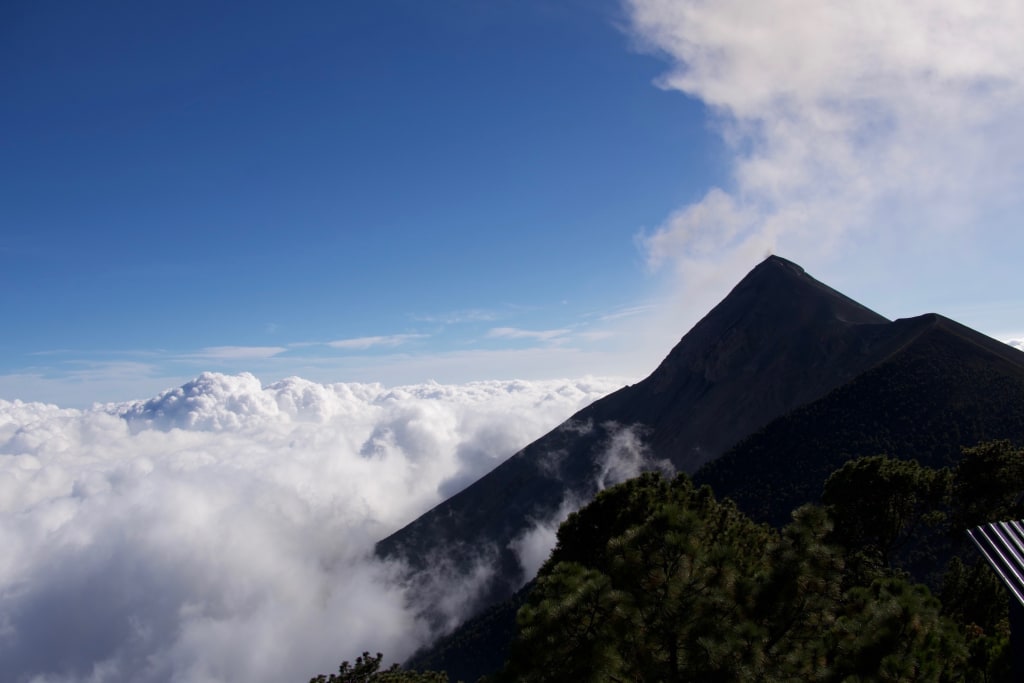
The hike to Fuego was a whole new level of challenging. It started off with a steep downhill slide back down Acatenango. The soil was so loose, I slid an extra foot with every step I took. The hiking sticks were crucial here. We eventually reached a short plateau and stared up ahead at the steep incline to Fuego. At this point we were at over 11,000 feet of altitude and we had already hiked almost 4 hours in the morning. I was really starting to feel the lack of air in my lungs even when I gulped giant breaths of air. I was cursing myself for waiting to take my second dose of the altitude medication.
This was the moment when I was truly thankful to have a private guide. Of course the rest of the group zoomed on ahead to Fuego, but I took it step by step, pausing to rest every 10 steps or so.
But I made it, and the payoff was huge. I looked around and found myself above the clouds. All I could see was the sun, the volcano, the clouds, and the trail ahead of me. I was awestruck. Was I in heaven?
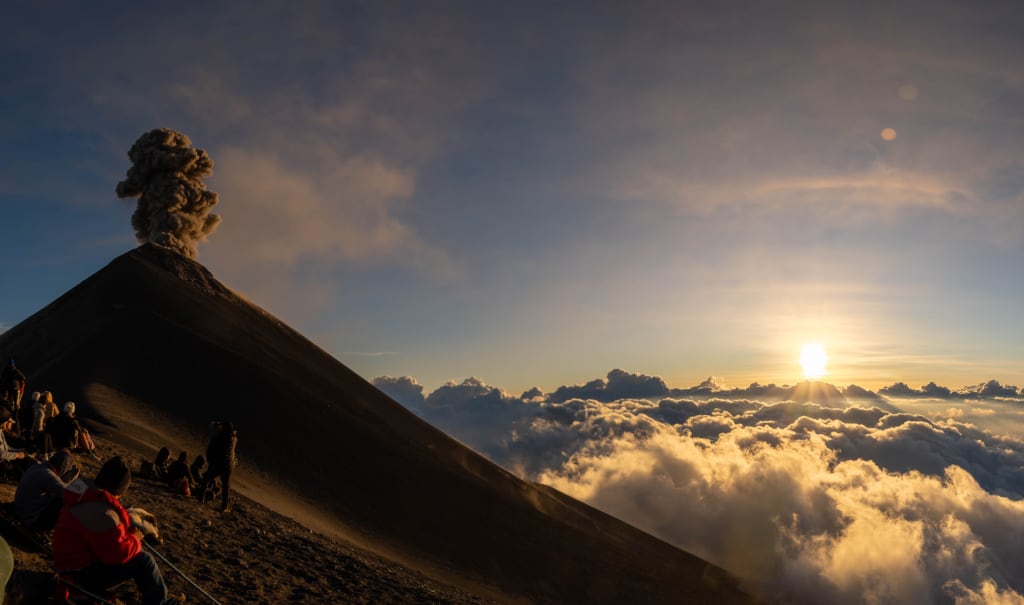

A group gathered at the foot of the volcano and waited with baited breath, alternating between watching the sunset to our right and the volcano straight ahead. Every ten minutes or so, the volcano would explode, sending red hot lava straight up into the air. We’d aggressively snap photos as each speck of lava landed back down on the slopes, and keep our eyes trained on the volcano until it happened again. Don’t blink or you’ll miss it!

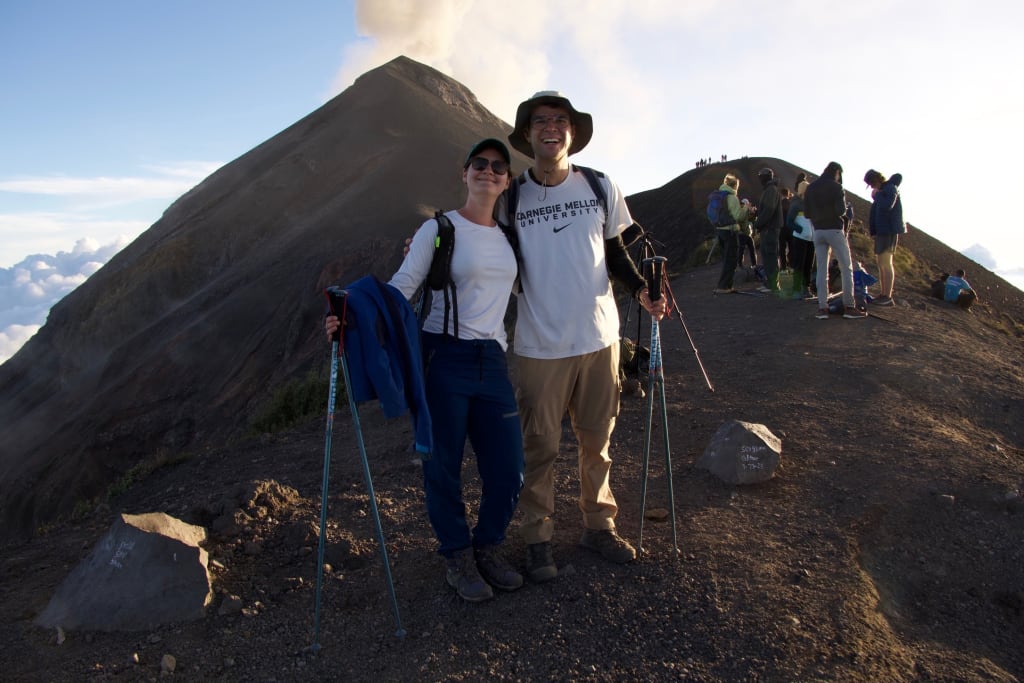
As the sun set, the cold set in. It was hard to capture the eruptions, because most of the time they start with no warning. Our hands were also so cold. Our private guide was incredibly patient though, and let us stay for hours, long after the rest of our group departed, so we could capture the perfect photo.

The 1.5 hour hike back to base camp is what really got me. I simply could not get enough air in my lungs. I was tired, and there was a giant line of people descending down the volcano heading back to base camp, leaving me little room to pull off to the side to rest.
When I finally made it back, I lost all appetite. My husband encouraged me to eat, as we had expended a lot of energy. Shortly after I finished dinner, though, things went south. With only a minute’s warning, I started to feel nauseous, until I made a mad dash for the cabin door to vomit into the trail. Unfortunately it was going to be a long night for me, with three other similar incidents. I ended up lying on the dirt in the fetal position, half napping, half waiting to vomit. Honestly though, the part that frustrated me most was that I had big plans to stay up all night and watch the volcano erupt, but I simply didn’t have it in me. This was a clear case of altitude sickness and overexertion. I hadn’t taken my second dose of the Acetazolamide soon enough, and I was now paying the price. No one else in my group suffered as severely from the altitude.
Given the rough night I had, my husband and I decided to skip the hike to the summit, which was set to depart at 3:45am the next morning. We instead woke to the rumbling of a particularly large eruption, and watched the volcano explode from the comfort of our cabin for over an hour.

We had a quick breakfast of banana bread, watched the volcano erupt for the last time, and headed back down the volcano at 7am.
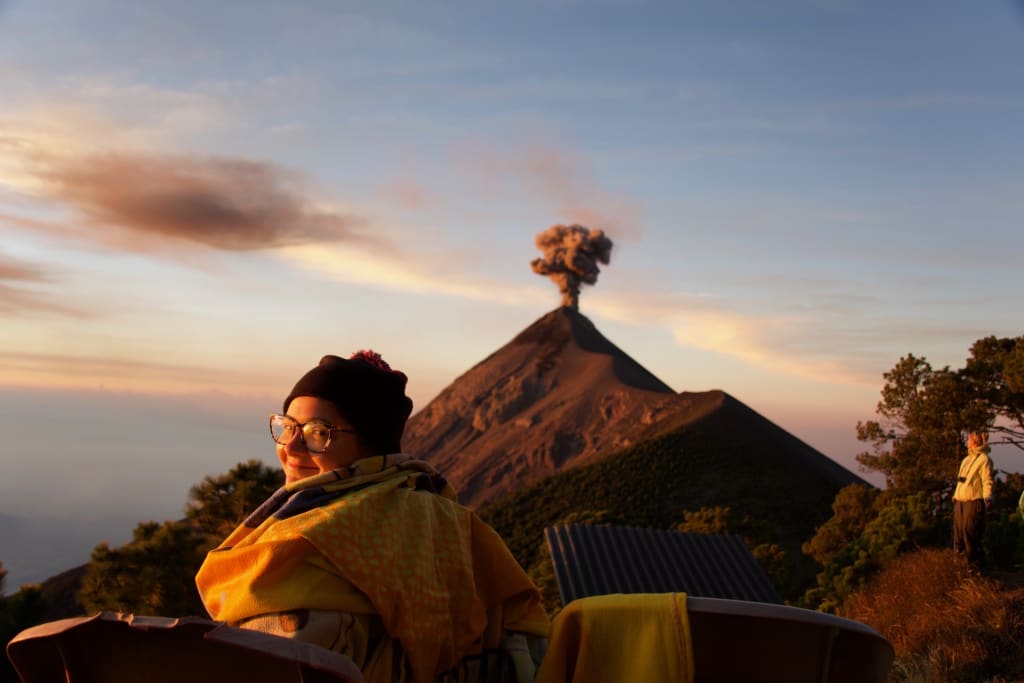
We were comparatively quite fast on the way down, and made it in just about 2 hours. We enjoyed a full Guatemalan style breakfast at the bottom of the volcano while we waited for the rest of our group to arrive. And just like that, it was over.
We hopped in the shuttle on our way to our next destination: Lake Atitlan. I highly recommend a stay on the lake immediately after this hike. You will be exhausted for the next few days, and there’s no better place to unwind and recover.
IS IT WORTH IT?
Yes, it is truly one of my favorite things I have ever done, especially the extra hike to Fuego, but there’s no beating around the bush. It’s HARD. You have to be willing to suffer through a grueling hike for the giant payoff at the end. I thought it was particularly challenging given my POTS, but my sister-in-law’s sister, a D1 college athlete, said it’s the hardest thing she’s ever done, and my marathon running husband said it was a 9/10 on the difficulty scale (he gave his marathon the high score of 10/10).
FAQs
What is the bathroom situation?
It depends on the tour operator, but I was pleasantly surprised by our situation. We had a bathroom hut set a little ways away from the cabins with a curtain as a door. The bathroom was elevated, but your business is ultimately dropping into a pit below the hut, which the tour company cleans every day. Our bathroom was well stocked with toilet paper and hand sanitizer, but I still recommend bringing your own just in case. My sister-in-law’s sister also recently did this hike and her tour company did not provide toilet paper.
What is the sleeping situation?
Again, this is largely dependent on the operator, but we had cabins, which is a massive upgrade from tents. It gets very cold on the volcano at night. I can’t imagine how cold it would be from a tent!
V-Hiking had 10 cabins, some shared, some private (which you could book for an additional fee). They provided sleeping bags and thick blankets as well. I found our cabins to be pretty clean!
Do I need a sleeping bag liner?
I personally didn’t feel the need to bring one. The cabin was relatively clean, plus you’re in so many layers at night, so you’ll have no skin to skin contact with the sleeping bag anyway.
What should I pack?
Here’s my packing list. Remember to pack light: you’ll either be carrying your pack or it will be weighed before you hand it off to the porters. Wear the Day Of Light Hiking Pants Athletic Long Sleeve or Short Sleeve Shirt Hiking Boots Merino Wool Hiking Socks Baseball cap Pack 40L backpack Thermal Layer Heavy Jacket Light Raincoat Heavy Pants (like sweats) Winter Hat Gloves Change of clothes (especially shirt, socks, and underwear) Walking Stick (you can rent these, they come in so handy on the volcanic sand, especially downhill) Bandaids Altitude Medication Advil Electrolyte Packets (I recommend LMNT) Camera (with extra batteries & zoom lens) Phone Battery Pack Snacks Water (at least 4L) Toilet Paper Hand sanitizer Wet wipes Headlamp Sunglasses Sunscreen Toiletries (toothbrush, toothpaste, deodorant, hair brush) Small bag for trash Cash for tips
Do I need to be fit?
Yes, you need to be relatively fit to attempt the hike. If you have heart problems, knee problems, or you suffer with altitude, it’s probably not the hike for you. That being said, you can go at your own pace and take your time. If your goal is to hike to Volcán Fuego, you must complete the hike to base camp in 6 hours or less or you won’t be allowed to participate.
Do I need medication?
I strongly recommend getting a prescription for Acetazolamide (also known as Diamox). Base camp sits at 11,000 feet above sea level, and the hike is long and strenuous, making hikers susceptible to altitude sickness such as dizziness, shortness of breath, and vomiting.
Am I guaranteed to see an eruption?
The volcano erupts pretty religiously, but weather conditions on the volcano vary greatly. Sometimes, the cloud cover is so intense, you can’t see Volcán Fuego. To maximize your chances of having clear weather, plan to hike in the dry season (November to April).
Was there a lot of exposure? Any steep dropoffs?
There was no exposure or steep dropoffs on this hike.
Is it possible to do it in one day?
The most common option is a 2 day trek, and there’s a good reason for that. Not only would it be a very long hike to complete in one day, but more importantly you can’t see the red lava until the sun sets, which is definitely a highlight! There are options to hike in one day, but I strongly advise you to do the 2 day option.
Is there water available?
There is water available at a convenience stand about 2.5 hours into the hike, but it’s expensive, and may not be operating depending on the conditions. Tour operators will recommend 3L of water, but I recommend bringing 4L of water. The hike is tiring and the combination of altitude sickness and dehydration would be crippling.
Is the Fuego add-on worth it?
Best money I’ve ever spent!
What happens if the weather is bad?
I sound like a broken record, but this depends on your tour operator. Most of the time they will operate, rain or shine, as long as it’s deemed safe. Make sure to read their policy when picking a tour operator.
Are meals provided?
They were provided by our tour operator, yes. (Did I mention you should read the FAQs on your operator’s website yet?)
We personally got breakfast the morning of the hike at a house at the base of the volcano owned by the tour company, which was a typical Guatemalan style breakfast of eggs, plantains, beans, and fruit, as well as coffee. For lunch, once we hit base camp, we had a packed meal of rice and veggies and meat (there are vegetarian options, which are just more veggies). For dinner, we had pasta after the Fuego hike. Breakfast the next morning was banana bread at base camp, followed by a full Guatemalan style breakfast back at the base of the volcano at the end of the hike. The food was pretty tasty and filling, but we still recommend bringing your own snacks.
Is hiring a porter worth it?
I can’t emphasize this enough - absolutely! It was such a weight off our shoulders (literally). They will carry up to 25 lbs (which they will indeed weigh your pack before you depart).
Has Volcán Fuego ever had a deadly eruption?
Yes, there was an eruption in 2018 that killed over 200 people that lived in a local village. No tourists were killed. Generally, the eruptions pose no risk, and operators are trained to recognize the warning signs.
What do I do with extra luggage?
Depending on the operator, you can store your luggage in a locked room in their office.
How does it compare to other hikes you’ve done?
This was the hardest hike I’ve done. Other challenging ones I’ve done (for comparison) include the 1 day Inca Trail, the Edelweiss Trail in Switzerland, and Trolltonga and Kjeragbolten in Norway.
Are tips required?
It’s recommended to bring tips for your porter and your guide, especially if you have a private guide.
How much does it cost?
This depends entirely on your operator, but we paid a total of 2950Q or $385 or 1475Q and $192 per person. Here’s the breakdown: Private Cabin: 850Q or $110 Private Guide: 600Q or $78 Porter (2 days): 450Q or $59 per person There was also the option to hire for the first day only for 250Q or $33 Entrance Fee: 100Q or $13 per person Optional Extra Hike to Fuego: 200Q or $26 per person We also paid 250Q per person for the shuttle to Lake Atitlan, which took a little over 3 hours. I would like to emphasize that we could have done this experience much cheaper, for as little as 1200Q ($157) or 600Q ($78) per person (shared cabin for 600Q, shared guide at no extra cost, no porter, but including the extra hike to Fuego for 200Q per person, which is a must do, and the entrance fee).
How long does each eruption last?
They don’t last long! Perhaps 20 seconds to 1 minute.
What camera do you recommend?
I would recommend a zoom lens for the best photos. My husband (the photographer) took the majority of the photos in this article with a Sony a6700 camera paired with a 8-300 mm all-in-one zoom lens.

