
Tikal Guatemala: The Mayan Ruins That Outshine Chichén Itzá
Tikal was robbed.
Twice, actually.
The first time was in 1981, when armed looters broke into the museum at Tikal and stole carved jade artifacts.
But that’s not what I’m talking about.
In 2007, the list of New Seven Wonders of the World was published, featuring architectural marvels like Peru’s Machu Picchu and the Great Wall of China. Mexico’s Chichén Itzá, an ancient Maya city, also made the list.
After visiting both Chichén Itzá and Tikal, I can’t understand how Chichén Itzá ended up on the New Seven Wonders list and Tikal didn't. As I said, Tikal was robbed.
Tikal has it all. It has towering temples jutting out from the jungle canopy that visitors can climb. It has howler monkeys hooting and hollering and spider monkeys swinging from tree to tree. It was one of the most magnificent Mayan cities at its height and today, it’s one of the most spectacular ruins you can visit on Earth, at least in my opinion.
Below, I’ll cover everything you need to know about visiting Tikal, from how to get there to what you can expect to see inside the park. If a visit to Tikal isn’t already on your Guatemala itinerary, let me convince you why it should be.

WHO WERE THE MAYA?
The Maya were an ancient civilization that built hundreds of cities across present-day Mexico, Belize, Guatemala, Honduras, and El Salvador. Their civilization thrived for thousands of years, with a golden age that lasted from ~250 to 900 CE.
Today, the Maya are known for their pyramids, their complex writing system, their impressive accomplishments in astronomy and mathematics, and, yes, their practice of human sacrifice.
WHAT IS TIKAL?
Tikal was one of the most powerful Mayan cities. Historians now estimate that between 250,000 and 300,000 Mayans lived here at the city’s peak (this is revised from their initial estimate of 60,000 after a recent LIDAR scan revealed that the city was much larger than previously thought).
Today, there are 5 temples and many pyramids to explore in Tikal. The shocking fact of the matter is that only 15% of the ruins are excavated, but even that small fraction takes hours to explore.
Temples and pyramids are not synonyms. Temples are built for meditation and worship. Pyramids are built as observatories for the stars.
Tikal was “discovered” in 1848. (I say “discovered” because many locals were aware of Tikal’s existence, but the expedition in 1848 was the first formal one commissioned by the government). Tikal became a protected park in 1955 and a UNESCO World Heritage site in 1979.
George Lucas filmed Star Wars scenes from the top of Temple 4 (before it became a UNESCO World Heritage site and filming was subsequently banned).
WHERE IS TIKAL?
Tikal is located in the Petén department of Guatemala in the northernmost part of the country. It is a 1 hour 15 minute drive to the nearest airport, Mundo Maya International Airport. It is roughly 2 hours away from the border with Belize to the east.
A BRIEF HISTORY OF TIKAL
I watched a number of documentaries on Tikal before my trip. I would recommend Ancient Maya Metropolis - PBS, Remodeling the Immense Maya Monument, and Secrets of Tikal, all of which are available for free on YouTube. I thought it was particularly cool seeing the recreations of what Tikal looked like during the time of the Mayas.
Tikal was a military superpower, so much so that neighboring cities would pay taxes to Tikal in exchange for military protection. But even a city as powerful as Tikal was not invincible. Tikal was conquered twice, first by Teotihuacán (in present-day Mexico) in 378 CE by the descendants of the Olmecs, and later when Caracol (in Belize) and Calakmul (in Mexico) teamed up to conquer Tikal in the 570s CE.
Tikal was able to earn their independence in the late seventh century. They started building temples in 695 CE to celebrate their newly regained power. In fact, even though the Mayans lived at Tikal since ~600 BCE, most of the ruins you'll see today were built in the last two centuries that the Mayans lived there.
There were 33 rulers in Tikal’s history, 2 of which were women.
Tikal suffered through a period of severe drought starting in 850 CE that eventually forced the Maya to abandon Tikal altogether around 900 CE and head north towards the Yucatán Peninsula in Mexico. We know roughly when the Maya abandoned Tikal because that’s when they stopped cutting down the trees. Since scientists can easily date the trees, we know when the Mayans fled.
I highly recommend a visit to ATM Cave in Belize if you’re interested to learn about how the Mayas responded to these intense seasons of drought.
OUR EXPERIENCE
We set off bright and early at 7:30am, arriving at Tikal National Park just after 8:15. Our guide, Tulio, showed us a giant recreation of the ruins at the Visitor’s Center and showed us the route we would be taking through the park.
As we started off down the path towards the Great Plaza, we came across a troop of spider monkeys playfully swinging from branch to branch. Soon after we continued along, there was another surprise: howler monkeys! While we often heard them vocalizing from a distance, they were rather quiet right in front of us. Our guide told us we were very fortunate to see both species of monkeys in one day.
We spent the next four hours exploring the ruins, starting with Temples I and II in the Great Plaza. Temple I is the emblematic temple you see when you google Tikal.
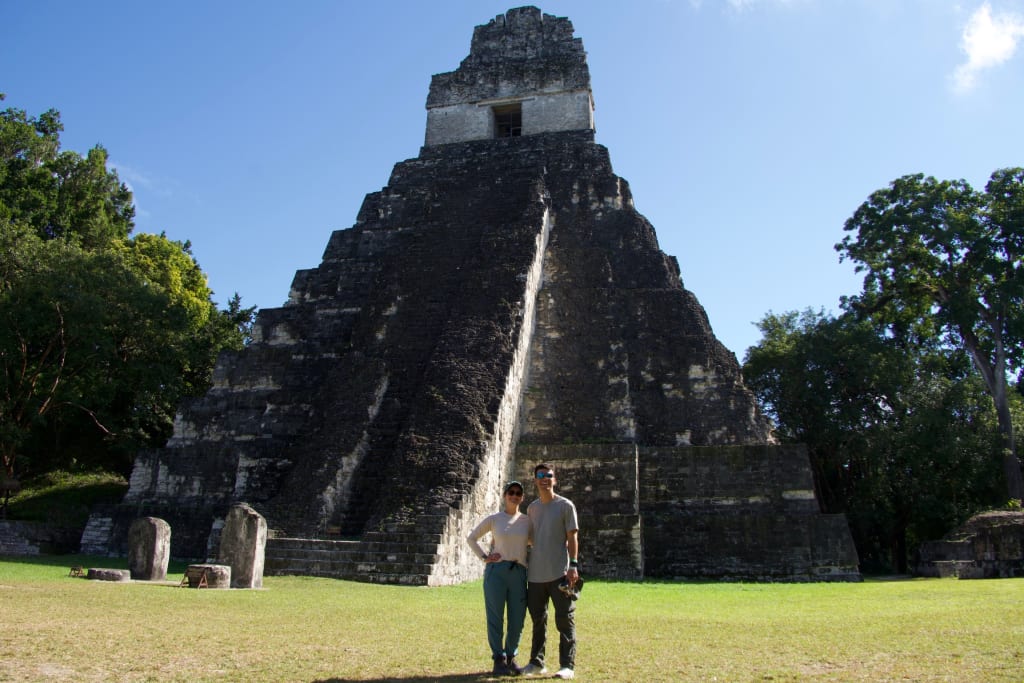
Temple II sits directly across from Temple I, and you can climb this temple to get a great vantage point of its neighbor. The 26th ruler of Tikal built Temple I in honor of himself, and the shorter Temple II for his wife. In this plaza there is also the royal residence and the royal tombs. You can climb up the royal tombs for a great view of Temple I from the side.
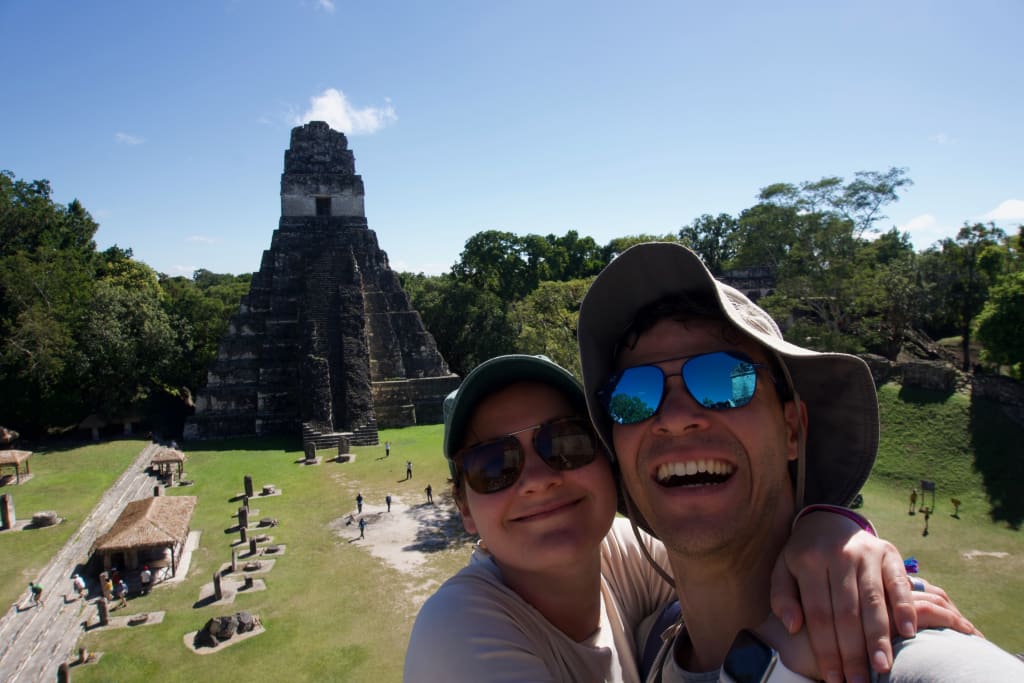
After the Great Plaza, we proceeded on towards a pyramid that had served as an observatory for the Mayans. The Mayans had many significant accomplishments, including the creation of an extremely sophisticated calendar and the concept of 0 in mathematics. They also excelled in astronomy, and built many observatories (which we call pyramids) to study the planets and the stars. We climbed a steep wooden staircase to the top of one of their pyramids, and saw the tops of Temple IV and Temple I peeking out above the jungle canopy. The jungle extended for as far as the eye could see. It was magnificent.

The last major stop was Temple IV, which we were also able to climb. There is another large temple, Temple V, but it was too far away to fit into a one-day tour according to our guide. That being said, I wasn't disappointed. I got a great feel for the site from the temples we were able to see and didn’t feel like I was missing out.

We thought the tour was over, but Tikal had one final surprise in store for us. We heard something that sounded like the croak of a frog. Our guide told us that it was in fact a toucan! While we didn’t lay eyes on the toucan itself, it was pretty cool hearing the sounds it made from a short distance away.

WHERE TO STAY?
There are two options for visiting Tikal: staying locally overnight or visiting as a day-trip.
If you want to stay overnight there are three options. Most tourists opt to stay in the larger town of Flores, located on an island on Lake Petén Itzá about 1 hour 20 minutes from the ruins.
Another option is staying at the town of El Remate, which is considerably smaller than Flores but only 45 minutes from Tikal. We stayed at Hotel Gringo Perdido in El Remate. Breakfast and dinner were included in the price of the stay and it was clean, despite being in desperate need of some renovations. It is located on the edge of the lake and there were plenty of hammocks to lounge in as well as paddle boards to take out onto the lake. One word of caution: there are crocodiles in the lake, but for some reason many tourists decided to swim and paddleboard anyway.
The final option for staying locally is choosing one of the three hotels located within Tikal National Park: Jungle Lodge, Hotel Tikal Inn, or Hotel Jaguar Inn Tikal. They are the most convenient, but from our research we found these accommodations to be quite rustic (no AC, etc).
For visiting as a day-trip, visitors usually drive from San Ignacio, Belize or fly from Guatemala City. The drive to San Ignacio is roughly 2 hours, but depends largely on how busy it is at the border (often there are huge tour buses that travel this route and bring crowds that can stall you at the border for over an hour). Flying from Guatemala City takes about 45 minutes.
BEST TIME TO GO?
The best time to visit is the dry season, which runs from November to April. March and April are much hotter, so if I had to pick the ideal window I would recommend January to February.
In terms of the best time of the day to visit, both sunrise and sunset tours are very popular in Tikal. We opted to go for the regular morning tour (hours after sunrise) because we were pretty exhausted after our Volcán Acatenango hike, and we heard the weather can be foggy, cloudy, or misty in the mornings. These sunrise and sunset tours also tend to be more popular, so you’ll be competing with other tourists for those amazing photos.
Year round, Tikal gets HOT. Make sure to start in the morning before the midday heat or in the late afternoon and bring sunscreen and a hat for protection.
DO I NEED A GUIDE?
You don’t need one, but I recommend one! We love learning on our travels, and there’s no better way than hiring a tour guide.
We went with Tulio from Tikal Go and had a fantastic time. Both myself (a history nerd) and Alex (not so much) had a great time, which historically has not always been the case. Tulio was easy to chat with, very informed, and gave us time to explore on our own. He would shepherd us from place to place, giving us the relevant background and history, and then wait for us on a bench to explore and take photos for anywhere between 20 and 45 minutes at a time. It was the perfect balance!
If you decide to go on your own, you’ll need to pay the entrance fee of 150Q or $20, as well as arrange your own transportation from your hotel to the national park.
OTHER MAYAN RUINS AROUND THE WORLD
Dozens of Mayan cities have been excavated and are open to visitors.
Mexico is home to many of the most popular ones, including Chichén Itzá, which is undoubtedly the most famous of them all. More than 2.5 million people flock to these ruins each year, excited to see one of the New Seven Wonders of the World.
Other notable sites in Mexico include Palenque, Uxmal, and Calakmul. Seeing Uxmal's giant Pyramid of the Magician is especially high on my bucket list. My guide at Chichén Itzá said that the most impressive ruins he had ever seen were at Uxmal and he had seen over 30 Mayan sites!
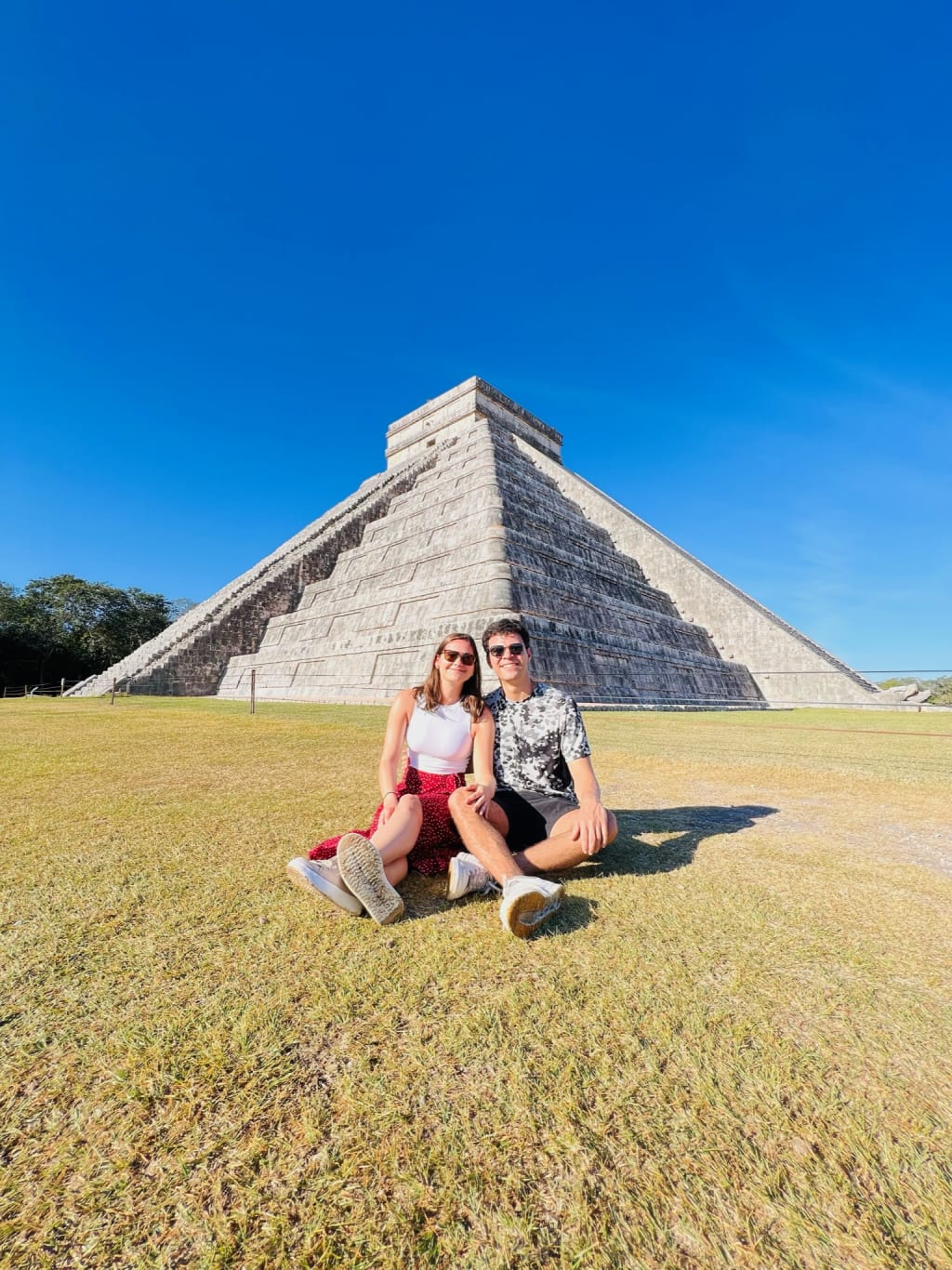
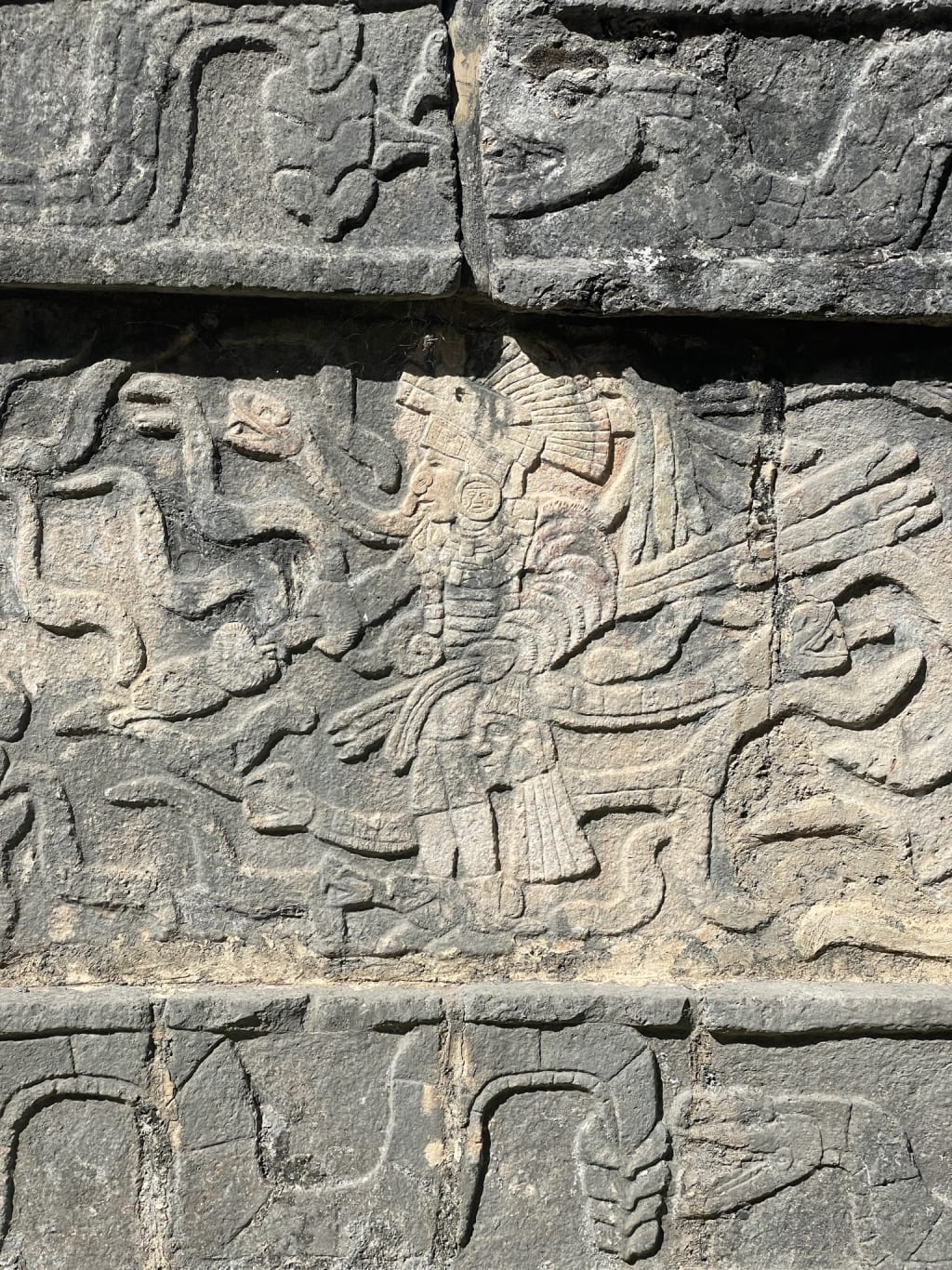
In Guatemala, Tikal is by far the most popular Mayan site to visit. It was one of the largest and most powerful cities of the Classic Maya world.
Copán in Honduras is another particularly noteworthy site, famous for its extraordinarily detailed stone stelae. Sadly, Copán receives a fraction of the visitors that sites like Chichén Itzá get, largely due to Honduras' high crime rates.
Belize also has a number of impressive ruins, such as Caracol, another major Classic Period city. But the most unique Mayan site in Belize is arguably ATM Cave, which wasn't a city at all, but rather a sacred cave used for religious ceremonies and sacrifices. Many tourists visit both ATM Cave and nearby Xunantunich when they stay in San Ignacio. Xunantunich was a much smaller Maya city, but its main pyramid is 130 feet tall, taller than Chichén Itzá's famous El Castillo.
COMPARING TIKAL AND CHICHÉN ITZÁ
We strongly preferred Tikal over Chichén Itzá for a number of reasons.
First, Tikal is significantly larger with many more large structures excavated. Tikal was one of the most dominant cities in the Maya world at its height during the Classical Period, whereas Chichén Itzá was considerably smaller and grew to power in the Postclassic and Terminal period.
The atmosphere in Tikal is also more immersive, as you’re deep in the jungle listening to the local wildlife, compared to the flat, open plains in Chichén Itzá.
Lastly, you can safely climb some of the temples in Tikal (while still preserving the ruins), which gives you a wonderful vantage point over the jungle canopy.
An added bonus is that Tikal receives fewer tourists, a few hundred thousand per year compared to over 2.5 million at Chichén Itzá, which makes for a much more peaceful experience.
IS IT WORTH IT?
Absolutely! Admittedly, it’s a bit out of the way and not as close to Guatemala’s other tourist attractions, like Antigua or Lake Atitlán. The good news is it’s very close to the border with Belize, and there are great activities like ATM Caves that pair well with a visit to Tikal. We have been to many ruins around the world and felt like Tikal ranked among the best.
FAQS
What is the bathroom situation?
There were bathrooms at the visitor center and in a handful of places throughout the park, although it’s sporadic. I always recommend bringing your own toilet paper and hand sanitizer while traveling in Guatemala, even though there was some available when I was at Tikal. Supply can vary.
How long should I plan to spend at Tikal?
I saw a lot of articles online recommending 2 days to explore Tikal. It is a huge site, over 200 square miles to be exact, but you can see the main highlights in less than a day. We spent 4 hours exploring the ruins and felt it was perfect.
Can I visit Tikal as a day trip?
Day trips to Tikal are very common, both from San Ignacio, Belize, as well as Antigua, Guatemala. Both options present their challenges though. If you’re coming from Belize, depending on crowds, there might be long lines at the border that will slow you down. If you’re coming from Antigua, you’ll need to fly to and from Guatemala City on the same day (the flight is only 45 minutes, so this is definitely doable).
Is Tikal accessible for people with mobility limitations?
Yes, the paths are mostly flat, although they’re not paved, but there is a lot of walking involved in a tour of Tikal. There are also a number of staircases to climb the temples, but you can skip these if you have mobility issues.
Can you climb the temples?
Yes, there are a handful of structures you can climb, most notably Temple II, Temple IV, and one of the pyramids. Thankfully you’re not climbing on the ruins themselves, but on adjacent staircases that hug the temples and allow you to see the cool views without damaging the ruins or hurting yourself.
What wildlife can you expect to see?
If you’re lucky, you can see coatis (a cousin of a raccoon), spider monkeys, howler monkeys, and birds (such as toucans). There are jaguars in the park, but they’re very elusive and actively avoid humans. There was a viral video in November 2025 where a jaguar attacked a coati and came within a foot of a tourist taking a video, but didn’t attempt to harm the tourist. That generated a lot of buzz, but our guide explained that while jaguars do live in Tikal, jaguar sightings near the ruins are very rare.
What should I wear?
I recommend wearing close-toed, comfortable shoes, as you’ll be walking a lot. I would also recommend something light since it will be hot, but bring either sunscreen or a light layer to protect yourself from the sun.
What should I bring?
Travel light. Bring bug spray, sunscreen, 2L of water (it’s hot!), a hat, a camera, toilet paper, hand sanitizer, and sunglasses.
Is there shade?
Yes! There is plenty of shade along the jungle paths.
Are the sunrise tours worth it?
We personally didn’t think so. We heard the weather can be foggy, cloudy, or misty in the mornings, and these sunrise and sunset tours also tend to be more popular, so you’ll be competing with other tourists for those amazing photos.


