
The Kumano Kodo: Hiking Japan's Ancient Pilgrimage (Hongu to Nachi)
Years ago, I stumbled upon one blog article about the Kumano Kodo. I had done a lot of research about Japan, but I had never heard of this hike. The couple who wrote the article said it was the highlight of their trip to Japan and that it was an underrated destination that receives a tiny fraction of the crowds that the ever-popular Tokyo, Kyoto, and Osaka receive. I was instantly interested and it became the main reason that Japan skyrocketed to the top of my bucket list.
Now, after completing the hike, I can confidently say I concur with that blog post: this was the most memorable, authentic, and delightful experience I had in Japan.
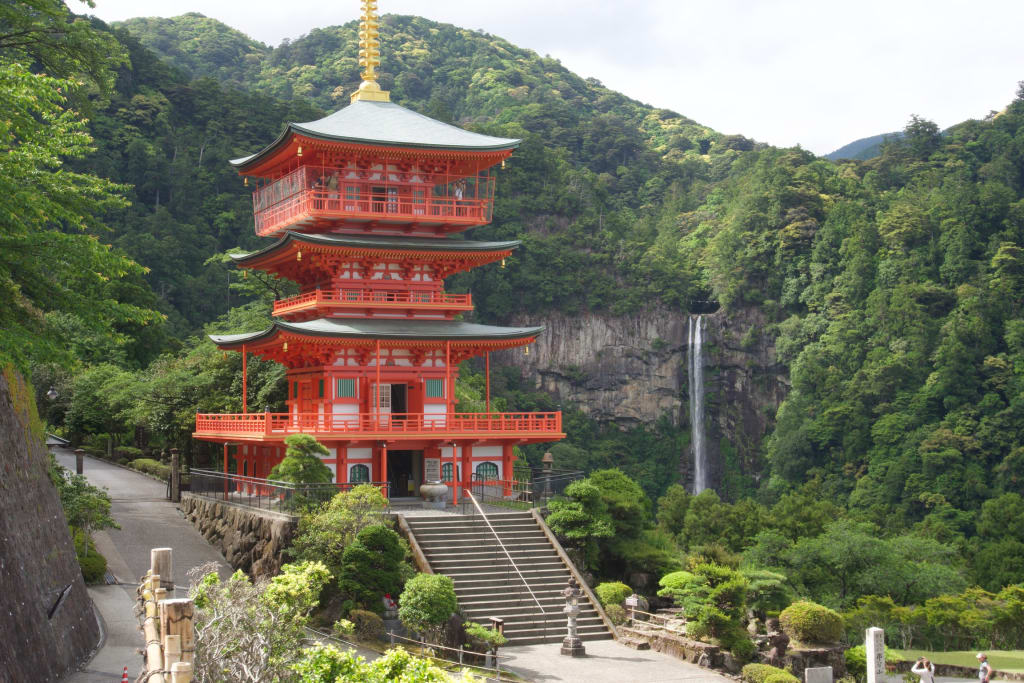
There are many reasons to fall in love with this hike. The peace and solitude on the trail contrasts perfectly against the crowds in Japan's major cities. The shrines and temples along the way are true marvels and you'll have them all to yourself in the middle of the day. The beauty of the pagoda in front of Nachi Falls in particular simply cannot be captured in a photograph.
And it's not just a hike, it's also an immersive cultural experience. You get a glimpse into what life is like in the Japanese countryside. A major part of the experience is staying in ryokans, traditional Japanese inns, and bathing in onsens.
I can go on and on about all the reasons you should do this hike, and I plan to. Let me convince you why this hike should make your bucket list too.
WHAT IS THE KUMANO KODO?
The Kumano Kodo is a network of pilgrimage trails that emperors and samurai would follow to get between major temples and shrines for over a thousand years. Today, it's one of only two pilgrimage trails in the world that are UNESCO World Heritage sites. The other is the Camino de Santiago in Spain. For me, because of the historical context, this hike was very reminiscent of the Inca Trail.
Since it is a network of trails and not just a single trail, there are various routes you can choose. We did the Nakahechi route, the main route that links the three Grand Shrines of Kumano. We hiked from Hongu to Nachi over two days. This is a fraction of the full route, which spans from Takijiri-oji to Nachi. Because there are buses that travel between the towns, it's easy to do just portions of the route.
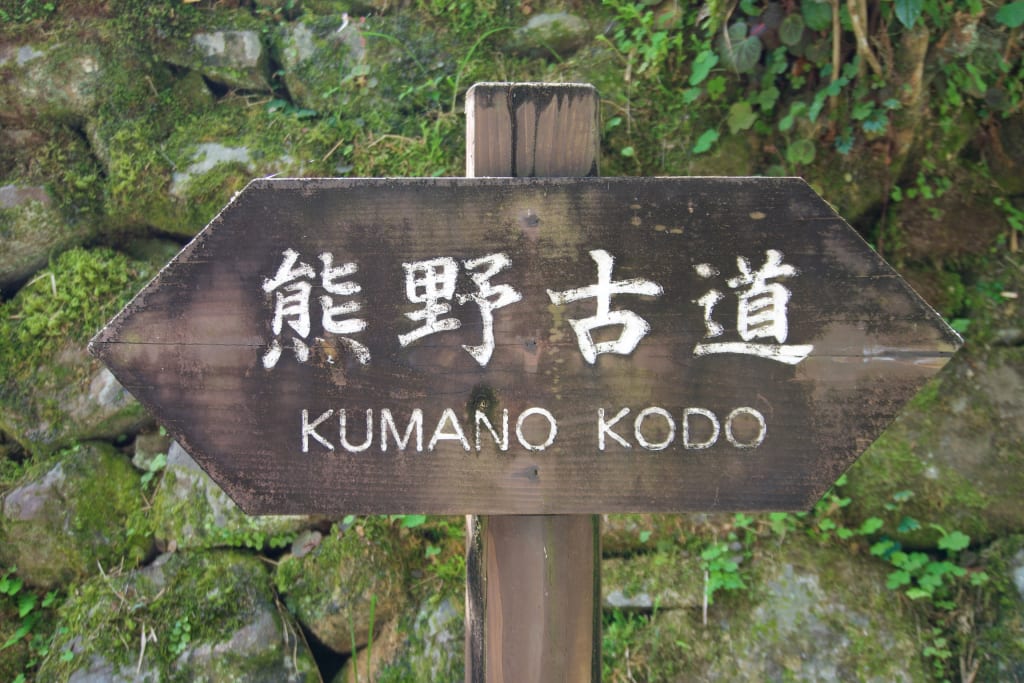
Other popular routes include the mountainous Kohechi route and the coastal Iseji route.
Throughout all the routes, there are various shrines dotted along the way. Some shrines are grand buildings and others are small stone statues within the forest.
OUR ITINERARY: HIKING THE NAKAHECHI ROUTE FROM HONGU TO NACHI
Below, I included the itinerary we would recommend, which is nearly exactly what we did with a few tweaks.
Day 1: Transportation to Hongu Area
Take the train from your starting point to Osaka
While it's possible to travel all the way from Tokyo, it would be a long day, and you'd have little room for delays. We recommend spending the night before your departure in Kyoto or Osaka.
Book a train on JR-West from Osaka to Kii-Tanabe (2 hours 20 minutes)
Even though you can make the reservation in advance on the JR-West website, you'll still need to pick up a physical copy of your tickets. You can do this at the kiosk of major train stations, such as Kyoto or Osaka. Arrive at the train station early with the credit card you used to purchase the tickets, no Apple Pay, and the pin you entered when you made the reservation. You can pick up your return trip tickets as well. You'll want to book this train at least one week in advance.
Take the bus from Kii-Tanabe to Hongu or Yunomine Onsen (1 hour 50 minutes)
This leg of the journey is the bottleneck. The bus from Kii-Tanabe only runs a few times per day, and the last bus departs in the late afternoon. Even though the bus departs from the same train station you'll arrive in and the station is relatively small, you'll want to arrive with enough time to ensure you make this bus.
While there are no bathrooms on the bus, the driver stopped once to let passengers off for a bathroom break after just over an hour. Bring cash! This bus did not accept Suica cards.
Check in to your hotel in Hongu or Yunomine Onsen
Hongu will be the departure point tomorrow, so it's the most convenient option. It's also larger than many surrounding towns, making it easier to find accommodations. That being said, many hikers, ourselves included, chose to stay in nearby Yunomine Onsen, a short bus ride away. It's an onsen town with a wonderful atmosphere.
We really liked the ryokan we stayed at: J-Hoppers. They didn't offer dinner at J-Hoppers, but there was a cute restaurant a couple minutes' walk away called You Got It Bar.
Day 2: Hike Hongu to Koguchi
If you're staying in Yunomine Onsen, start by taking the bus to Hongu
It's a short ride. I would not recommend walking. The road from Yunomine Onsen to Hongu is hilly and winds back and forth. It's also a one-lane road with two-way traffic. Save your energy for the scenic hike, trust me. We caught the first bus out at 7:03 AM. Here is the full schedule.
Explore the largest torii gate in the world at Oyunahara
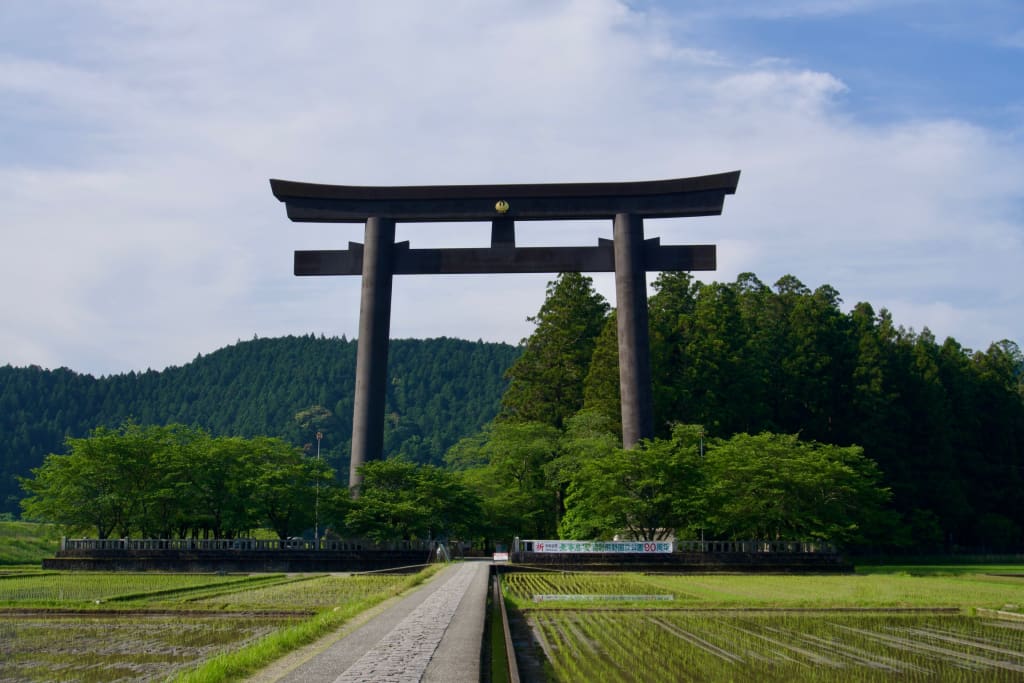
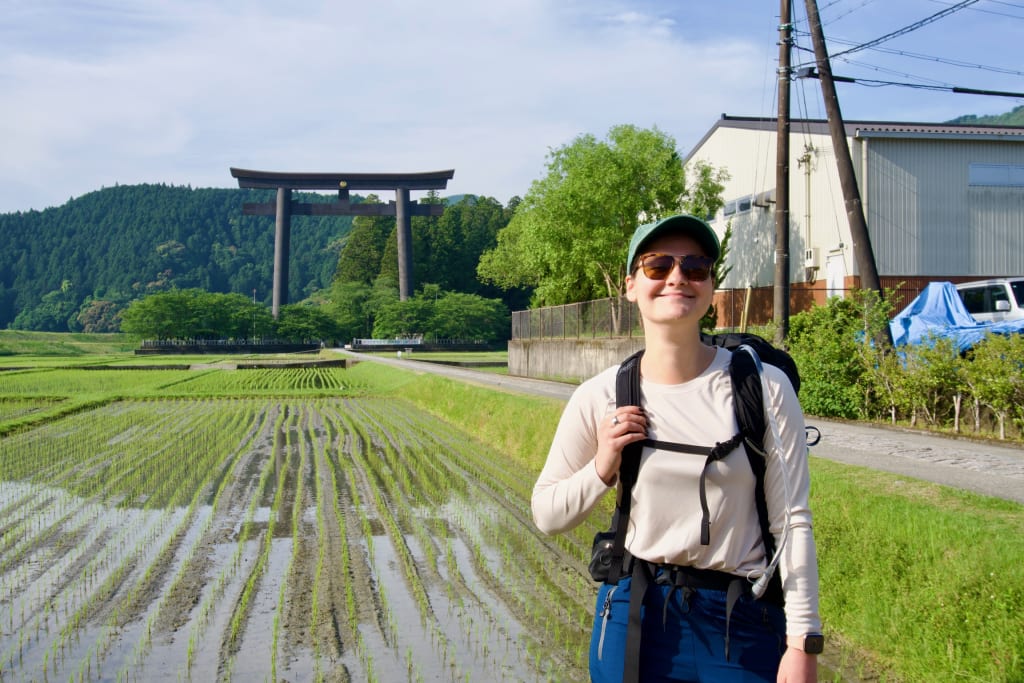
As soon as we hopped off the bus, we were greeted with views of this stunning, giant torii gate surrounded by rice paddies. The sheer size of it is hard to comprehend until you're standing before it. Before a major flood in 1889, this gate marked the entrance to the Kumano Hongu Taisha shrine. The shrine now sits on higher ground, but Oyunahara remains one of the most important and sacred sites along the Kumano Kodo.
Explore Kumano Hongu Taisha Shrine
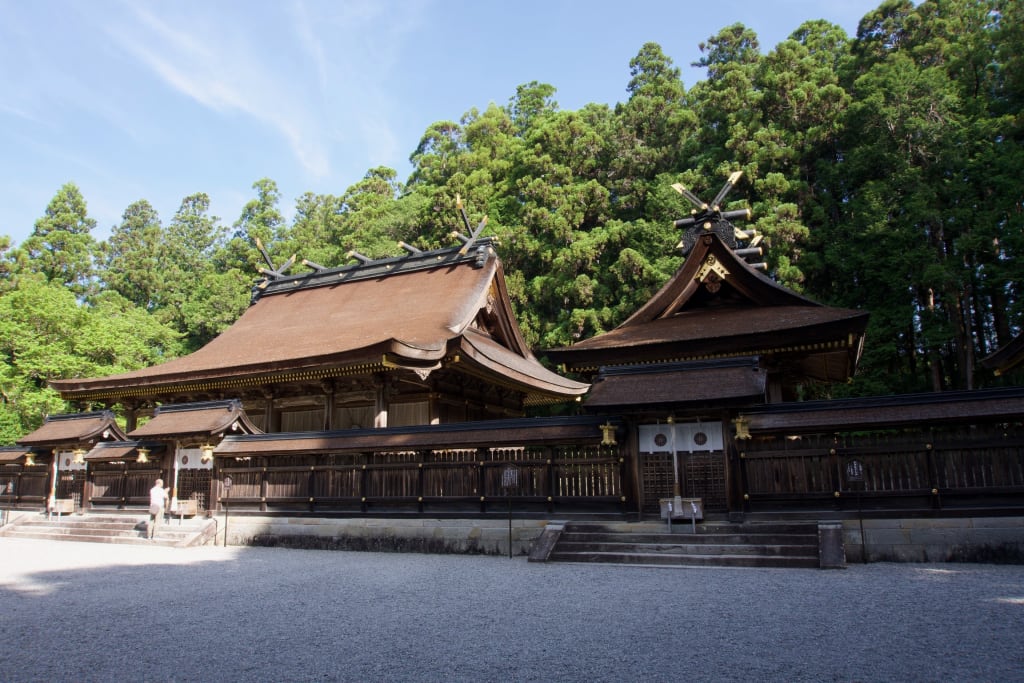
We then climbed the steep stone staircase to Kumano Hongu Taisha, one of the three Grand Shrines of Kumano. For over a thousand years, emperors, samurai, and ordinary pilgrims have traveled along the Kumano Kodo to pray here. Unlike many of the temples and shrines we visited in Kyoto, where most visitors were tourists taking photos, Hongu Taisha felt like a place where faith is very much alive.
Bus from Hongu to Ukegawa
You can also walk from Hongu to Ukegawa, which is what we did. We do not recommend this. For most of the way, you're walking alongside a busy road. There's a short section in the forest, but the signs are confusing, and the trail is narrower and less well maintained than the rest of the trek.
Ultimately, you're not missing any great scenery in this section, and it takes a little over an hour to walk it. Conserve your energy and take the bus. Use Google Maps to find the bus route.
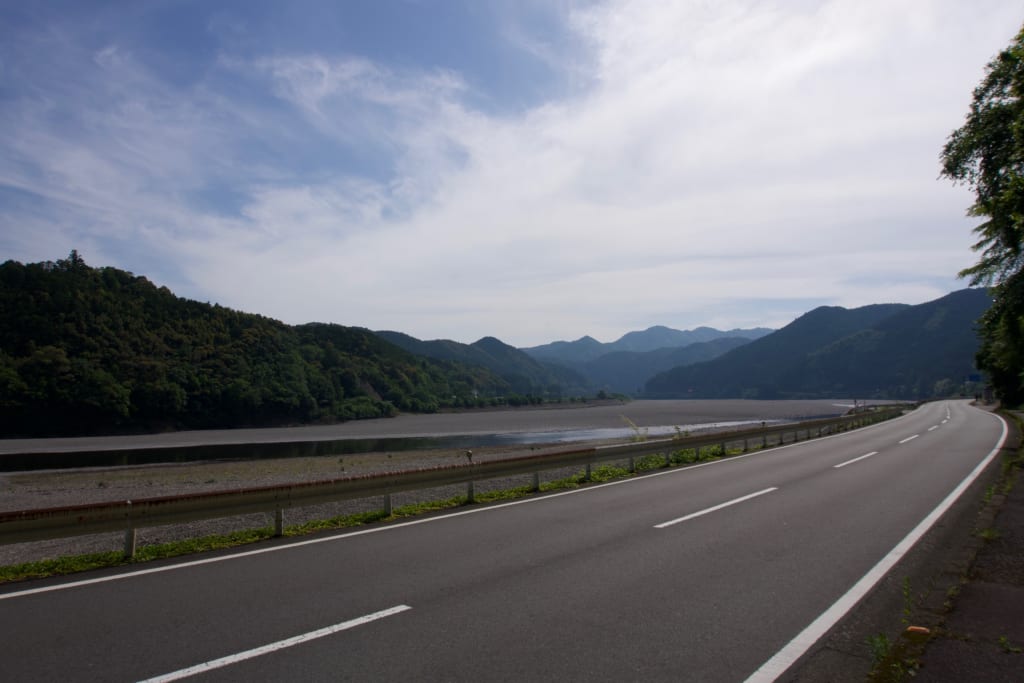
The road from Hongu to Ukegawa.
Just a few paces from the trailhead at Ukegawa, there is a convenience store. Stock up on snacks for your hike.
Hike Ukegawa to Koguchi (the Kogumotori-goe section)
Our stats: 10 miles, 2,900 feet of elevation gain, 6 hours 15 minutes total according to Alex's Garmin watch.
Your first stretch of the hike! Enjoy the sounds of the Japanese Bush Warbler whistling its tune and the solitude of the trail. The entire day we saw fewer than 15 fellow hikers.
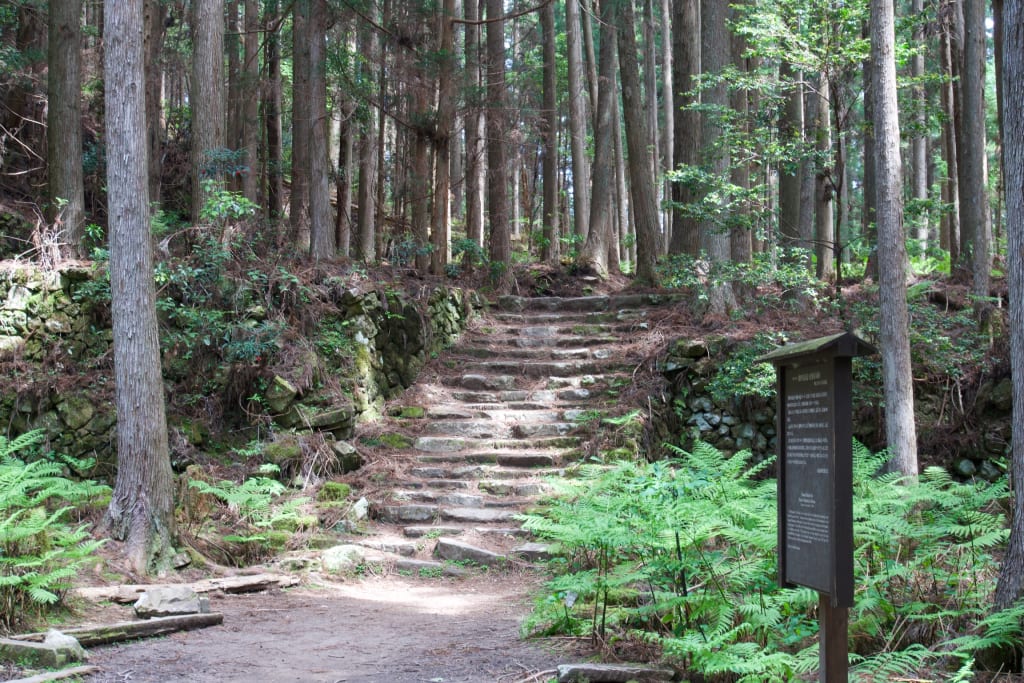
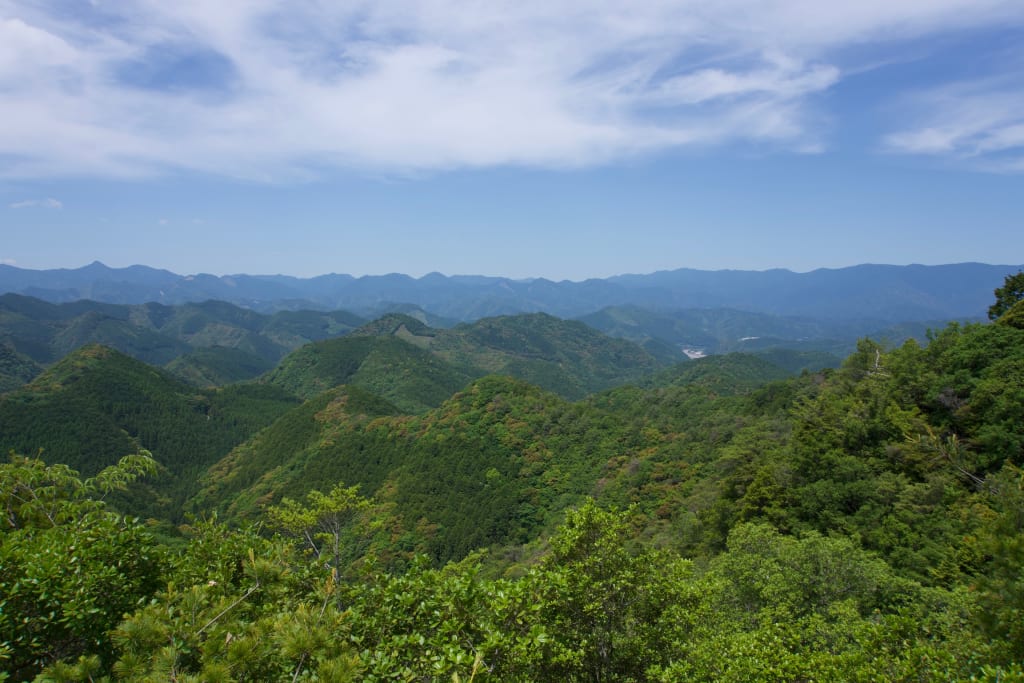
Enjoy a snack at the Hyakken-gura viewpoint.
The trail is very well maintained and there is one set of bathrooms at around the halfway point of the hike, where the trail encounters the paved road.
With an hour of the hike still remaining, you'll exit the forest and enter a tiny village called Koguchi. At this point, it's helpful to have the route downloaded on AllTrails. This route will guide you to public restrooms and a cafe where you can grab a beer or a snack.
Stay overnight in Koguchi or Kumanogawa Hitari
If you're staying in Kumanogawa Hitari like we were, you'll want to take the bus from Koguchi to Kanmaru. The walk is over an hour long along busy roads and you'll be exhausted from a long day of hiking. The bus is quick, around 10 minutes, and the bus stop is very close to the ending point of the hike.
We stayed at Sansaro Cafe and Guesthouse and absolutely loved our experience here. Our host welcomed two other guests and cooked us all a lovely dinner. We chatted with our fellow hikers over a home-cooked meal and ended the night at the public onsen, which was a short 10 minute walk from the guesthouse.
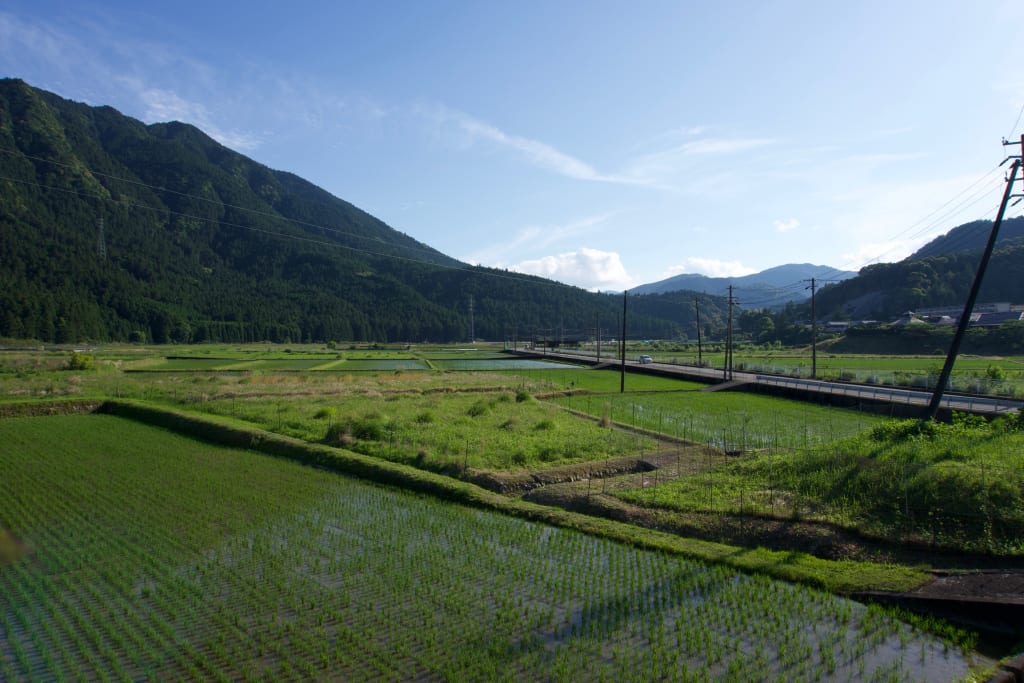
The view from our accommodations.
We stocked up on snacks and water at a convenience store a short walk away so we could get an early start the next morning.
Day 3: Hike Koguchi to Nachi (the Ogumotori-goe section)
Take the bus from Kanmaru to Koguchi if staying in Kumanogawa Hitari
We caught the first bus at 7:17 AM.
Start hiking in Koguchi
Our stats: 10 miles, 4,000 feet of elevation gain, 7 hours total according to Alex's Garmin watch, with 6 full hours of active hiking time.
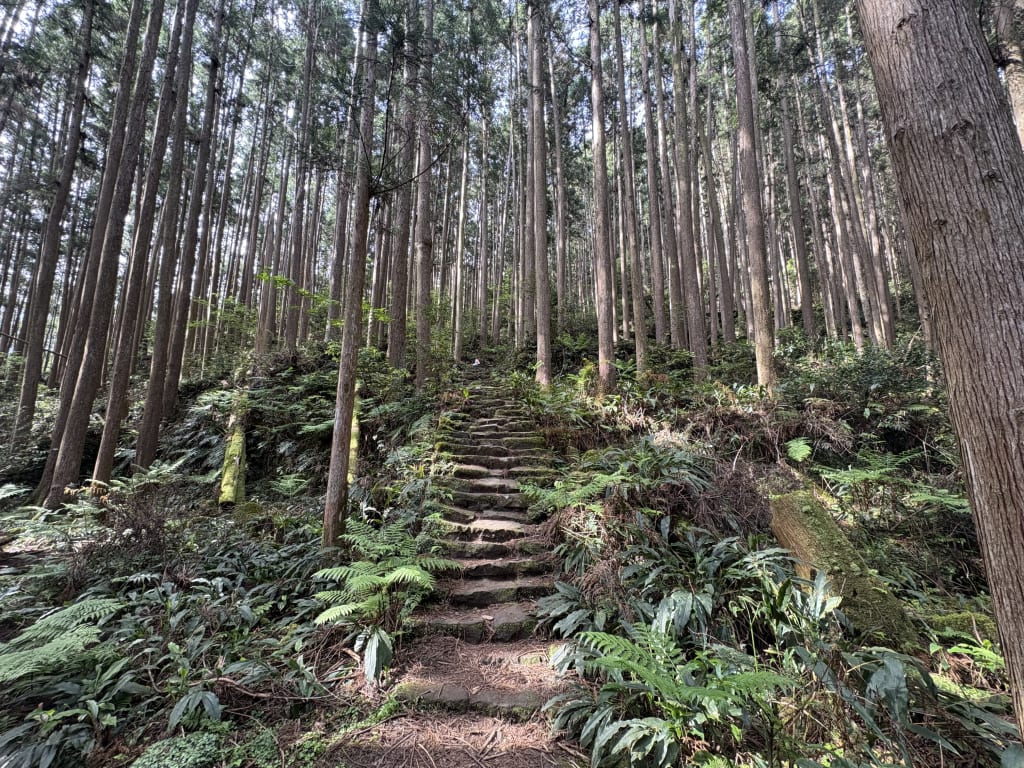
Be sure to download the route on AllTrails before you start. There are bathrooms and a vending machine with beverages roughly halfway through the hike.
Finish the hike in Nachi
Explore Seiganto-ji, Kumano Nachi Taisha, and Nachi Falls.
Stay overnight in Nachi, if possible, and Kii-Katsuura if not
We snagged a reservation at Mitaki Sanso Traditional Minshuku, just a 5 minute walk from Nachi Falls.
Day 4: Transportation to Osaka (and Beyond)
Optionally explore the tuna market in Kii-Katsuura
We don't necessarily recommend this, as we were personally quite tired after two days of trekking! Other guests at our hotel checked it out though.
Bus from Nachi to Kii-Katsuura (20 minutes)
No need for advanced reservations. Here is the bus schedule.
Train from Kii-Katsuura to Osaka (4 hours)
You should have picked up the tickets on Day 1. If you arrive early at the train station like we did, you can use the ticket kiosk to make a same-day reservation change for free.
The train hugged the coastline for the first hour or two, making the ride quite scenic!
Travel onwards to your next destination
We returned to Kyoto.
HOW TO BOOK ACCOMMODATIONS
I'm not going to lie. Booking accommodations for the Kumano Kodo stressed me out. I was planning on short notice, only 10 weeks out, and I made the mistake of trying to work with the Kumano Travel website. That website was a headache and a half.
For starters, there's no way to filter based on dates to see which accommodations are still available, so I had to click into every hotel in every town, then click the dates available, and write on a note on my phone which hotels were available in which towns on which dates until I found one hotel in each town I was planning to stay in that were available on three consecutive days. That took two hours.
To make matters worse, you can't just make a reservation on the website. You can submit a reservation request and they will email you one month later to let you know if your hotels are available or not. That was not a typo. I had to wait an entire month to hear back, and my first choice accommodation wasn't available at that point. Good thing I decided to take matters into my own hands in the meantime and look for alternatives.
I highly recommend using Booking.com and Airbnb to make your reservations.
Specifically, start looking for accommodations in Koguchi first. This is where you'll stay after the first full day of hiking, Day 2 in the itinerary, and it's the smallest town with the fewest accommodation options. Koguchi was fully booked out 10 weeks out when I looked, but I found this Airbnb in nearby Kumanogawa Hitari which was fantastic. Once I found a date with availability in Kumanogawa Hitari, I planned the dates of my entire Japan itinerary around that.
Search Koguchi on Airbnb. Many of the smaller towns won't show up in search results. Read the property descriptions carefully and make sure the accommodation is near Koguchi. Sometimes Nachi properties appear in the search results, but that's the town you'll be staying in the day later.
Working backwards, you'll now want to secure accommodations for Day 1. We recommend staying in one of the onsen towns, Yunomine Onsen, where we stayed, or Kawayu Onsen. If there's no availability, try nearby Hongu. It's a larger town and it's the starting point for Day 2's activities. We stayed at J-Hoppers in Yunomine Onsen and loved it, especially the private onsen. We were also happy that they provided free rice porridge for breakfast.
Last on the list, look for accommodation in Nachi, the ending point of the hike, for Day 3. We stayed at Mitaki Sanso Traditional Minshuku. If there's no availability in Nachi, try Kii-Katsuura. It's a much larger town and you should have no issues finding somewhere to stay.
STAYING IN RURAL JAPAN: RYOKANS AND ONSENS
Part of what makes the Kumano Kodo special is that it's not just a hike with a crazy viewpoint. It's a hike with a rich history and deep cultural immersion to this day.
One of the most memorable parts of the experience was staying in ryokans, traditional Japanese inns. In a ryokan, you'll sleep directly on futons laid out on the floor on top of tatami mats. You'll be provided with kimonos and slippers to wear around the property.
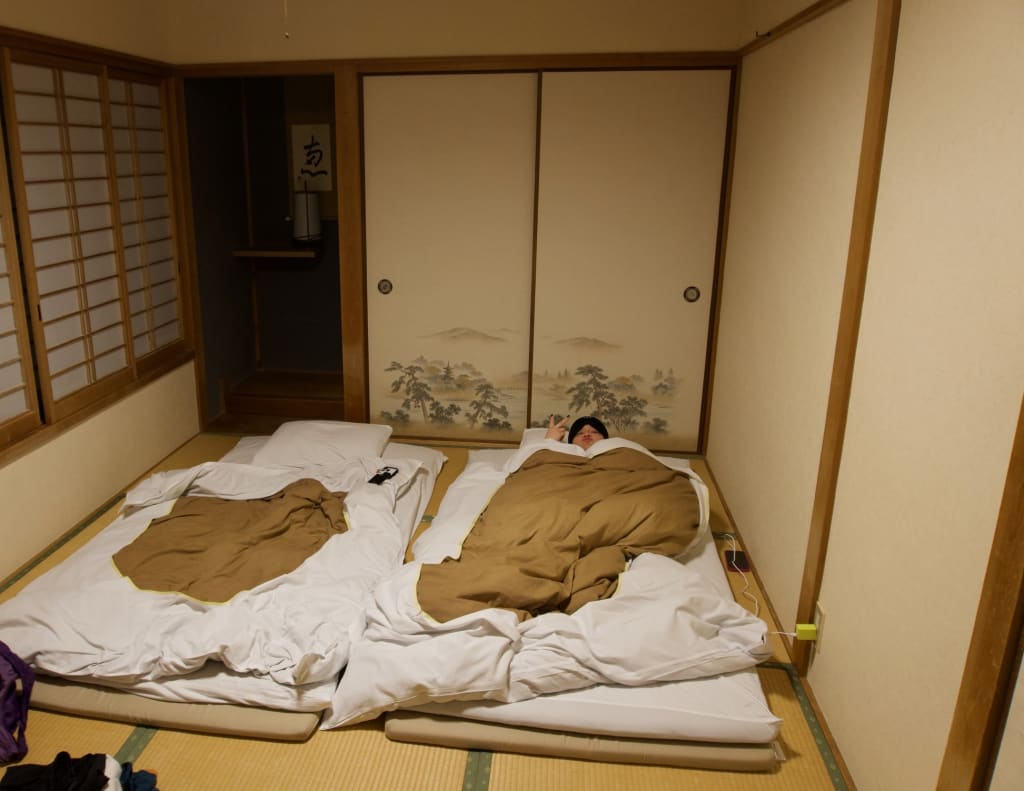
And, instead of showering in en-suite bathrooms, you'll bathe in an onsen. Onsens are traditional hot springs and bathing facilities. Some ryokans offer private onsens that are more comfortable to Western travelers, like J-Hoppers. Others recommend nearby public onsens that the locals use.
Now you might be wondering what, exactly, a visit to a public bathing facility entails, so I'll break it down. Onsens are gender-separated. In a changing room, you'll strip down until you're naked. In many facilities, bathing suits are prohibited. Then you'll wash with soap and water at one of the shower stations in the main area. Afterwards, you can enter the hot springs. Some facilities have indoor and outdoor onsens you can choose from.
Many onsens have strict rules against entering onsens if you have tattoos, so be sure to ask if tattoos are okay before entering.
I bathed in a public onsen twice. I got quite lucky, because while I encountered a few women in the changing rooms on their way in or out of the onsen, I had the onsen itself to myself both times. I recommend stepping outside of your comfort zone and giving it a try. It's an authentic cultural experience and it's not as strange for the locals as it is for Westerners, so it won't be awkward even if you share the space with other people. If you truly don't feel comfortable giving it a go, I'd recommend bringing body wipes with you on the hike and using those instead.
BEST TIME OF YEAR TO HIKE
For the best weather, I would hike between late March through the end of May. There's also a brief window between the end of October and November that is quite pleasant.
If at all possible, I would avoid the months of July through September, as the risk of typhoons is at its highest in addition to the weather being hot, humid, and rainy most days. December through February is also less than ideal with colder weather and shorter days.
Be prepared for rain no matter when you choose to hike, as it comes and goes quite quickly in this region. Bring rain coats, dry bags, and ponchos to protect yourself and your gear. I'd also pack extra hiking socks so you're not sloshing around in wet socks all day if it rains in the morning.
OUR EXPERIENCE
Day 1
We were this close to abandoning our plans to hike the Kumano Kodo before we even arrived on Day 1. It felt as though the universe was conspiring to prevent us from doing this hike at all costs and we were ready to take the signs as we saw them.
After taking a short 15 minute bullet train from Kyoto to Osaka, we boarded our next train which was set to depart for Kii-Tanabe. An announcement started playing over the speakers: the train was delayed four hours because a tree had fallen in the tracks. We were instructed to speak with the customer service desk for alternate arrangements.
We spent 15 minutes Google translating back and forth with the customer service desk until we aligned on a Plan B: take the train to Namba Station, catch another train to Wakayama there, and finally catch a third train in Wakayama that would bring us to Kii-Tanabe. Sounds simple enough, right?
We made it to Namba just to encounter a new issue. The train to Wakayama was delayed as well, this time because a person had tragically been hit by a train. The train was delayed for a whopping 12 hours. At this point I was asking myself: How exactly did Japan's transit system get its reputation for impeccable punctuality and no delays?
Now we had to take a gamble. We could head back to Osaka and try to catch our original train departing four hours late. The issue was, if the train was delayed by even 10 minutes more, we would miss the last bus out of Kii-Tanabe headed for Yunomine Onsen where we were supposed to stay overnight. If we had to wait until the next day to catch the two hour bus, we'd be starting our hike quite late. We'd also have to figure out where to sleep in Kii-Tanabe on the fly.
We were already quite drained by this point, but we weren't ready to give up yet. As I mentioned, this hike was the reason I wanted to visit Japan anyway! Our gamble paid off and the train departed exactly four hours late as planned. We caught the last bus out of Kii-Tanabe with 10 minutes to spare.
It's worth mentioning: all jokes aside, we did just get really unlucky. Trees fall in the tracks somewhat frequently, but for the only other train to the Kii peninsula to also be delayed by several hours was an unfortunate turn of events. I'm just glad we made it.
We spent the night unwinding at J-Hoppers, bathing in the private onsen in the hotel, and eating at You Got It Bar nearby. After such a long day, we were asleep the minute our heads hit the pillow.
Day 2
We got up bright and early at 6 AM. We inhaled some free rice porridge for breakfast and caught the first bus to Hongu at 7:03 AM.
We spent about an hour exploring Oyunahara and Kumano Hongu Taisha in Hongu. We started with Oyunahara, the largest torii gate in the entire world. It was quite stunning, especially with the rice paddies surrounding it.
We then ascended the steep steps up to Kumano Hongu Taisha, one of the three major shrines along the Nakahechi route, alongside Kumano Nachi Taisha and Kumano Hayatama Taisha. What a warm up!
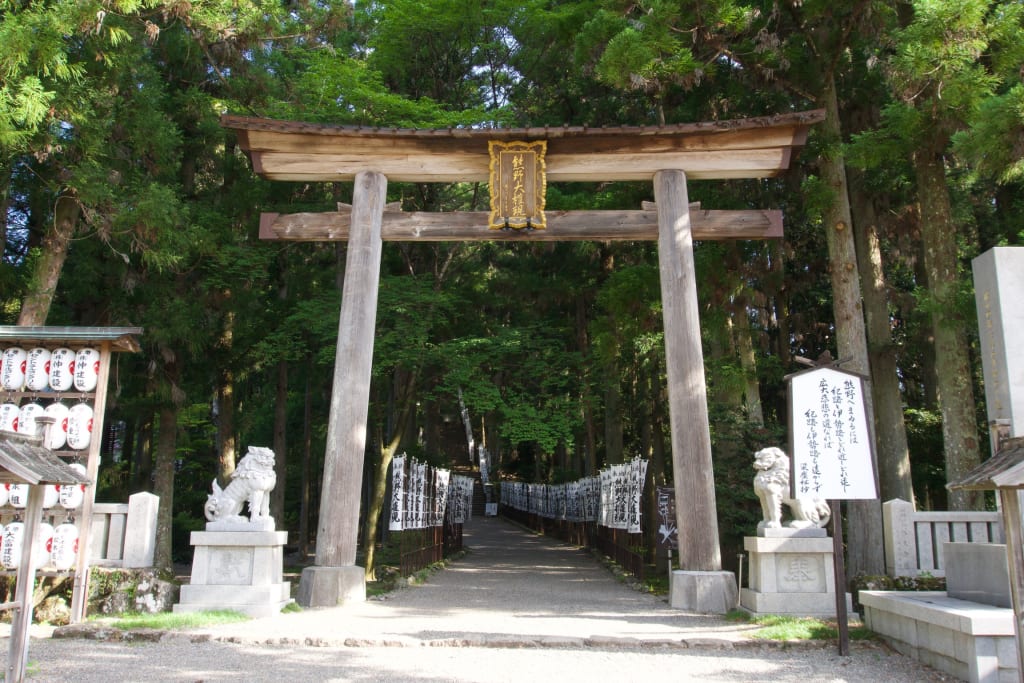
We watched as a man prayed before the shrine. He bowed twice, rang the bell, clapped, then bowed once more. At the shrines and temples we visited in Kyoto and Tokyo, no one was praying. The entire crowd was tourists snapping photos. It was nice witnessing a spiritual moment at the shrine.
We headed back down the steep stairs leading up to the shrine and towards the main road to start the hike towards Ukegawa. In hindsight, I wish we had just taken the bus. The majority of this stretch was along a busy road with nothing interesting to see. The signs leading to the forest were also confusing and the trail wasn't as wide or well maintained as what we found throughout the rest of the hike. We even encountered a snake in the middle of the trail that slithered away as we approached. Take my word for it: you're not missing anything by taking the bus. Conserve your energy for the hike.
From Ukegawa, we grabbed some snacks at the convenience store just a few steps away from the starting point of the trail, and then set off into the forest.
We were immediately surrounded by tall Japanese cedars and the song of the Japanese Bush Warblers.
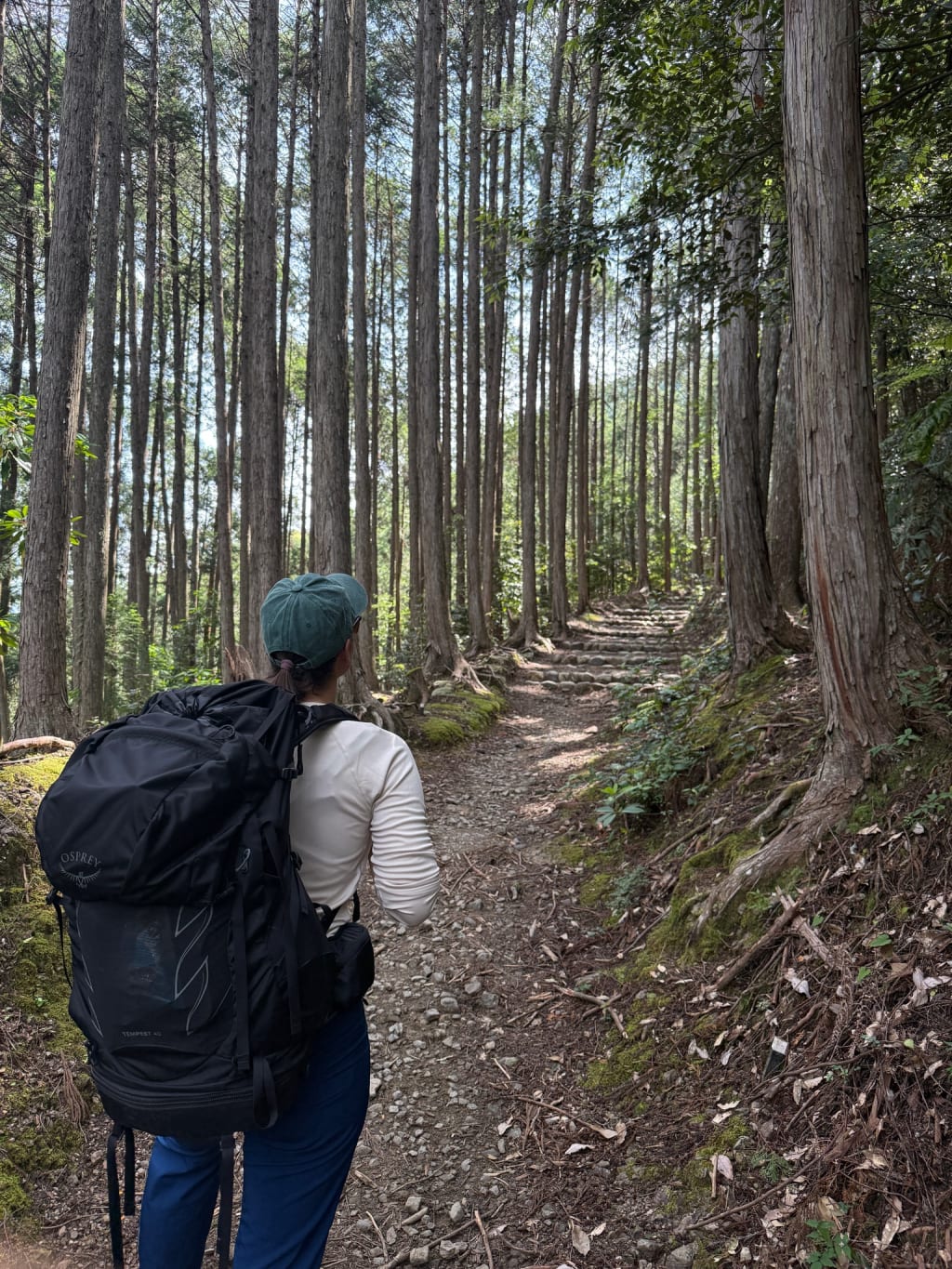
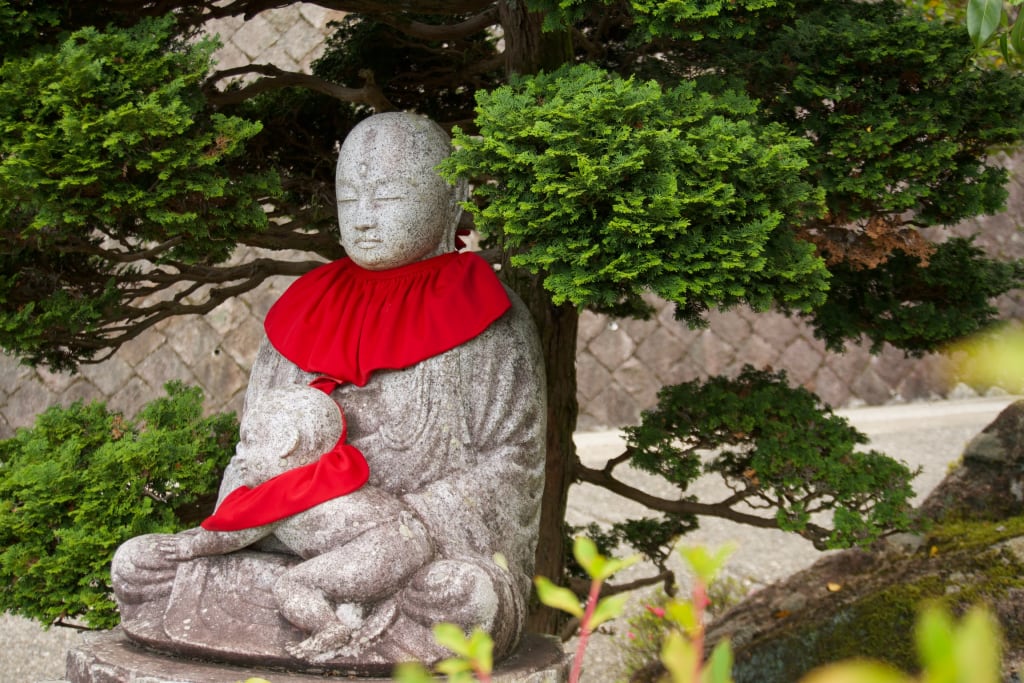
Along the way, we encountered small shrines in the form of stone statues and the remains of old teahouses.
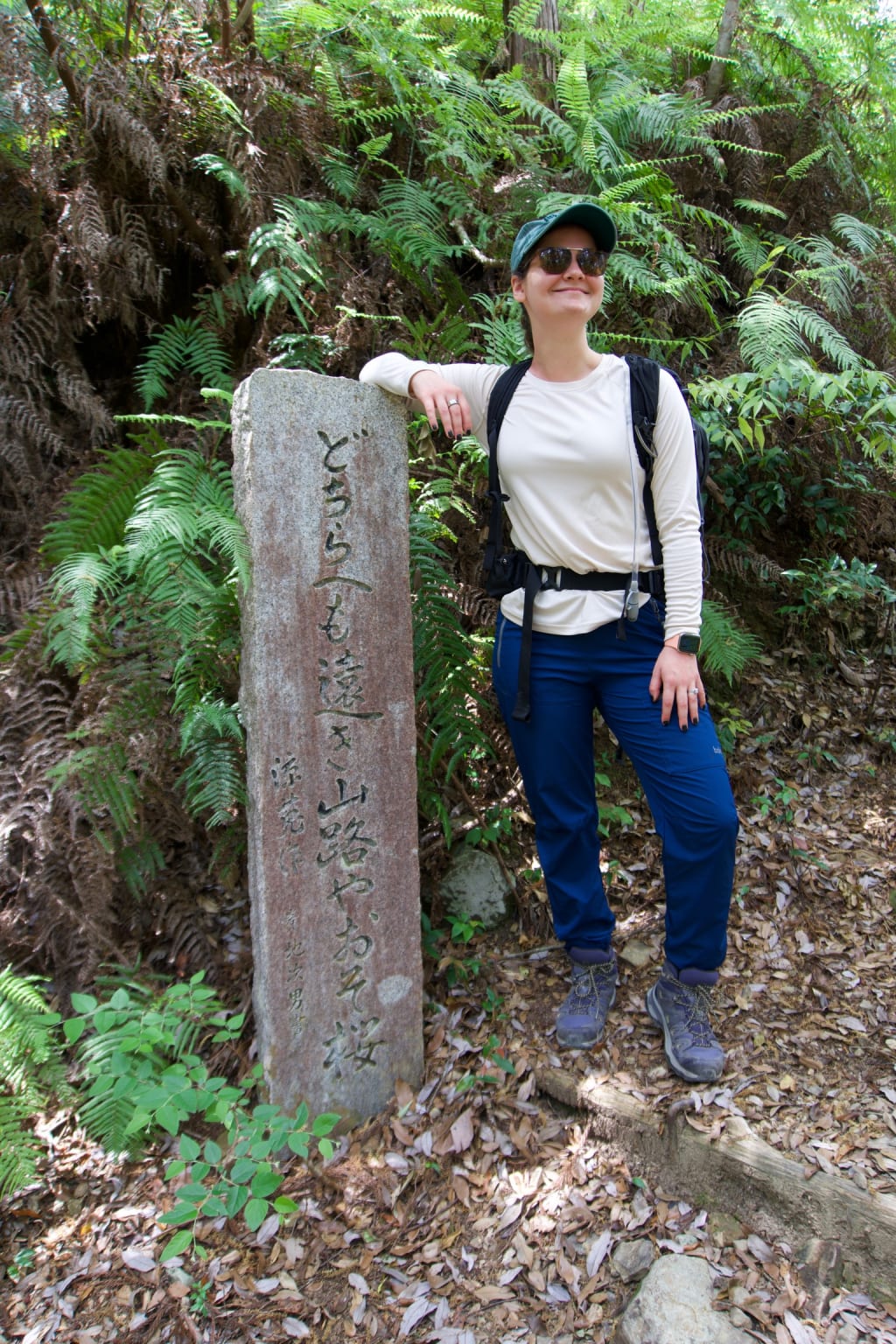
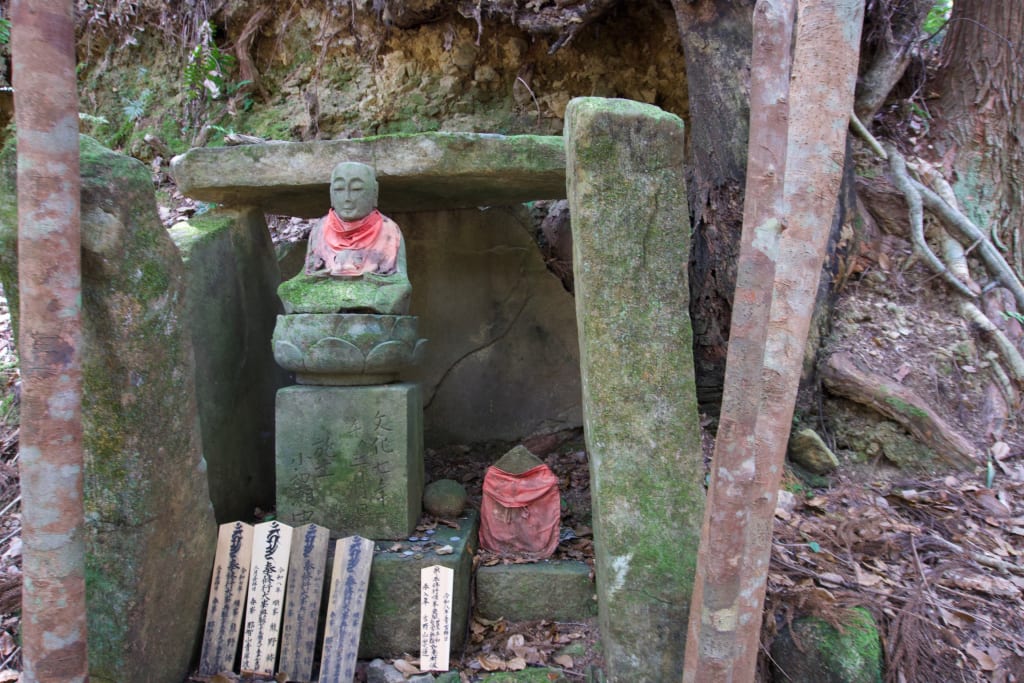
My favorite shrine was the one dedicated to lost souls who die as children and don't have enough karma to make it to the afterlife. I desperately wish I snapped a photo! I did capture this photo of another shrine though.
The other highlight from Day 2 was the viewpoint at Hyakken-gura. We stopped here to enjoy a snack and admire the rolling hills.
After hours of steady inclines and declines, we exited the forest and entered the small town of Koguchi. Alex stopped at the bank of the river to splash his face with the cold water.
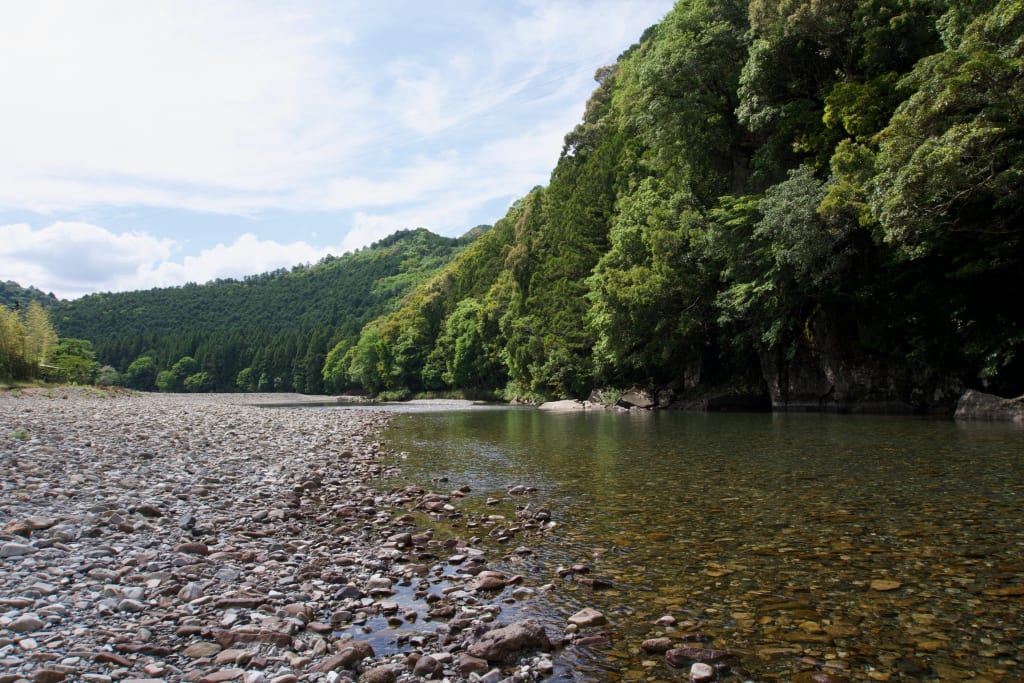
At this point, the AllTrails route Alex downloaded came in handy as there was no signage. We followed the route to the end point: a bar with public restrooms. I collapsed into the chair and refused to move for the next hour. Thankfully Alex was willing to fetch me snacks.
When I was finally ready to move again, we made our way to the Kanmaru bus stop that would take us to the nearby town of Kumanogawa Hitari. We enjoyed a lovely home-cooked meal made by our host and schlepped over to the convenience store to stock up on snacks and water for the next day, as well as a reward for our 10 miles of hiking: frozen soft serve ice cream. Yum!
After dinner, we made our way over to the public onsen. Alex and I were forced to part ways, as the onsens were public and gender-separated. I met a kind woman in the changing room who guided me through the process: strip down here, head into the next room with the public showers, and then soak in the hot springs. Luckily I was the only person in the onsen so I could soak by myself. The hot water felt great on my sore muscles!
Day 3
We woke up at 6 AM sharp in order to scarf down a quick breakfast and make the first bus to Koguchi at 7:17 AM. The forecast called for rain so we were worried we'd end up sloshing through the muddy trails for seven hours straight. Thankfully, we got incredibly lucky and miraculously avoided the rain the whole day.
We started the hike before 8 AM. There were to be no slow starts today. The first two hours of today's trek were through Echizen-toge Pass. Don't just take it from me. The poet Fujiwara Teika wrote, "it's impossible to describe precisely how tough it was" back in 1201.
Despite the steep incline, the first hour of today's hike ended up being my favorite of the entire trail. Gorgeous stone steps wound through the cedars. It was simply beautiful.
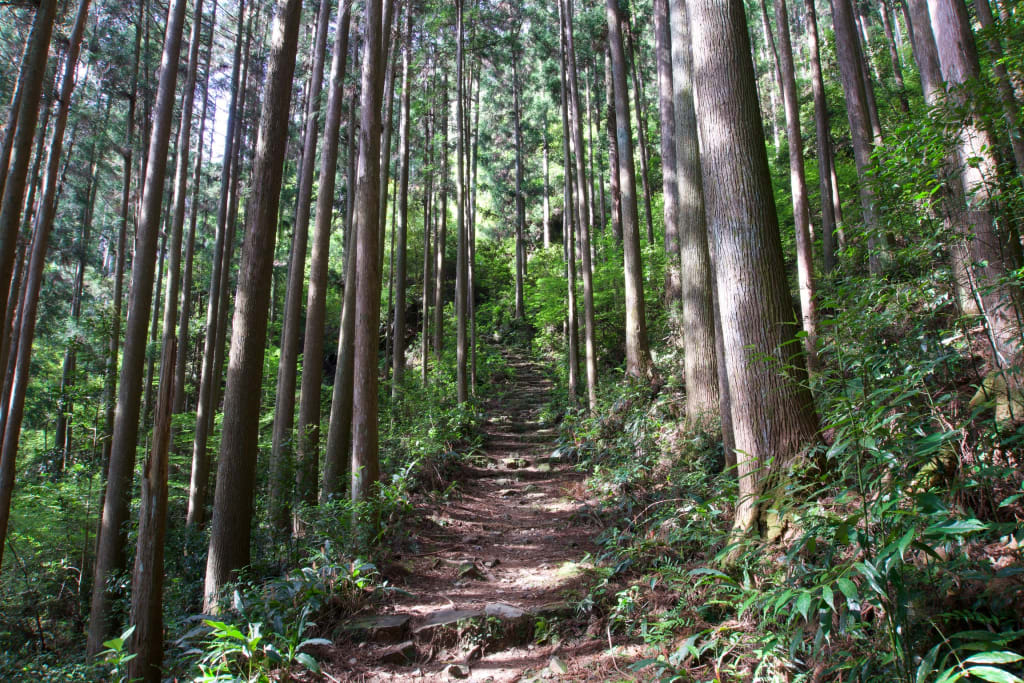
By the second hour, though, the thrill had worn off. This hike was grueling! I was stopping quite frequently to catch my breath. Thankfully, just after the second hour, the trail leveled out and we continued onward.
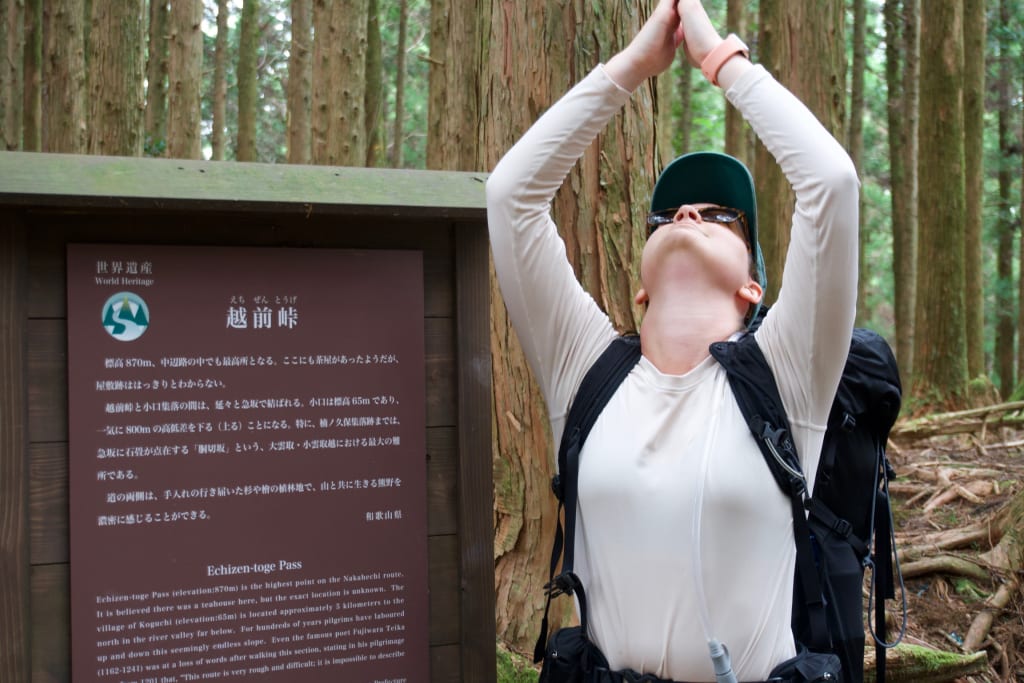
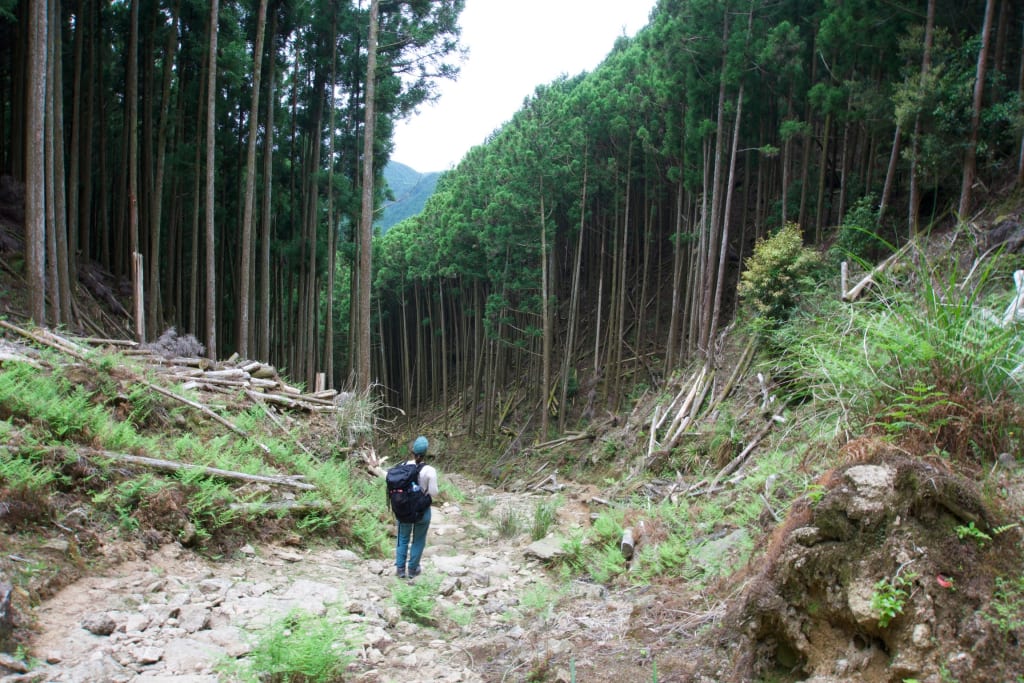
I found the Kumano Kodo to be quite a spiritual place in general, with all the shrines dotting the path. I found it especially so in the Moja-no-Deai section: the Abode of the Dead. As the sign announces, "tradition holds that those who walk this path may meet a deceased friend or relative coming in the opposite direction." Legend has it that when a traveler tries to speak to the figure, they vanish. I had lost my grandmother just two weeks before, and after reading this placard I found myself subconsciously glancing up ahead a little more often on this section of the trail.
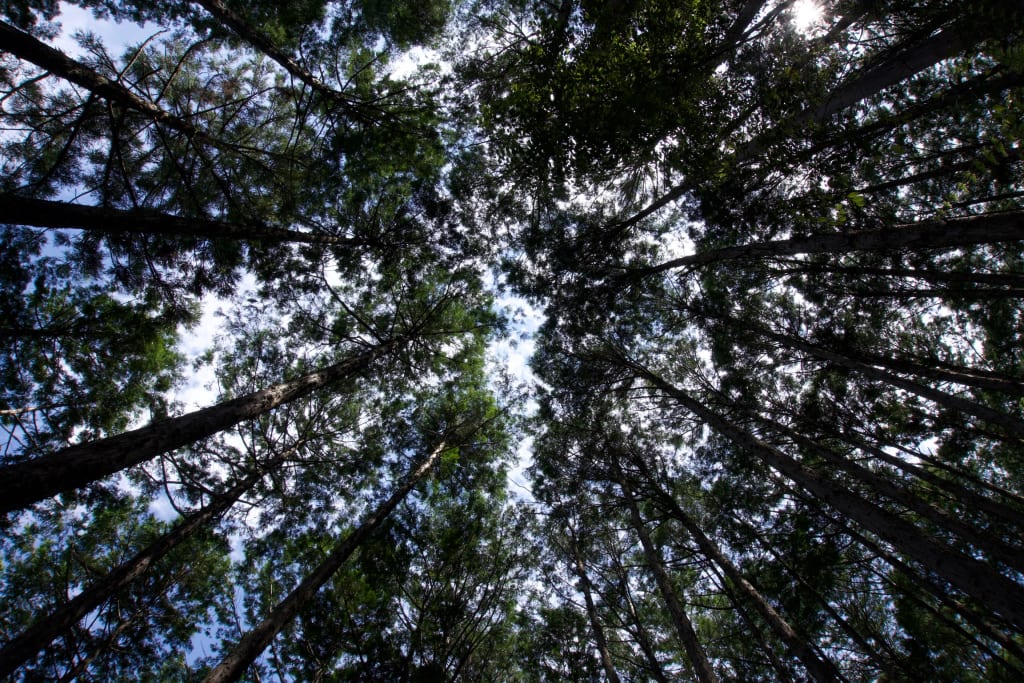
After four or five hours, Alex and I were growing quite tired and a little delirious. We kept cracking jokes to keep the spirits high and to keep the other one focused on anything other than how our legs burned!
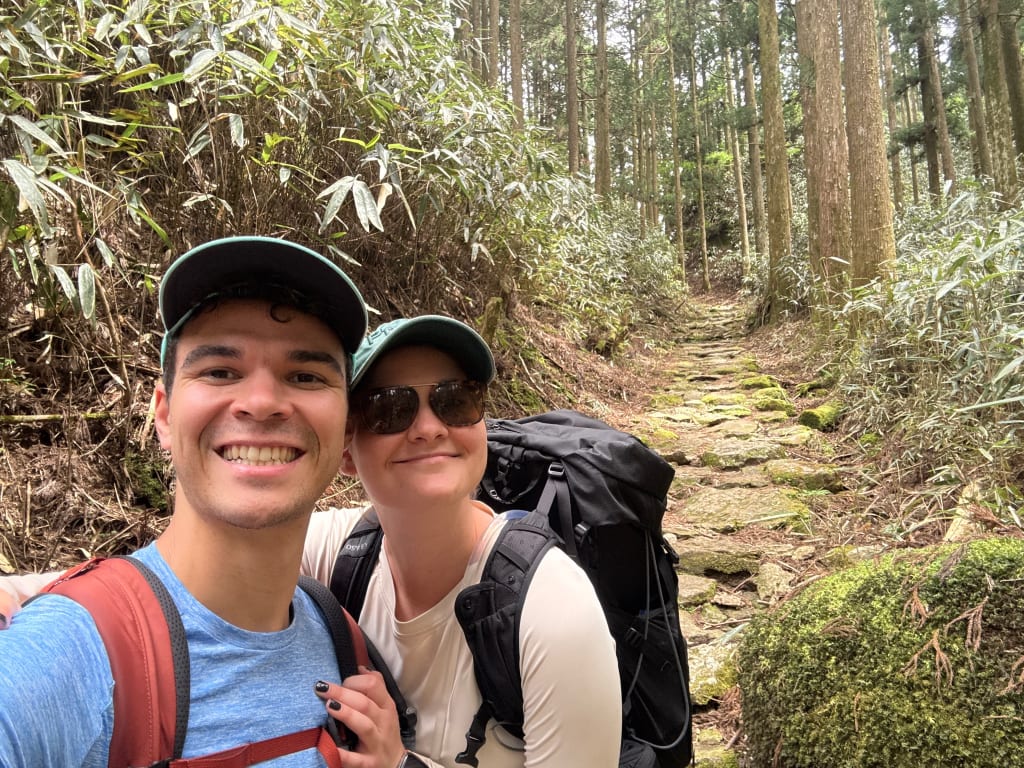
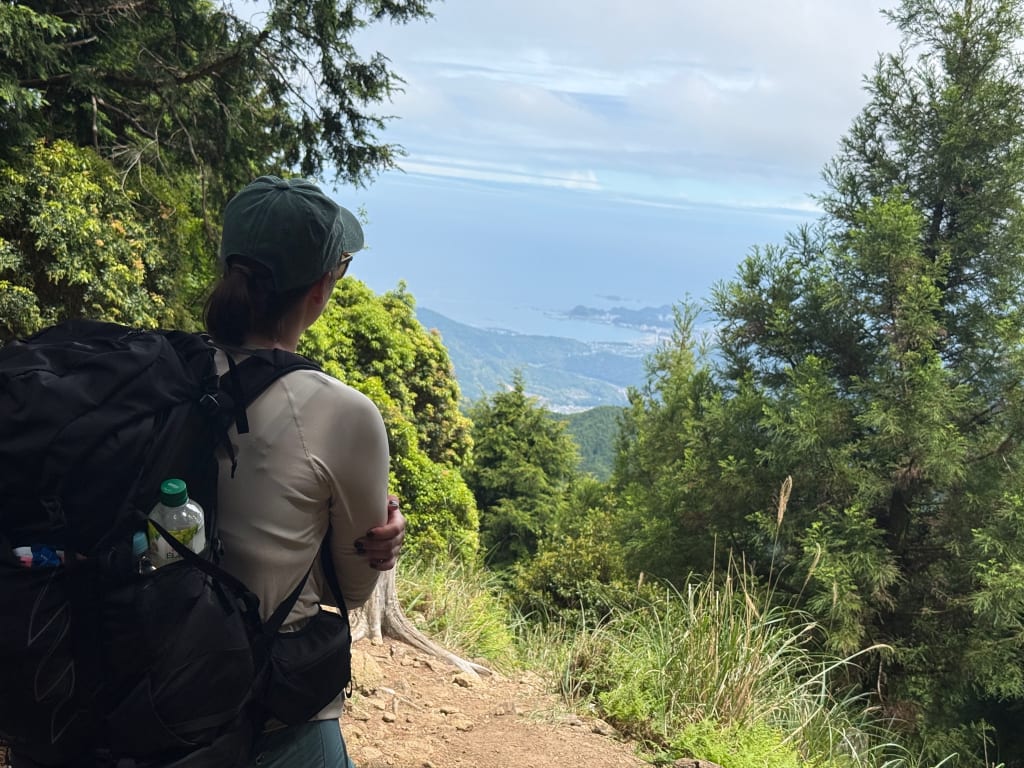
We reached a signpost advertising a small detour to the Funami-jaya Teahouse remains. It was just a few minutes to a nice viewpoint over the coastal town of Kii-Katsuura. Seeing how close we were gave us the jolt of energy we needed to finish the hike.
After seven hours, we made it to Seiganto-ji, a large, orange pagoda which stood beside Nachi Falls, surrounded by rolling green hills and Buddha statues.
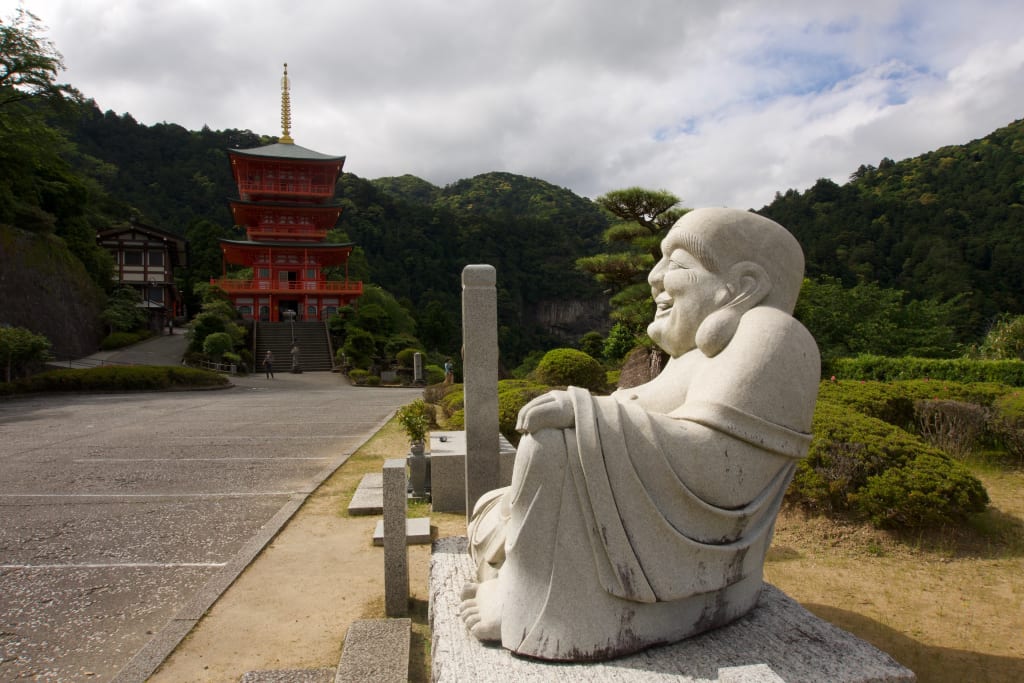
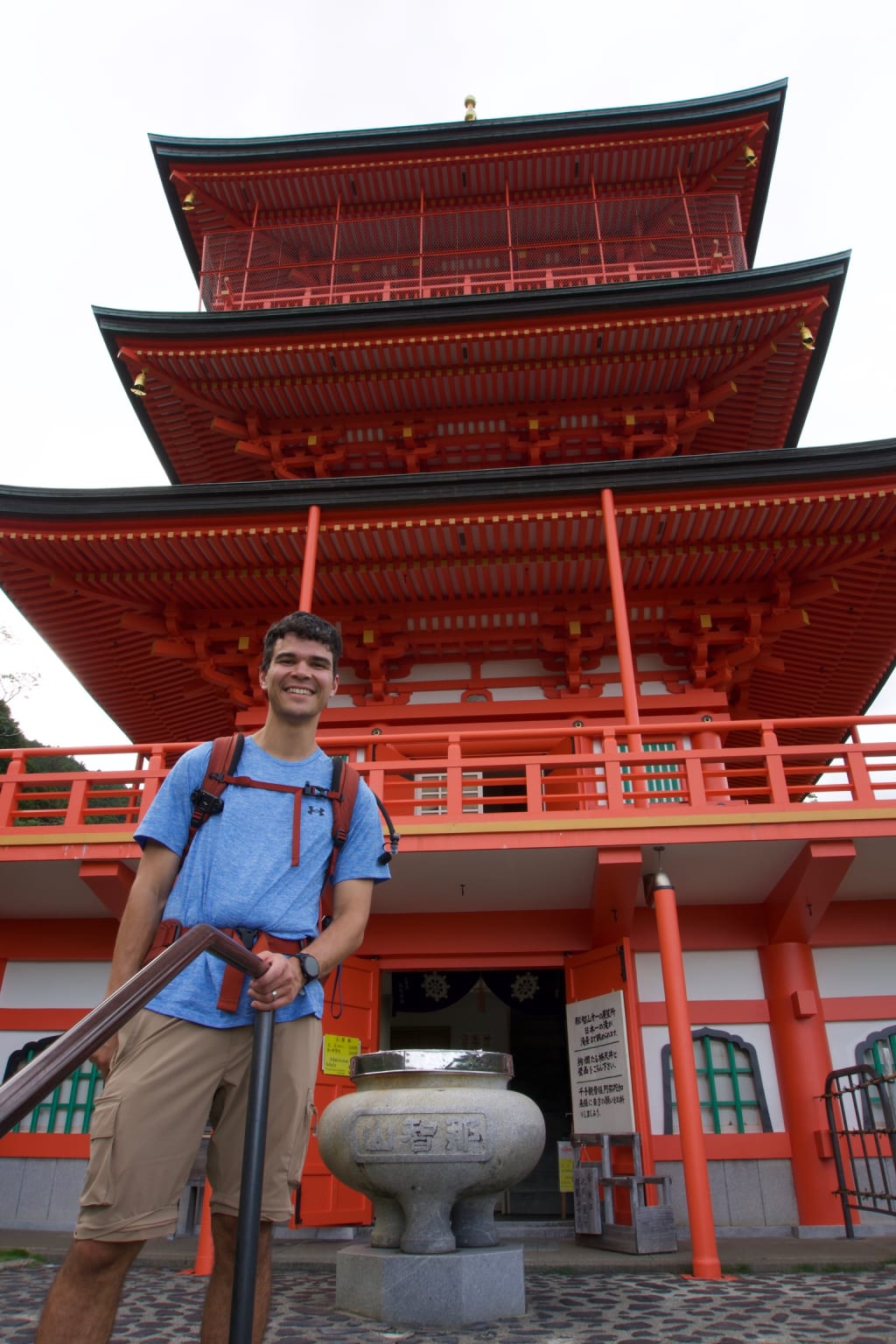
If you turned 180 degrees, you could see the ocean. It was stunning, and we practically had the entire place to ourselves. Fewer than five other people wandered the grounds with us and it was smack in the middle of the day at 3 PM!
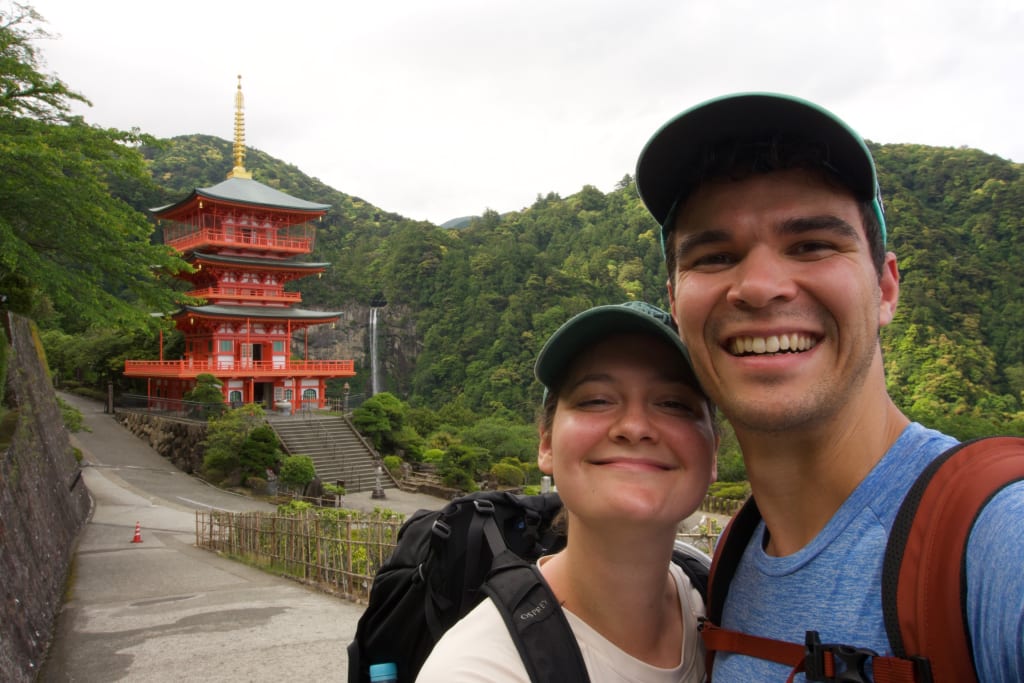
After the pagoda, we explored the base of Nachi Falls.
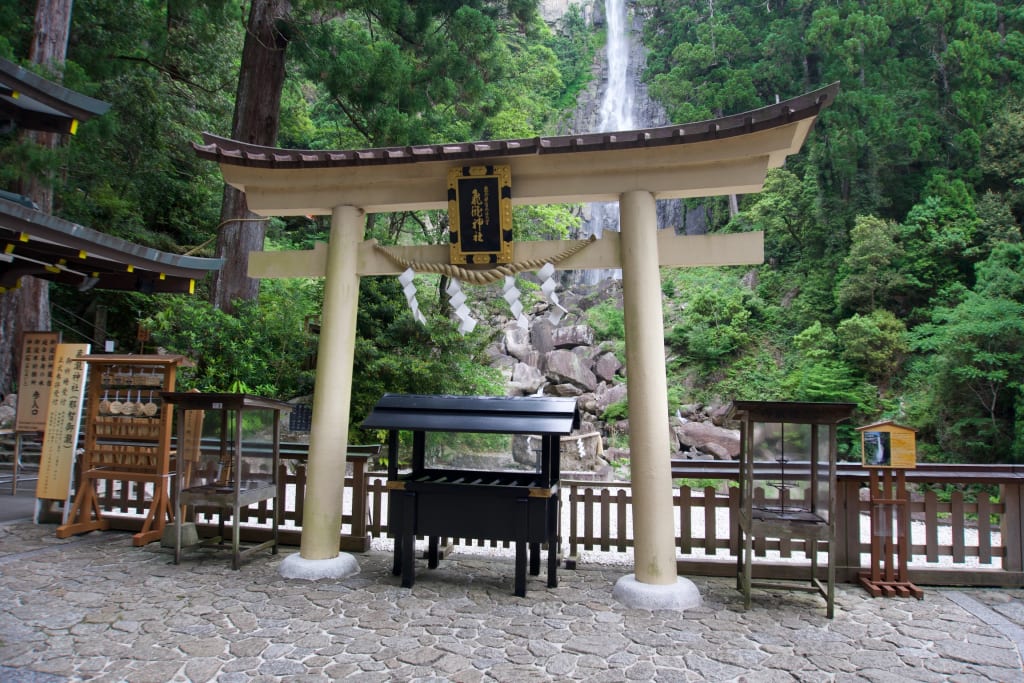
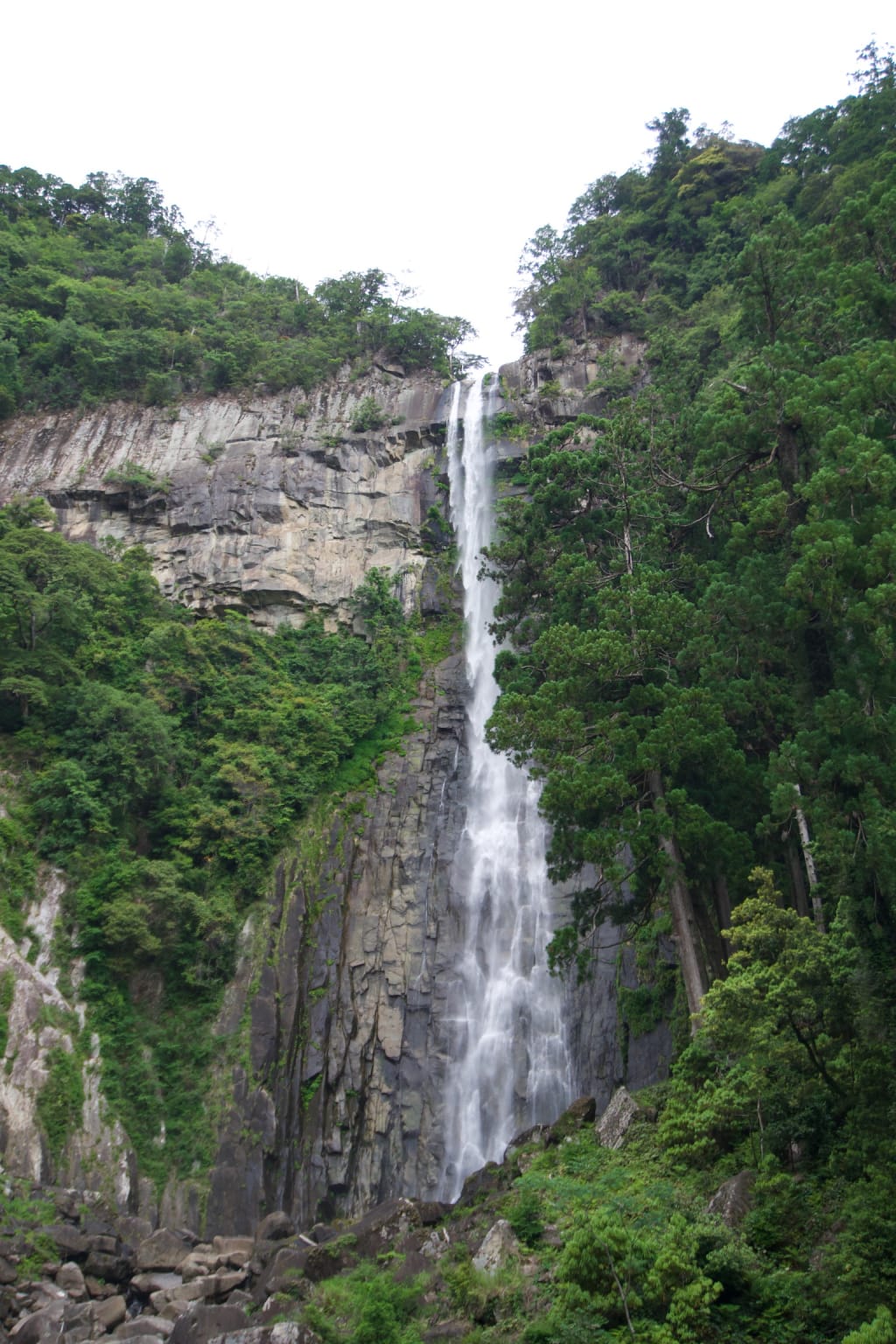
This involved going down, and eventually up, a giant flight of stairs. It was a tough sell, but it was worth it.
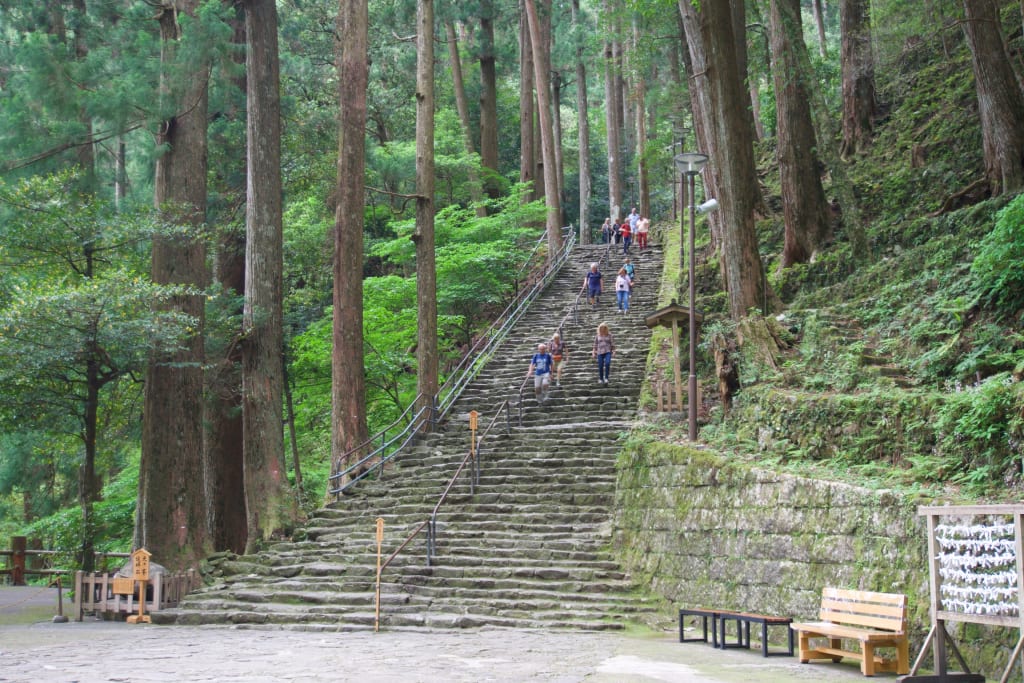
With the very last ounce of energy we had left, we hobbled over to our hotel for the night, Mitaki Sanso Traditional Minshuku, which was thankfully only a short 5 minute walk away. We had bento box dinners, bathed in the public onsens, and went to bed early. Our hotel offered unlimited free ice creams, so we each took two. Don't judge us! It's part of the experience, okay?
We were beyond elated that evening. Between the chaotic train trip a few days earlier and the dismal weather forecast calling for downpour the entire day today that we somehow avoided, things were not always looking so rosy. But we managed to have a phenomenal experience doing this hike that had been on my bucket list for years and I couldn't be happier!
Day 4
I feel almost evil saying it, but we were happy when it downpoured the entire next day. It just made us appreciate our dry feet the day before even more, plus we planned to spend the entire day on the train anyway. This could have been what our hike was like yesterday, but it wasn't. It almost felt like the universe was rewarding us for pushing through all the chaos on Day 1.
Otherwise, thankfully, the day was relatively uneventful. There were no delays and we made it back to Kyoto in time to enjoy a nice dinner and collapse into bed nice and early.
IS IT WORTH IT?
This hike is absolutely worth going out of your way and even planning your entire Japan trip around. This hike brought us to Japan and it didn't disappoint.
The only downside of this hike is the scenery doesn't change too much along the way, but it wasn't about the views. It was about the spectacular start and end points, seeing the Japanese countryside, exploring ryokans and onsens, feeling the serenity of the forest, the physical challenge, and being far, far away from the crowds.
I smile every time I think back to all the amazing memories we made doing this hike and it was the top experience in one of my favorite countries on planet Earth.
FAQS
What should I pack?
Here are a few essentials worth highlighting:
- Cash! Many restaurants or buses don’t take credit cards or Suica cards.
- Rain ponchos, dry bags, rain coats, and waterproof shoes. It rains year-round.
- Bandaids for blisters
- Body wipes (in case you’re uncomfortable with onsens)
- 40 L hiking backpack
Here is my complete packing list, excluding the items already mentioned above:
- Advil
- Pepto-Bismol (in case of traveler’s diarrhea)
- Prescriptions you might need
- Electrolyte packets for hydration
- 2 hiking outfits (sports bras, underwear, quick dry pants, T-shirts or long-sleeves)
- Merino wool hiking socks (bring at least 5 pairs)
- Hiking boots
- PJs
- Flip flops
- Baseball cap
- Passport
- Credit card
- Phone charger
- Shampoo
- Body soap
- Makeup
- Makeup remover wipes
- Deodorant
- Toothbrush and toothpaste
- Hair brush
- Bug spray (we didn’t use this, but better to have it and not need it)
- Toilet paper
- Hand sanitizer
- Sunglasses
- Water bladder
- Eye mask
- Bag (to separate dirty and clean clothes in backpack)
- Ziploc bags (for trash)
- Camera gear
- Snacks
Do I need hiking boots?
We always wear hiking boots and we recommend them. That being said, the trail is generally well maintained and not technical, so you can wear sneakers if preferred. However, you'll want to have waterproof footwear since rain is quite common.
Are there food options for vegetarians?
I was particularly worried about this, as I read that vegetarianism isn't very common in the Japanese countryside. Thankfully, I had plenty to eat. In Yunomine Onsen, there was a vegetarian rice and vegetable dish at You Got It Bar in town, although it didn't have any protein. At Sansaro Cafe in Kumanogawa Hitari, my host cooked me a vegetarian dinner with beans. In Nachi, my hotel made some swaps in the bento box they offered. There are also lots of convenience stores along the way where you can pick up snacks. I also recommend bringing some high-protein snacks for lunches. I brought dried edamame and chickpeas with me for an added boost of protein.
One thing to note: It's imperative that you share your dietary restrictions at the time you make your booking. They will likely not be able to accommodate last-minute dietary restrictions or food requests. It doesn't hurt to send a reminder a week before your reservation as well.
How much water should I carry?
You should carry enough water for the entire hike on both hiking days, although there is a vending machine in the middle of the second day with some beverages. Depending on the heat and humidity, I would recommend carrying between 3 and 4 L, although I drink a lot of water. The second hiking day, Day 3, was particularly strenuous.
Are there convenience stores I can buy snacks or water from?
Yes. There are convenience stores in Ukegawa and Hongu at the beginning of Day 2. We purchased water directly from our hotel, J-Hoppers, in Yunomine Onsen and got snacks in the convenience store at the trailhead in Ukegawa. There's also a convenience store in both Koguchi and Kumanogawa Hitari at the end of Day 2 where you can buy supplies for Day 3.
What is the bathroom situation along the hike?
There is one set of bathrooms at roughly the midpoint of the hike on both hiking days, but that means there will still be stretches of up to 3 hours with no bathrooms. The trail is narrow and there will be limited spots to pull over for a bush pee, although there will be options in case of an emergency. Thankfully the trail is not crowded at all. If you do step off the trail, make sure to watch your step. We did see a small snake at one point.
Is the trail crowded?
Not at all! Despite how hard it is to get hotel reservations, it was delightfully uncrowded when we hiked in mid-May, a popular time to hike. We had a few hours on the second day where we didn't see a single other soul, and we saw about 12 people total on the entire first day.
How far in advance should I book hotels?
Due to the limited availability in some of these small towns, you should try to make reservations as far out as possible, ideally 6 months out. However, don't let it deter you if you want to hike and haven't made reservations sooner. We made ours 10 weeks out and another hiker we met in Kumanogawa Hitari made her reservations 5 weeks out. I would recommend staying in Yunomine Onsen, Koguchi or Kumanogawa Hitari, and Nachi. For the best availability on short notice, check Hongu, Kumanogawa Hitari, and Kii-Katsuura.


