
Why Hiroshima Should Not Be Missed (Day Trip from Kyoto)
I recognize that when most people dream about a vacation, they're not envisioning depressing museums or learning about dark chapters in world history.
But a major reason I travel is to better understand the world. Sometimes that means hiking through beautiful landscapes or seeing incredible wildlife. Other times, it means learning about devastating events that shaped human history and help me understand the world as it is today.
So no, I wouldn't describe a visit to Hiroshima as "fun." But I will tell you it was one of the most impactful travel experiences I've ever had and should not be missed on a trip to Japan.
WHAT HAPPENED IN HIROSHIMA?
It was a Monday morning at 8:15 AM. The residents of Hiroshima were commuting to work. Schoolchildren lined the streets, helping with war-related construction projects. In just a few seconds, the lives of Hiroshima's 420,000 residents would change forever.
The United States dropped the world's first atomic bomb on Hiroshima on August 6th, 1945. Three days later, they dropped the second in Nagasaki.
In Hiroshima alone, 140,000 people would die from the impacts of the bomb by the end of 1945. Some would die instantly, especially those within 1 km of the hypocenter. Others suffered from burns, injuries, and radiation exposure and died in the weeks that followed. To make matters worse, this horrifying statistic actually drastically underestimates the true impact of the bomb. Thousands of people would die in the years that followed from cancer caused by radiation. Even those who survived would suffer from ailments or the social stigma that came with being from Hiroshima. The survivors often reported having a hard time finding marriage or employment prospects for the rest of their lives.
Before visiting Hiroshima, I couldn't fully grasp how much more devastating an atomic bomb was compared to the other bombs dropped throughout the previous years during World War II. Now I understand that this bomb was in a league of its own. An ordinary bomb destroys a building. This bomb destroyed a city. It burned human skin as far as 3.5 km from the hypocenter. It broke glass windows as far away as 27 km away. It took the lives of hundreds of thousands of people. It changed the course of history. In my opinion, the dropping of the atomic bombs in Hiroshima and Nagasaki were among the most catastrophic events in modern human history.
SOME RELEVANT HISTORICAL CONTEXT
It was July 1945. Germany had surrendered two months earlier, but the United States was still at war with Japan. The US issued the Potsdam Declaration asking Japan to surrender. Japan did not accept.
The US considered a few options to end the war in the Pacific. The first was to invade Japan on the ground, but military leaders worried the casualties would be enormous. They could allow the USSR to enter the war with Japan, but relations between the former allies were deteriorating as they negotiated the post-war order in Europe. The third option was to use the atomic bomb they spent $2 billion (the equivalent of $30 billion today) developing with the Manhattan Project. This is the option they moved forward with.
Proponents argued that, despite its devastating human cost, the bomb would prevent even greater casualties on both sides by bringing the war to a rapid end. Historians continue to debate this to this day.
The bombs were dropped on August 6th and 9th, and Japan surrendered on August 15th.
The United States picked Hiroshima as a target in part because, up until that point, the city had not been bombed, so that they could fully understand the impact of the atomic bomb they were dropping by studying the devastation in the city after the bomb was dropped. If they dropped it in a city that had been heavily bombed, such as Tokyo, it would be more difficult to understand the impact.
WHY THIS IS RELEVANT TODAY
The bombings of Hiroshima and Nagasaki marked the beginning of the nuclear age. After the United States demonstrated the power of nuclear weapons in 1945, the Soviet Union accelerated its own nuclear program, successfully testing a bomb in 1949. Over the following few decades, several other countries developed nuclear arsenals as well, including the United Kingdom, France, China, India, Pakistan, Israel, and North Korea. By the mid-1980s, the world had nuclear stockpiles capable of killing every human on the planet multiple times over.
Today, nine countries possess nuclear weapons. South Africa also developed nuclear weapons but voluntarily gave them up and dismantled them.
Since the bombings in Japan, the United States and five other countries developed a bomb estimated to be 625 times as powerful as the atomic bomb: the hydrogen bomb. This bomb was tested in Bikini Atoll in the Marshall Islands and had devastating impacts on the residents there.
Nowadays, there are two schools of thought on nuclear weapons. Supporters of the "nuclear deterrence" theory argue that nuclear weapons discourage conflict by making the consequences of war unacceptably high, so no one is willing to make the first move and use a nuclear weapon. The opposing viewpoint argues that as long as nuclear weapons exist, humanity remains vulnerable. A nuclear war would be devastating. In addition to the immediate destruction and loss of life caused by the blasts, soot and particles from bombs would block the sun's rays, causing temperatures to plummet and triggering a "nuclear winter" that could last for years and cause many people to starve, as we wouldn't be able to produce enough food.
As tensions escalate between the United States and Iran over Iran's nuclear program, the world is once again debating many of the same questions. Should countries possess nuclear weapons? Do they prevent war or make it more likely? It's critical that we as citizens educate ourselves on the topic and understand what is at stake.
IS IT SAFE TO VISIT HIROSHIMA?
After reading about the effects of radiation from the bomb, you might be wondering if it's safe to visit Hiroshima today. It is. In fact, our guide told us that Hiroshima has less radiation exposure than your average city today.
You may be wondering why Hiroshima is safe while places like Chernobyl remain uninhabitable nearly 40 years after the 1986 nuclear disaster. The major difference is that the atomic bomb in Hiroshima exploded in the air 600 meters above the ground, which significantly reduced radioactive contamination in the ground. By contrast, in Chernobyl, the land was contaminated, so radiation is much higher and parts of the Chernobyl Exclusion Zone remain restricted today.
TOP ATTRACTIONS IN HIROSHIMA
Plan to spend at least 3 hours in Hiroshima visiting the "must do" sites. I recommend planning your day in the following order:
Hiroshima Peace Memorial Museum
The Hiroshima Peace Memorial Museum is one of the most emotional, impressive, and informative museums I've visited. It does an excellent job focusing on the human impact of the bomb instead of just the dry historical facts, as well as providing the relevant historical context that will set you up well to understand and appreciate the memorials you'll see. We spent around 2 hours here taking it all in.
Cenotaph
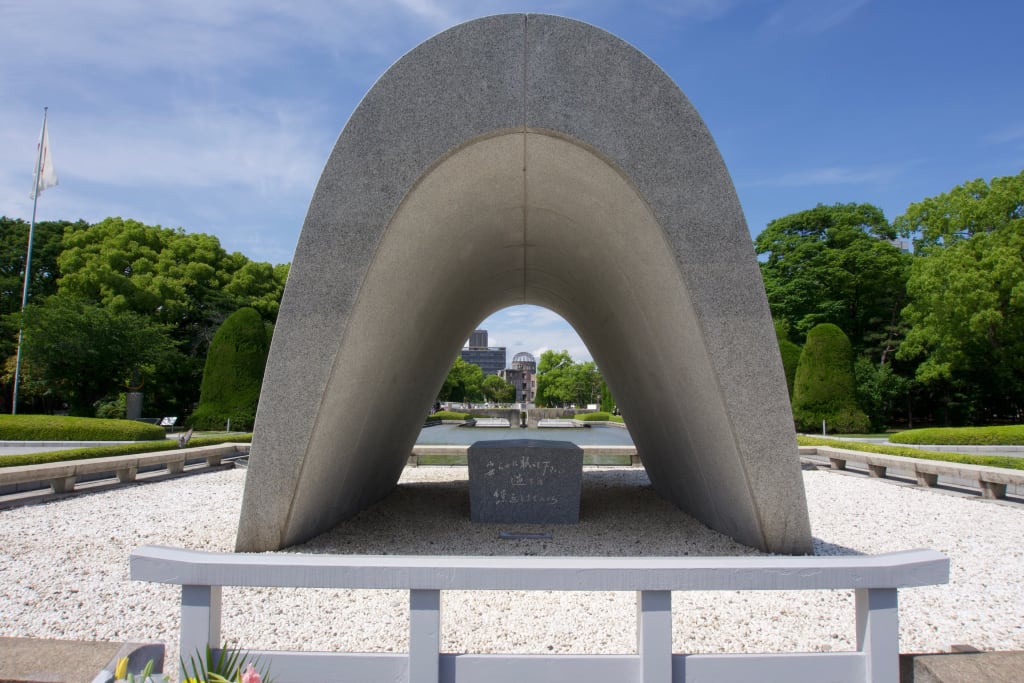
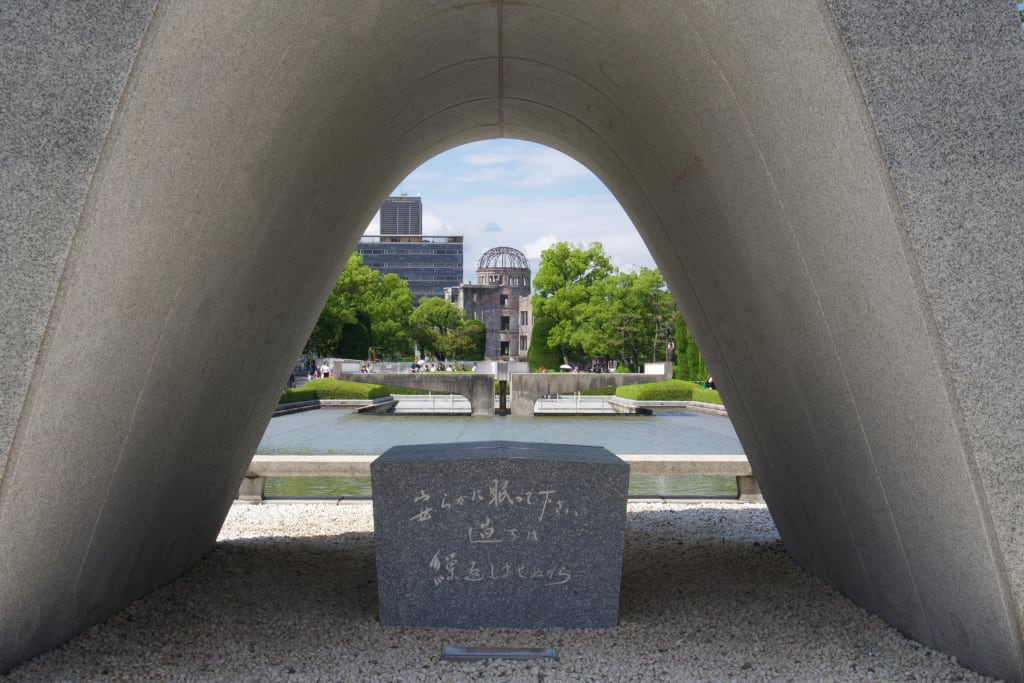
Right outside the museum, there is the Cenotaph: a monument containing all the names of the known victims of the atomic bombing. New names are added each year. Inscribed on the Cenotaph are the words: "Let all the souls here rest in peace, for we shall not repeat the evil."
From the Cenotaph, you can see the A-Bomb Dome and the Eternal Flame, which will burn until all nuclear weapons have been eliminated from the world.
Children's Peace Monument
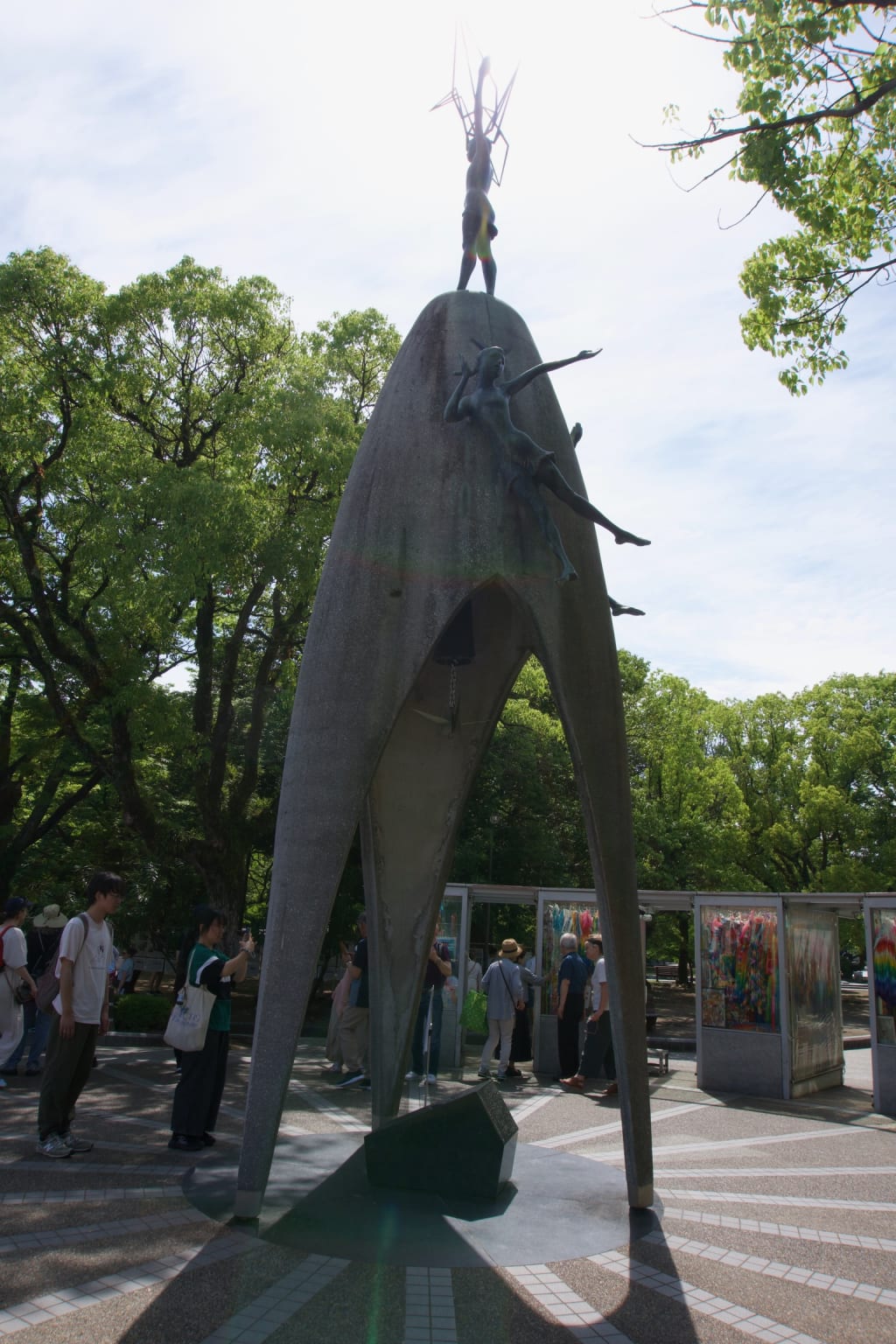
The Children's Peace Monument commemorates the children who lost their lives after the atomic bombing. It was inspired by Sadako Sasaki, who was exposed to radiation from the bomb at 2 years old that led to a leukemia diagnosis years later. While in the hospital, she folded 1000 paper cranes as a symbol of hope for recovery. Tragically, she lost her life at age 12. Today, children from around the world fold paper cranes at this site as a symbol of hope.
The Atomic Bomb Dome (A-Bomb Dome)
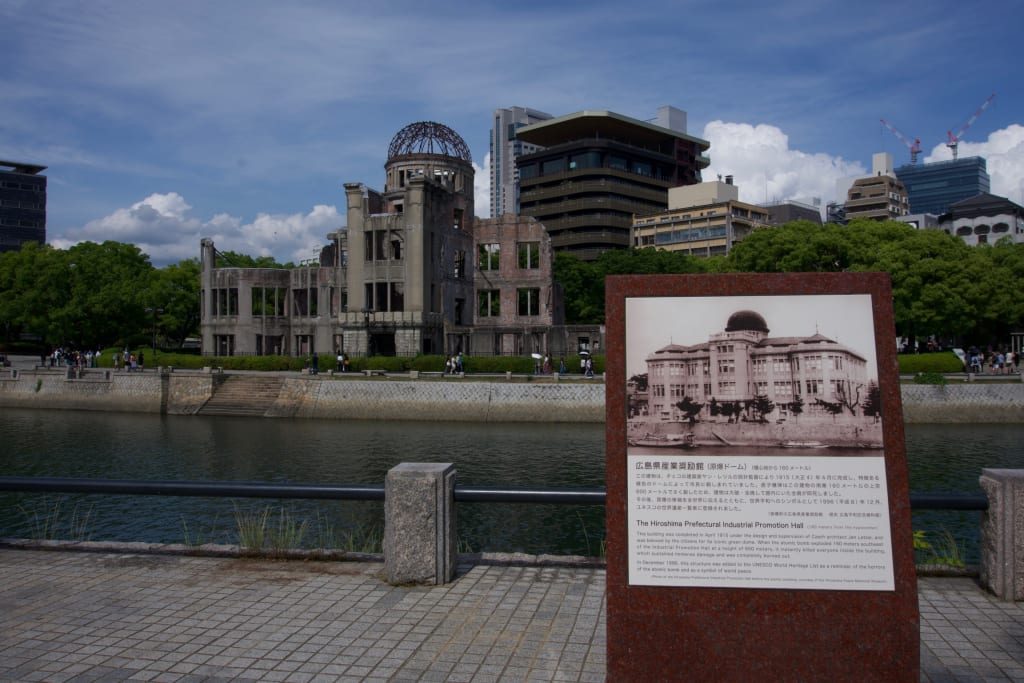
The Atomic Bomb Dome is the most recognizable landmark in Hiroshima. It is the remains of a building that was standing when the atomic bomb struck the city. As the citizens of Hiroshima were rebuilding their home, they debated whether or not to destroy the A-Bomb dome. Many survivors didn't want the reminder of the horrors of the bomb, but ultimately, it was kept to serve as, as UNESCO puts it, a "stark and powerful symbol of the most destructive force ever created by humankind" but also "hope for world peace and the ultimate elimination of all nuclear weapons." The building was deemed structurally unsound, so they reinforced it so it can remain standing.
Hypocenter
A simple plaque marks the spot directly beneath where the atomic bomb exploded. The bomb was aimed at the Aioi Bridge nearby, but it detonated slightly off target.
WITH MORE TIME
Hiroshima Castle
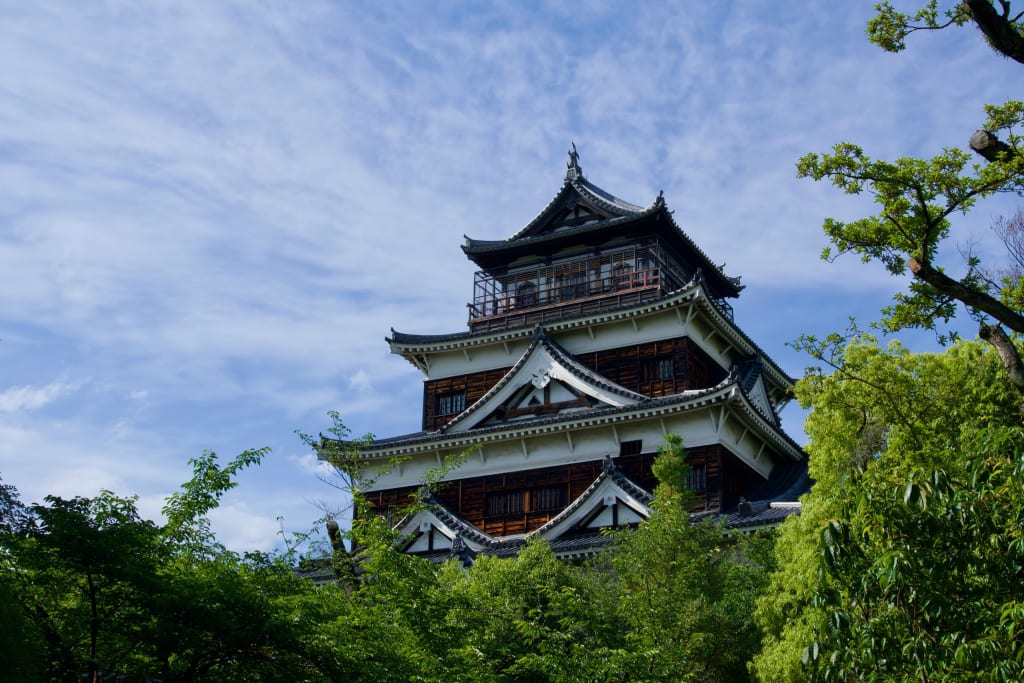
Hiroshima Castle is a reconstruction of the castle built in the 1590s that was destroyed by the atomic bomb. It was closed for renovations when we visited in the spring of 2026, but it usually serves as a museum covering Hiroshima's history before the bombing.
Miyajima
Miyajima is a small island located about an hour from Hiroshima, best known for its iconic Torii gate which appears to "float" in the sea at high tide. While it's said to be quite beautiful, it can also be quite crowded.
HOW TO GET THERE
From Kyoto, you can take the Shinkansen (bullet train) to Hiroshima. It takes ~1 hour 45 minutes each way.
OUR EXPERIENCE
Alex and I made the day trip from Kyoto. We got up bright and early to catch the train to Hiroshima and headed straight for the Hiroshima Peace Memorial Museum.
The Hiroshima Peace Memorial Museum is one of the best museums I've ever been to, and I wouldn't call myself much of a museum enthusiast. My husband, Alex, is even less of a museum geek nor a history nerd (like I admittedly am), and he felt the same way. It is very engaging and well put together. I learned a ton.
The first part of the museum is dedicated to sharing the stories of the victims. It feels incredibly human. I felt the emotional impact immediately.
Unfortunately, I felt it a little too deeply. On rare occasions, I have episodes of vasovagal syncope, when my body overreacts to certain triggers. I also have dysautonomia, which impacts my body's ability to regulate my heart rate and blood pressure. These conditions together mean that sometimes I feel very dizzy, to the point of fainting. After a week of intense hiking and jet lag, my body wasn't prepared to handle this graphic material, and I nearly fainted. I tried to push through, but had to speed through some of the sections telling the victims' stories to find a seat. I was very disappointed, but Alex filled me in on the exhibits I missed afterwards. I took a brief break and picked back up with the sections that were less emotionally intense and more focused on both the history of the bombing and the relevance it still holds to this day.
Luckily, I was able to read lots of the victims' stories before I threw in the towel. I saw photographs of the victims' burns. I saw artwork depicting skin peeling off zombie-like humans and desperately thirsty people drinking the black rain that fell from the sky. I saw many burnt and disfigured belongings and the clothes that schoolchildren were wearing the moment their lives changed forever. I vividly remember many exhibits that I saw.
Trigger WarningClick to reveal hidden photo
Graphic museum exhibit showing injuries from the atomic bombing.
Click to reveal hidden photo
Graphic museum exhibit showing injuries from the atomic bombing.
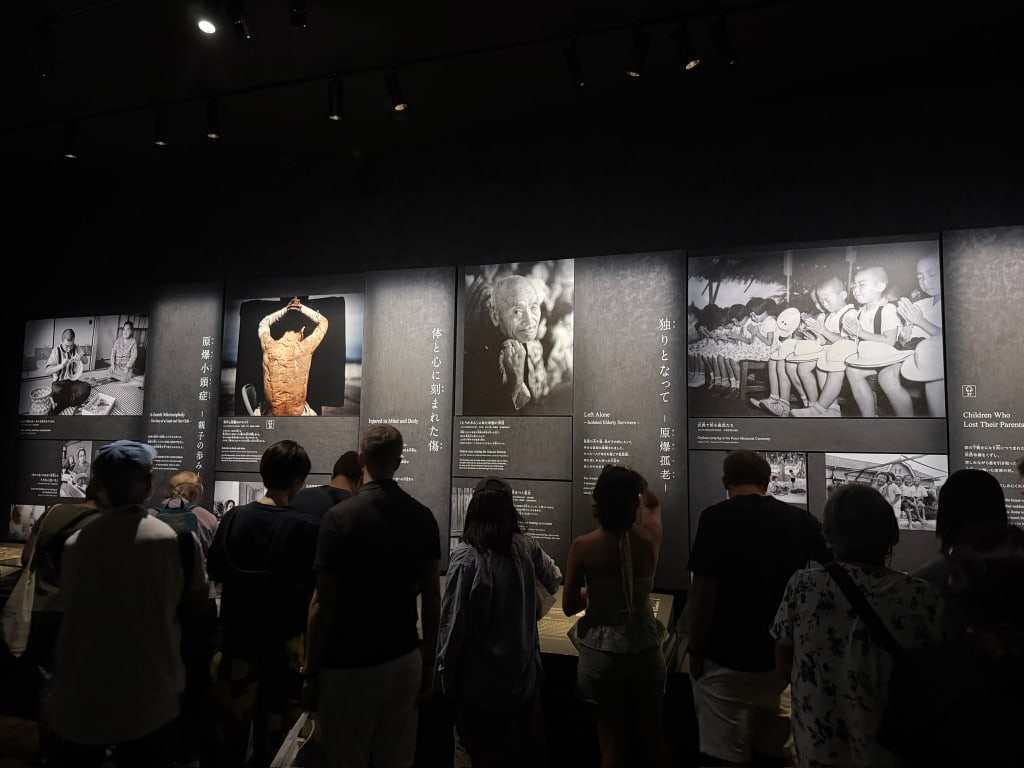
I've visited sobering historical sites before, including Dachau Concentration Camp in Germany, the 9/11 Museum in New York (USA), and the Catacombs in Paris (France), all without incident. I did feel that this museum was more emotionally intense and graphic than all those experiences though. It also left more of an impact on me. I acutely felt the suffering that these poor victims experienced. The museum did an incredible job of showing the human cost of war and nuclear weapons and left a lasting impression. Despite how difficult it was to see, I am so glad I went.
After leaving the museum, we spent the next hour walking through the Peace Park, visiting the Cenotaph, Children's Peace Monument, A-Bomb Dome, and Hypocenter. With all the context I gathered from the museum, I was able to truly appreciate the importance of these memorials.
We ended the day with a brief stop outside Hiroshima Castle, which was closed for renovations. Honestly, compared to everything else we had seen that day, the castle did not leave much of an impression.
I spent the entire train ride home reflecting on what I learned. This was one of the most impactful and eye-opening experiences I'd had in all my travels.
IS IT WORTH IT?
Yes, in my opinion every visitor to Japan ought to take a trip to Hiroshima. A visit to Hiroshima is incredibly impactful and important, especially today, and I could not more emphatically recommend a visit.
FAQS
Is it overwhelming emotionally?
There's no getting around this. Yes, I found it to be a little emotionally overwhelming, and there are parts of the museum that are quite graphic. That being said, my reaction to the museum was largely determined by my medical conditions. The average visitor will likely be able to handle it. In fact, I was shocked to find many large groups of schoolchildren visiting the museum, and they all seemed to handle it quite well.
Should I visit if I don't want to see the graphic material?
Yes, there are rooms in the museum that are more historical and don't show any graphic material. The museum is still well worth a visit even if you don't explore every room.
Is this a good place to bring children?
I saw many large groups of schoolchildren visiting the museum, and they all seemed to handle it quite well. I admire Japan's commitment to ensuring future generations understand the consequences of war and the importance of peace, and I know Germany has a similar program with schoolchildren being required to visit the concentration camps. That being said, I personally wouldn't bring my young children there (if I had any), as the museum is quite graphic and intense.
Is Hiroshima worth visiting if you aren't a history buff?
Yes. Alex in particular is not very interested in history and he was very engaged in the material in Hiroshima. Neither of us would call ourselves "museum enthusiasts" but it's one of the best museums we've been to and we highly recommend a visit.
Do you need a guide?
You do not. The museum is incredibly informative and will provide you with all the context you need to get the most out of your visit. We went with a guide but did not have a great experience and felt we would have enjoyed it more exploring on our own, especially as the guides are encouraged not to explore the museum with their guests, which is where you'll spend the majority of your time.
How much does it cost?
Visiting Hiroshima's Peace sites is incredibly affordable. Entrance to the museum is 200 yen (less than $2). The other sites (the Cenotaph, Children's Peace Monument, A-Bomb Dome, and Hypocenter) are all free to visit.
Hiroshima Castle costs 370 yen (~$2.50).


