
Visiting the Amazon Rainforest in Peru: My Honest Review of Tambopata
Oh, the Amazon Rainforest. We were told it was a must-see for wildlife lovers like ourselves, so Alex and I embarked on a journey that involved a plane, bus, and boat to see for ourselves. In this article I’ll explain everything you need to know to visit the most biodiverse place in the world for yourself and of course answer the ultimate question: is it worth it?
WHERE IS THE AMAZON RAINFOREST?
The Amazon Rainforest covers 40% of the South American continent and spreads across 9 different countries. Brazil claims the majority, with over 60% of the rainforest contained within its borders, followed by Peru at 13%, and Colombia, Bolivia, Ecuador, Venezuela, French Guiana, Guyana, and Suriname all holding smaller swaths as well.

While many tourists access the rainforest in Brazil, we chose to visit during a 12 day trip to Peru. Within Peru there are three primary access points: Manu National Park and Puerto Maldonado in the South and Iquitos in the North.
Manu National Park is said to be the most pristine and biodiverse, but is also the hardest to access. Iquitos is famous for pink dolphins but was much further away from Cusco. Puerto Maldonado is the easiest to access from Cusco and boasts higher wildlife density and biodiversity compared to Iquitos. We chose to visit Puerto Maldonado for these reasons.

WHERE TO STAY
We chose to stay at Tambopata National Reserve. It has some of the highest wildlife density in the Amazon and is particularly famous for the macaw claylicks just a short boat ride away from the lodge where dozens and sometimes hundreds of macaws gather to feed on the mineral-rich clay. Unlike many regions in the Amazon, the Tambopata National Reserve is on protected land, which means there are more regulations protecting wildlife and limiting crowds. However, since the land is protected, you can’t fish for piranha like you can in other regions, so that’s worth noting if that’s of interest to you.

BEST TIME TO GO?
The best time to go is during the “dry” season from June to October. During this time, it’s easier to walk on the trails and wildlife often congregates near rivers, making them easier to spot.
HOW DO I GET THERE?
We took a 1 hour flight from Cusco to Puerto Maldonado. From Puerto Maldonado airport, we met up with employees from Tambopata who steered us to the bus. It took around an hour and a half to get to the river port by bus. From there, it was 2 hours by boat to Tambopata.
DO I NEED A GUIDE?
Yes, you will need a knowledgeable guide on your treks through the rainforest to keep you safe. Most lodges provide guides as part of the package so you don’t need to worry about hiring a guide yourself.
At Tambopata, we had one guide for 6 people.
HOW LONG SHOULD I STAY?
We stayed 4 nights (3 full days) and if the weather had cooperated, this would have been a perfect amount of time.
WHAT CAN YOU HOPE TO SEE?
Below I’ve listed what you can expect to see in the region of the Amazon Rainforest near Puerto Maldonado specifically.
Jaguars
Jaguars are the third largest cat in the world, but have the strongest bite of all the cats and can pierce the skull of a caiman or crocodile, unlike lions and tigers which have to kill their prey by the neck.
If you dream of spotting jaguars in the wild, the Amazon Rainforest might not be the best place to visit. Jaguars are famously elusive creatures to begin with, and the dense vegetation in the Amazon makes it easy for them to come and go without notice. Tambopata advertises a 35% chance of seeing a jaguar while staying at their lodge, and have identified 25 unique jaguars via jaguar cameras in the rainforest in the years between 2016 and 2024. For jaguar lovers, our guide recommended the Pantanal in Brazil. It is much easier to spot jaguars in the Pantanal because their range is much smaller (25-40km compared to 300km in the Amazon) and the vegetation is much less dense.
We did not see any jaguars while in the Amazon, but visiting the Pantanal in Brazil is extremely high on my bucket list.
Capybaras & Agoutis
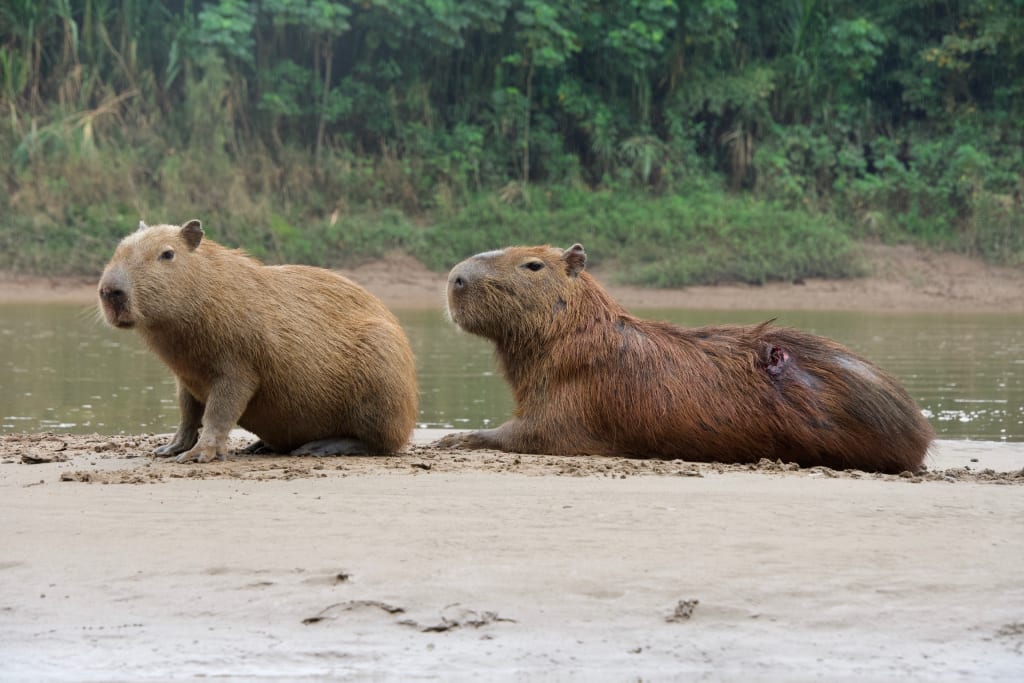
Capybaras are the world’s largest rodent and typically weigh between 75 and 150 pounds. They can often be found lounging by the rivers. There’s a very strong chance you see capybara while in the Amazon.
Agoutis are another species of rodents that resemble oversized guinea pigs and are fairly common in the Amazon.
A rodent’s teeth never stop growing.
Tapirs
Tapirs are the largest native mammal in the Amazon. They’re so large, even the powerful jaguar can’t kill an adult. They are nocturnal, so often difficult to spot. We unfortunately did not come across one during our time.
Caiman
Both white and black caiman can be found in the Amazon Rainforest. Caiman are smaller crocodile-like reptiles.

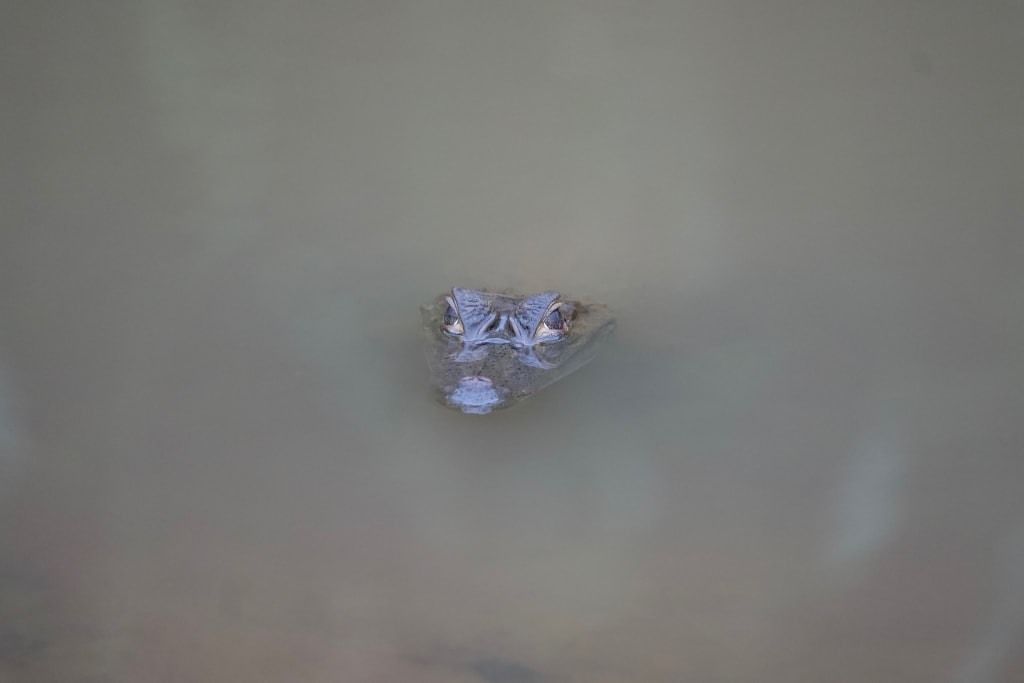
The river alongside Tambopata is not the Amazon River, it’s the Tambopata River.
Snakes
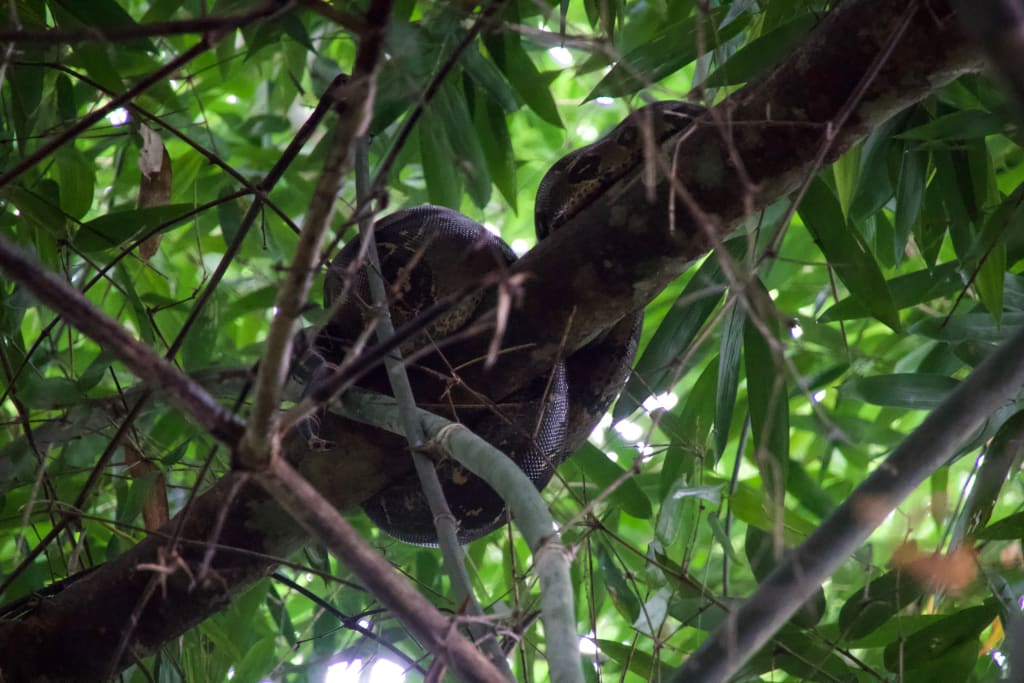
There are a wide variety of both venomous and non-venomous snakes you can expect to see in the Amazon. We had the good fortune of seeing a boa constrictor (non-venomous) in the tree above our heads on one of our walks.
Monkeys
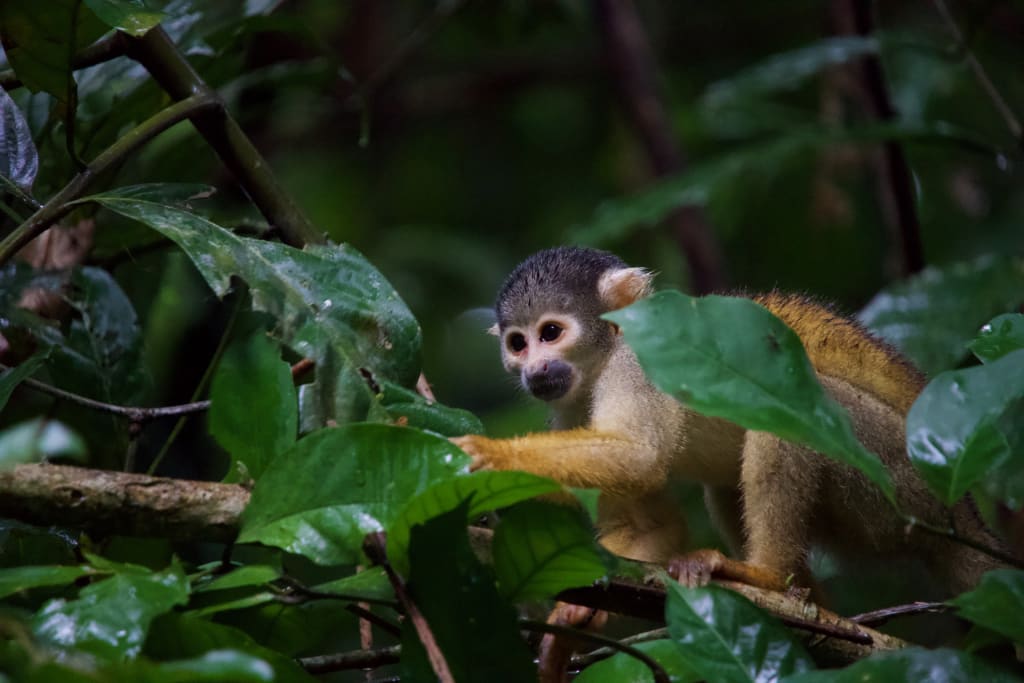
There are 8 species of primates in the Tambopata region, including the howler monkey, Peruvian spider monkey (which are bigger than regular spider monkeys), squirrel monkey, and capuchin monkey. We personally saw red howler monkeys, squirrel monkeys, capuchin monkeys, and Tamarins.

Birds
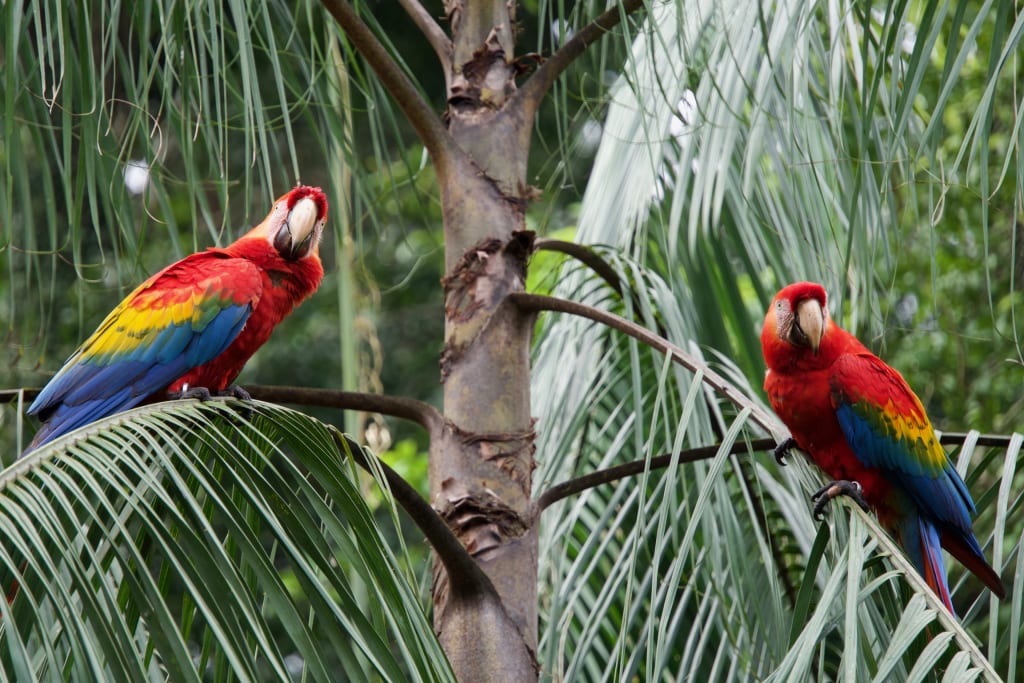
The Tambopata region boasts an astounding 632 species of birds. Some notable species include the scarlet macaws (the sight of which were a highlight of my trip to the Amazon), the harpy eagle (you have a 9% chance of seeing one), and the toucan. We saw many macaws up close and one toucan from a distance, in addition to other bird species.
Insects & Arachnids
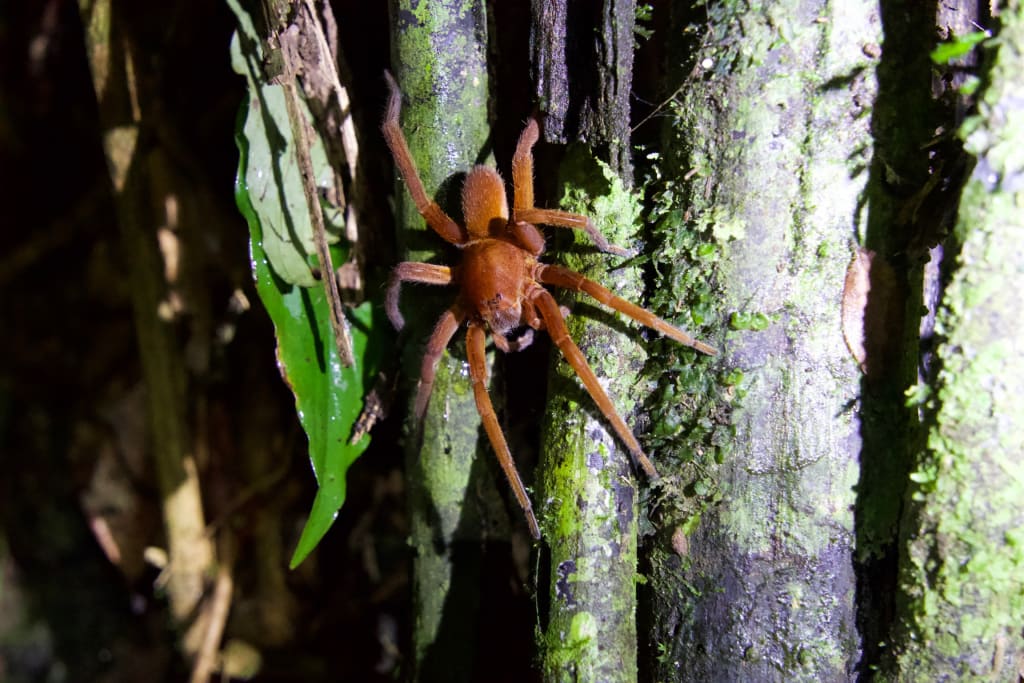
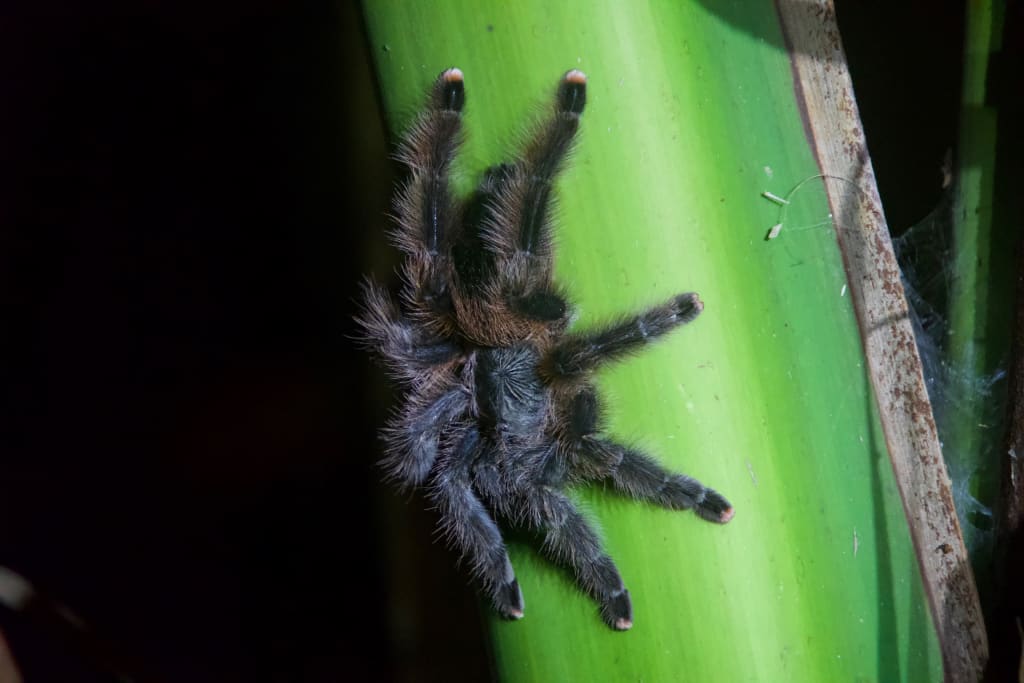
There are many species of insects and arachnids you can expect to see, including leafcutter ants, bullet ants, wandering spiders, and pinktoe tarantulas, to name a few.
Giant River Otters
This is another species you shouldn’t get your hopes too high on seeing. Tambopata claims there is a 4% chance to see giant river otters.
SOME FUN FACTS ABOUT THE AMAZON
- There are at least a thousand species of monkeys in the world.
- Only 1% of the Amazon’s trees are identified.
- Anteaters primarily eat termites, not ants.
- Deforestation is problematic for wildlife because it limits food resources, limits animals’ ability to escape from predators, and often leads to inbreeding.
- Spider webs are made from two types of silk: sticky strands that form the trap in the center of the web and stronger, non-sticky strands that anchor the web to surrounding branches around the outside.
- There is a palm in the Amazon often called the “walking tree” because it can grow new roots in the direction of sunlight while older roots die off, giving the appearance that the tree slowly moves over time.
OUR EXPERIENCE
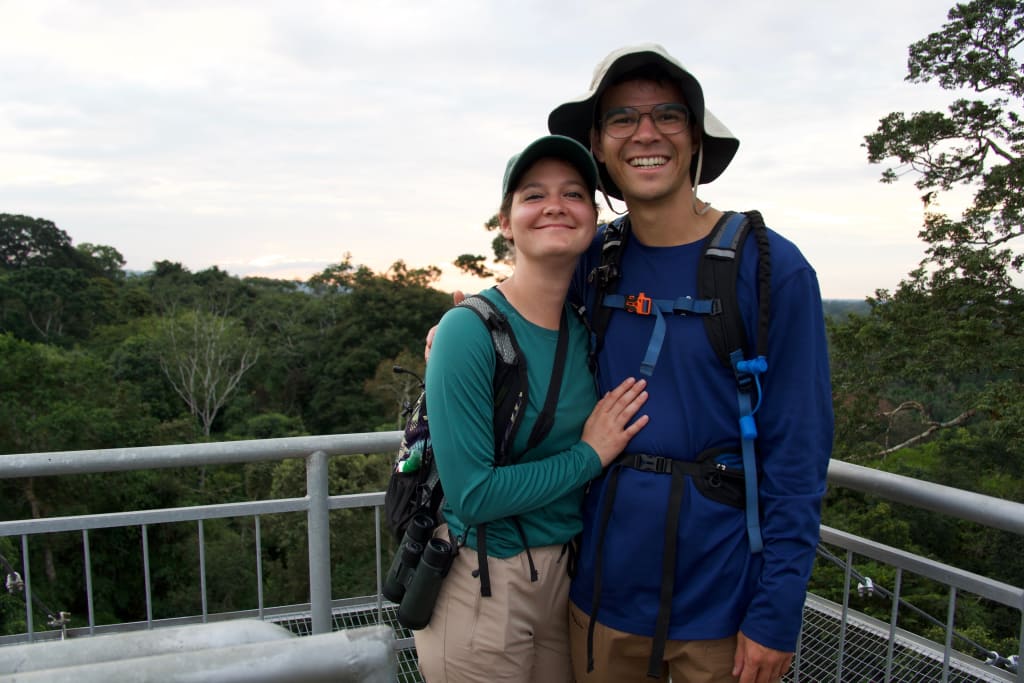
We stayed in the Amazon Rainforest for 4 nights in July 2024. We did a night walk, climbed the sky-tower to see the view over the canopy, watched the macaws flock to the claylick, boated down the river in search of wildlife, and attended night lectures.
Candidly we have very mixed reviews on our stay at Tambopata. I’ll break down this section by the Good and the Bad.
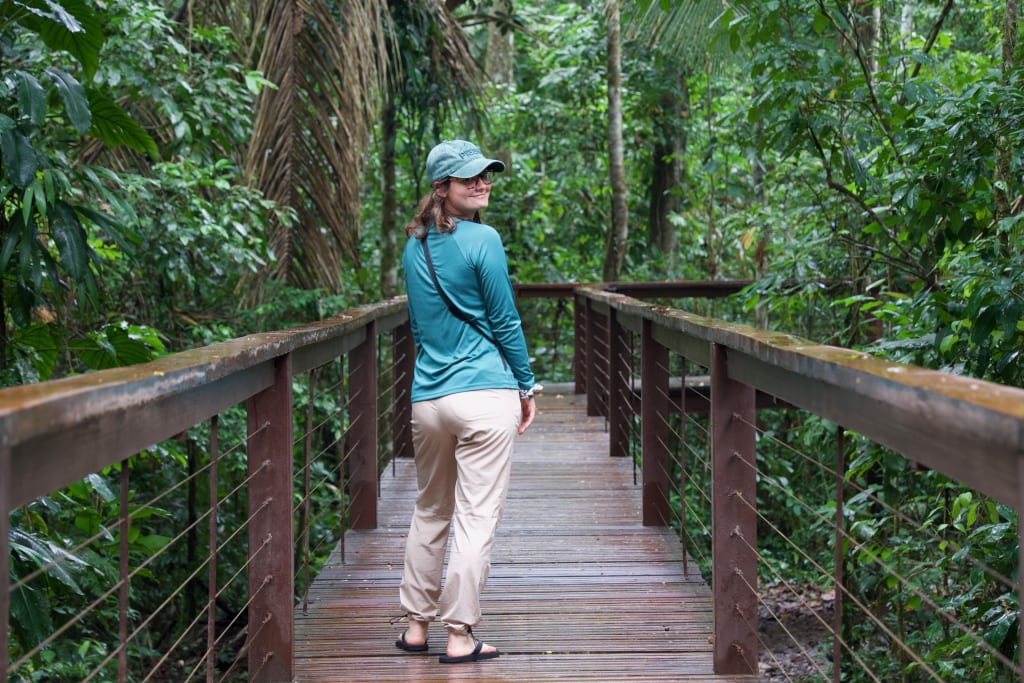
The Good
One of the absolute highlights of our entire trip to Peru was seeing scarlet macaws up close. Not only were they prevalent throughout the canopy in the rainforest, but also around the lodge itself, as Tambopata has run the Tambopata Macaw Project since 1989. This program creates artificial nests to allow macaws to reproduce more successfully and gives researchers the chance to study their behavior. Many macaws can be found in the branches around the lodge, and you’ll even have the opportunity to watch the bravest of the birds dive into the kitchen to snatch some fruit from the breakfast bar. Watching them plot, swoop closer, and finally commit to the steal is very entertaining and Alex and I had a blast trying to capture photos.

In addition to macaws, we had a number of notable animal sightings, including capybara, spider monkeys, spiders, tarantulas, toucans, and more.
Lastly, I thoroughly enjoyed the lectures they had each evening on various topics and learned a ton.
The Bad
Unfortunately, I have a substantial amount to say for this section.
I’ll start with the wildlife. We were very excited to watch the macaws feed on the famous claylicks, but they were just too far away to enjoy. I understand the need to maintain a distance, but you could barely see the birds with the binoculars from the bank where we watched. It felt quite underwhelming honestly.

More generally, we spent so much time waiting for something to happen while on our walks. Even on the one day we had good weather, the activities were long and we had 2 interesting wildlife sightings the entire day (squirrel monkeys and capybara).
Now, on to the lodge. We got very unlucky during our stay, and encountered a fierce rainstorm and cold front that lasted for 2 of the 3 days we were there. This rainstorm not only made it nearly impossible to walk the trails, but also meant that the wildlife were burrowing away hiding from the storm as well, so there was nothing to see.

While I acknowledge that Tambopata Lodge can’t control the weather, I walked away feeling quite disappointed with their rainy day backup plans for tourists.
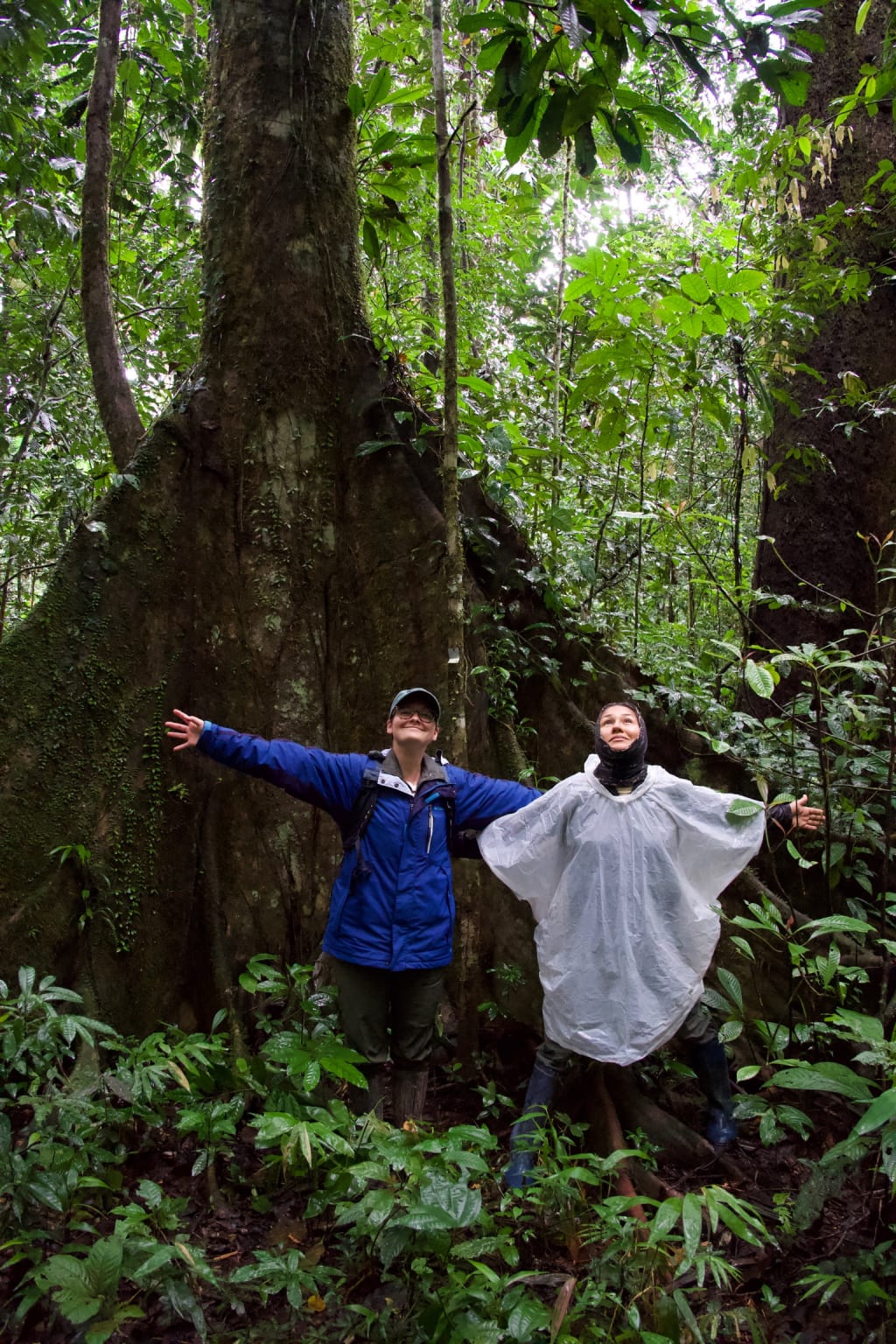
To start, they hosted exactly one fifteen-minute activity over the two rainy days: a Pisco Sour tutorial. This “tutorial” consisted of the bartender making exactly one drink that was handed out to one lucky winner, so the vast majority of participants didn’t even get a taste. Meanwhile, the masseuse onsite sat on her phone in the corner the entire day and the staff could be heard playing billiards day and night, yet there was no entertainment provided for the guests paying almost $900 a night! In my opinion, the resort could have offered a 30-minute massage for free to each guest or even a discount on the pricey treatments. They could have had an hour where guests could use the billiards table instead of the staff, or they could have hosted more educational sessions during the day. The lack of effort that was put into the programming on rainy days was quite disappointing.
I also wasn’t blown away by the rooms. As advertised online, the rooms have only 3 walls, with one omitted so guests can enjoy the sounds of the rainforest around them. That sounds quite romantic, but in reality I just heard the sounds of the guests snoring and coughing in the room next to me. The bedrooms were back to back along one wall, with no separation, so it ended up being quite noisy.
Lastly, the food was just alright. The hot soups were very bland and the food was pretty repetitive. They didn't have too many options for me as a vegetarian either.
WAS IT WORTH IT?
I cannot confidently say that our trip to the Amazon Rainforest was worth it.
There were moments I enjoyed, and it is a spectacular place with so much to see and learn, but it was remote and a significant investment of time and capital and I’m not sure we had enough “wow” moments to justify the time and money spent here.
Compared to other wildlife destinations, the density of sightings was lower and from a further distance. I would recommend a number of spots for wildlife lovers before the Amazon, including an East African safari or the Galápagos Islands.
Ultimately, I would be open to going back to the Amazon, but not with Tambopata, and not anytime soon. It’s pretty low on the list of places I’d like to return to. I might check out another region of the Amazon instead, and I’ll definitely visit Brazil’s Pantanal before I head back to the Amazon.
FAQs
How much does it cost?
We paid $864 per night to stay at Tambopata National Reserve. This includes the guide, the activities, food, and lodging.
What is the bathroom situation?
Excursions are typically around 2 hours, so you’re encouraged to just use the facilities at the lodge before and after you leave.
Are there poisonous or dangerous species?
Yes. There are many poisonous species of both plants and animals in the Amazon. Do NOT touch anything and do not wander around without a guide.
What camera should I bring?
Alex had the Sony a6400 camera paired with a Tamron 18-300mm lens. I would recommend buying a lens with more zoom for this trip if you’re able. We now have a Sony G 200-600mm lens that would have been perfect for some bird shots.
Do I need any medications or vaccines?
Yes, you should get a Yellow Fever shot, a typhoid shot, and bring malaria medication (we have used Atovaquone-proguanil many times and never experienced side effects).
What should I pack?
- You don’t want to leave too much skin exposed in the Amazon, as you could brush against a plant that irritates your skin or get bitten by an insect. It’s hot, but I recommend packing long-sleeve, light athletic shirts and thin hiking pants
- Atovaquone-proguanil (Malarone) or other malaria-prevention
- Advil & any other medications you might need for a remote place
- Rain jacket
- Hat for sun protection
- Camera with a zoom lens
- Flip flops to wear around the lodge
- Our lodge provided rubber rain boots, but you should confirm your lodge will too
- Water bottle
- Plug adapters
- First aid kit
- Hand sanitizer & wet wipes
- Binoculars
- Head lamp
- Insect repellent
- Sunscreen
- Small backpack for day trips
How far in advance should you book?
I’d recommend booking 4-6 months in advance. I booked 4 months in advance (March for a July trip) and had no problem with availability.
Is there wifi in the rainforest?
Yes, but it’s pretty spotty. I was most surprised to have wifi on the boat from Puerto Maldonado to Tambopata (Starlink).
How physically difficult are the walks?
They’re not too difficult and tend to be short walks on flat trails. That being said, the humidity contributes to how tiring they feel.
How buggy is the Amazon?
There are, of course, a lot of bugs. I recommend carrying DEET bug spray on all excursions and applying generously.
Can you bring suitcases to the Amazon?
We were told we would need to store our suitcases at headquarters and bring a smaller, weight-limited bag for our time in the Amazon. However, we ended up bringing all our luggage and they never stopped or asked us to store our luggage elsewhere.


