
Why the 1 Day Inca Trail to Machu Picchu Is My Favorite Hike Ever
The perfect hike has to meet a few criteria.
It has to be challenging enough to get my blood pumping, but not so grueling where I’m cursing my life choices the entire way.
It has to have an epic payoff at the end that makes all the effort worth it. And, ideally, it would have beautiful scenery along the way as well.
The Inca Trail checks all those boxes and more. Throughout the entire hike, we were surrounded by the lush green peaks of the Andes and to have one of the New Seven Wonders of the world at the end? Surely there’s no better payoff than that. The Inca Trail also scores some bonus points for a long and rich history that shows up in the ruins that dot the trail.
The Inca trail has it all. I’ve done some unbelievable hikes in my lifetime (Volcán Acatenango in Guatemala and the Narrows in Utah, USA come to mind as well) but this has to be my favorite. If you don’t have the time or the will to do the 4 day Inca Trail, I highly recommend you do this 1 day version instead. It was my favorite thing we did in Peru and made our visit to Machu Picchu so much richer.
WHAT IS THE INCA TRAIL?
The Inca Trail is a network of roads that connects the scattered Incan villages in the Andean highlands. Nowadays, tourists from around the world hike along the same roads on their way to Machu Picchu.
Most tourists do a 4 day hike. We chose the 1 day hike because we were short on time and wanted to visit Cusco, the Sacred Valley, Machu Picchu, Rainbow Mountain, and the Amazon in one trip. We also wanted to do the hike up Huayna Picchu and knew we would probably be tired of hiking after the full Inca Trail. The 4 day version is also considerably harder and you reach higher elevations, hiking up to almost 14,000 feet above sea level at a section called Dead Woman’s Pass.
WHAT IS MACHU PICCHU?
Machu Picchu is the most famous set of Incan ruins in Peru and one of the New Seven Wonders of the World.
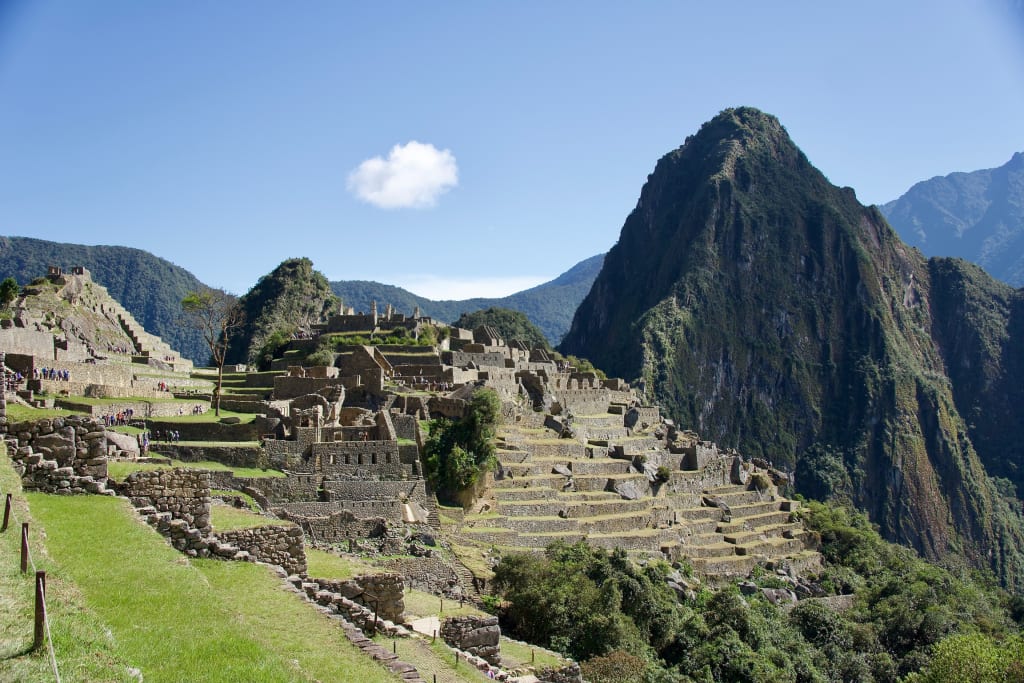
The exact purpose of the settlement is unknown, but many believe it was a summer getaway for the famous emperor Pachacuti. He is often thought of as the greatest ruler of the Incan Empire and his military conquests paved the way for the empire to become the largest in the pre-Columbian Americas.
Machu Picchu was built in the 15th century and abandoned roughly a century later, around the time of the Spanish conquest. Its “discovery” by foreigner Hiram Bingham in 1911 made international headlines. I say “discovery” in quotes because the site was previously known to local indigenous communities before Bingham arrived.
WHO WERE THE INCAS?
The Incan Empire was the largest empire in the pre-Columbian Americas. At its height in the 15th century, it stretched from present-day Colombia through Ecuador, Peru, Bolivia, Chile, and Argentina.
The Incas were master engineers. Without iron tools or the wheel, they constructed roads, bridges, and stone cities that have withstood centuries of earthquakes. Their buildings were assembled using precisely cut stones that fit together so tightly that they didn’t require mortar. One of the best examples of their engineering mastery is at Sacsayhuamán on the outskirts of Cusco. It’s definitely worth a visit.
One interesting fact about the Incas is that, unlike other pre-Columbian empires such as the Maya, they had no system of writing. Instead, they used a complex record-keeping system called quipus: knotted cords in various colors that would record numbers and other information.
Sadly, this empire existed for only about a century before the arrival of the Spanish. In 1532, Spanish conquistador Francisco Pizarro captured the Incan emperor Atahualpa, triggering the rapid collapse of the empire. Although the empire disappeared, the Incan culture is alive and well today. Millions of people still speak Quechua, the language of the Incas, and in many highland communities, traditional clothing and customs have been passed down through generations.
My favorite non-fiction book of all time is Kim MacQuarrie's The Last Days of the Incas. It provides a lot of context on the Spanish conquest of the Incan Empire and is well worth a read before a trip to Machu Picchu.
OUR EXPERIENCE
I was this close to quitting the hike before I even started it. In retrospect, I probably should have, but boy am I so glad I didn’t. This is still my favorite hike I’ve ever done.
Things started to go wrong on the train from Ollantaytambo. Our train halted to a stop and we sat on the tracks while we waited for an explanation. Finally, a member of the staff came over and explained that a train up ahead was having problems with their engine. Thankfully, I speak Spanish and was able to understand what they were saying. We sat and waited, sweltering on the hot train.
All of a sudden, I got an alert from my Apple Watch: “Irregular heart activity. Heart rate exceeds 140 bpm after more than 10 minutes at rest.”
“That’s odd,” I thought. I felt completely fine.
That didn’t last long. Within a minute of getting the alert, I felt a tingling sensation in my brain and knew I was about to lose consciousness. Alex grabbed me a snack and some water, but I had to fight to stay conscious. It was torture.
After a few hours, the train finally started moving again. At this point I had a decision to make. I could get off the train at the 104km point as planned to start our hike to Machu Picchu, or I could remain on the train and head to the hotel to rest.
I’m not proud of the decision I made. It was pretty reckless. I had no idea what was wrong with me and I was putting myself in a dangerous position by trekking out into the middle of the mountains where I couldn’t easily get medical care if I needed it.
But I had flown all this way to do this hike and I was going to do it.
I got very lucky. I was fine. I didn’t know it at the time, but this was my first episode of presyncope caused by a condition I would get diagnosed with a few months later: postural orthostatic tachycardia syndrome (POTS). Blood had pooled in my legs instead of returning to my heart, reducing blood flow to my brain. The hike stimulated blood flow and I actually felt much better within an hour after starting the hike. Of course, I didn’t know that would be the case. I just didn’t want to miss out.
As soon as we stepped off the train at the 104km mark, our guide Domingo told us we’d have to move quickly today. We had to make it to the Wiñay Wayna checkpoint by 3:30pm otherwise the staff would turn us around, and we were now on a tight timeline given the train delay. This was not the news I needed, but it was time to get a move on.
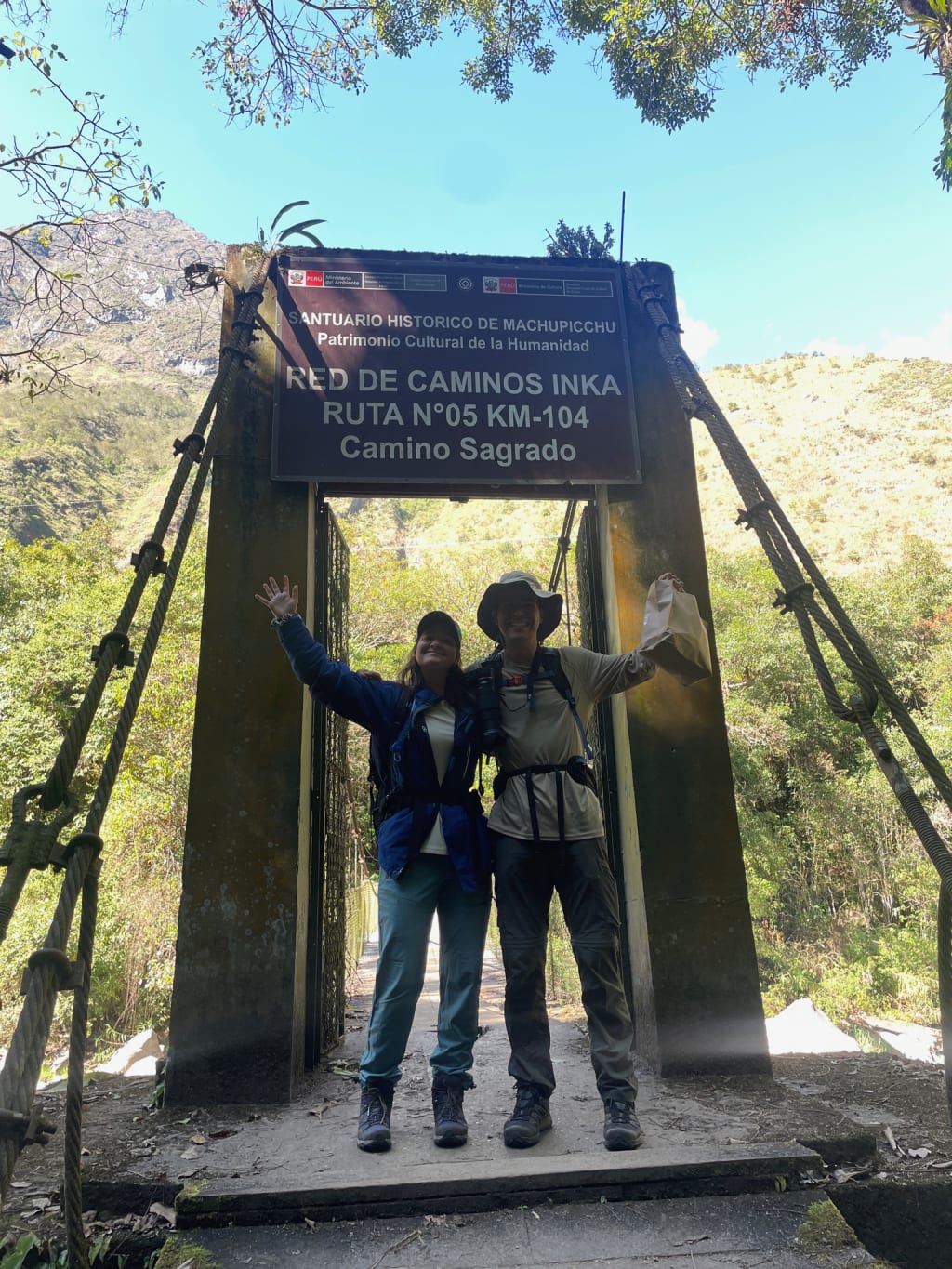
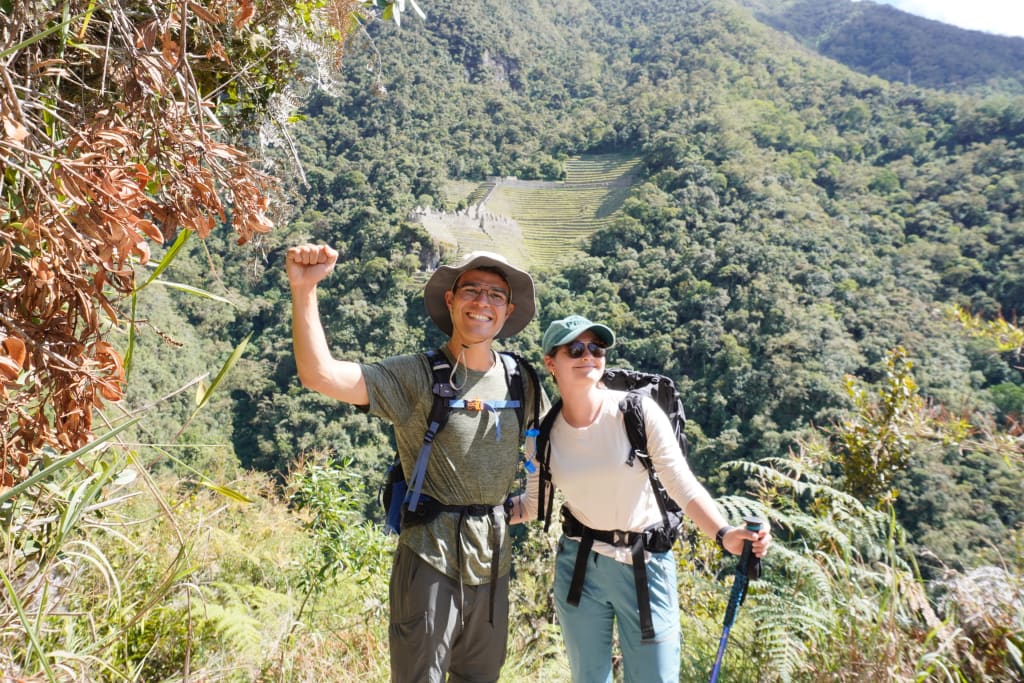
Almost immediately after we started the hike, we encountered our first set of Incan ruins, Chachabamba. As we continued along the trail, the gorgeous green Andean mountains came into view. We would be treated to these views for the remainder of the hike.
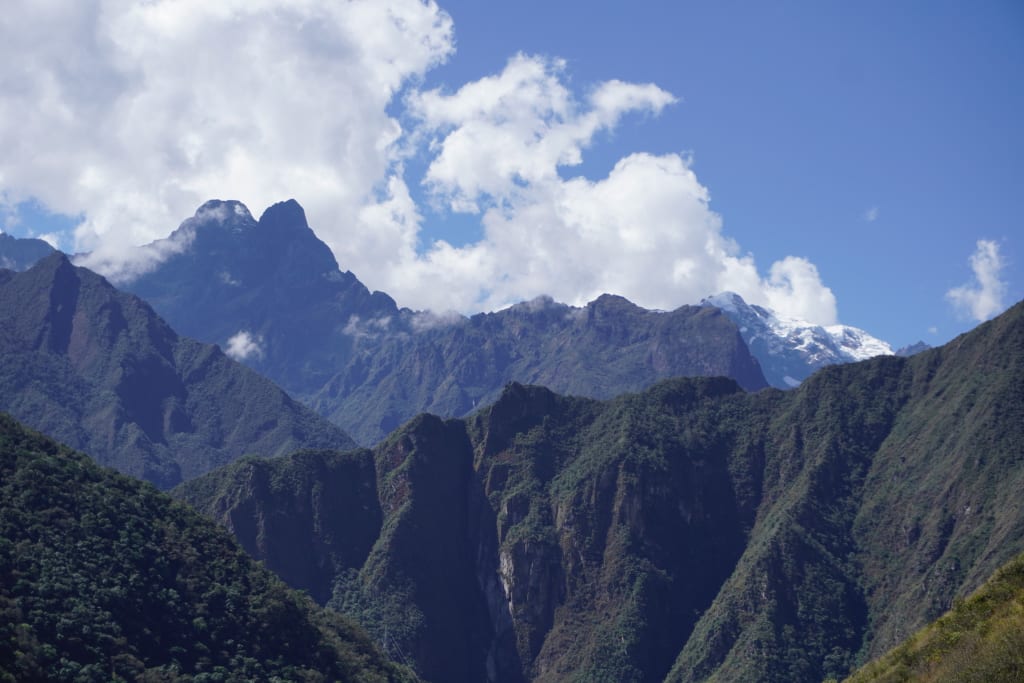
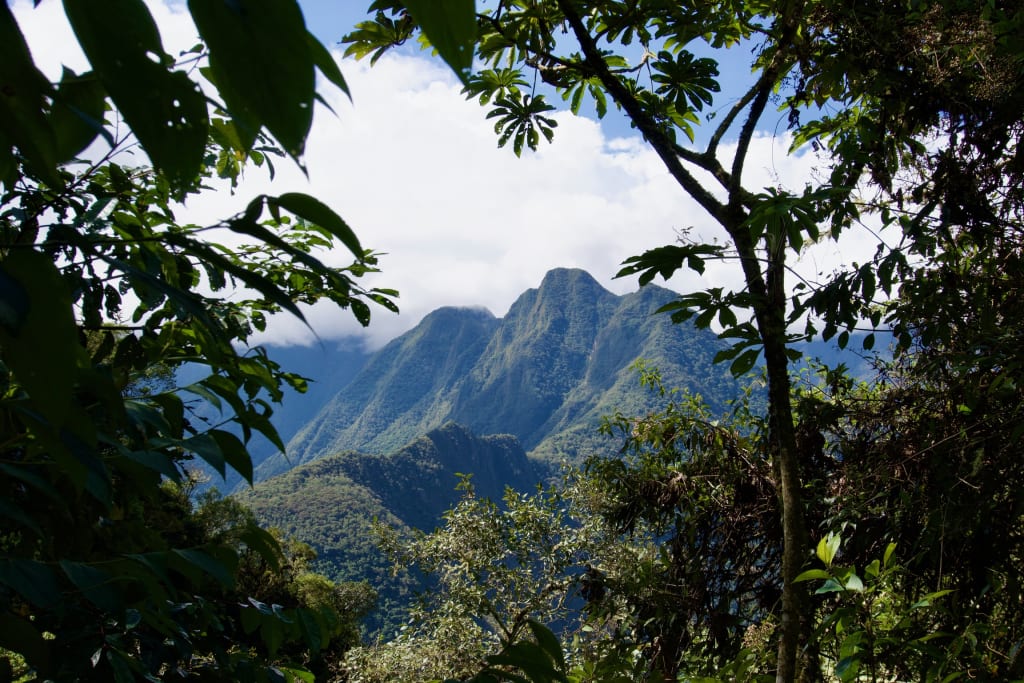
About two hours into the hike, we saw the ruins of Wiñay Wayna in the distance. At this point, my nerves were calming and I was starting to feel the dizziness lift. Hallelujah!
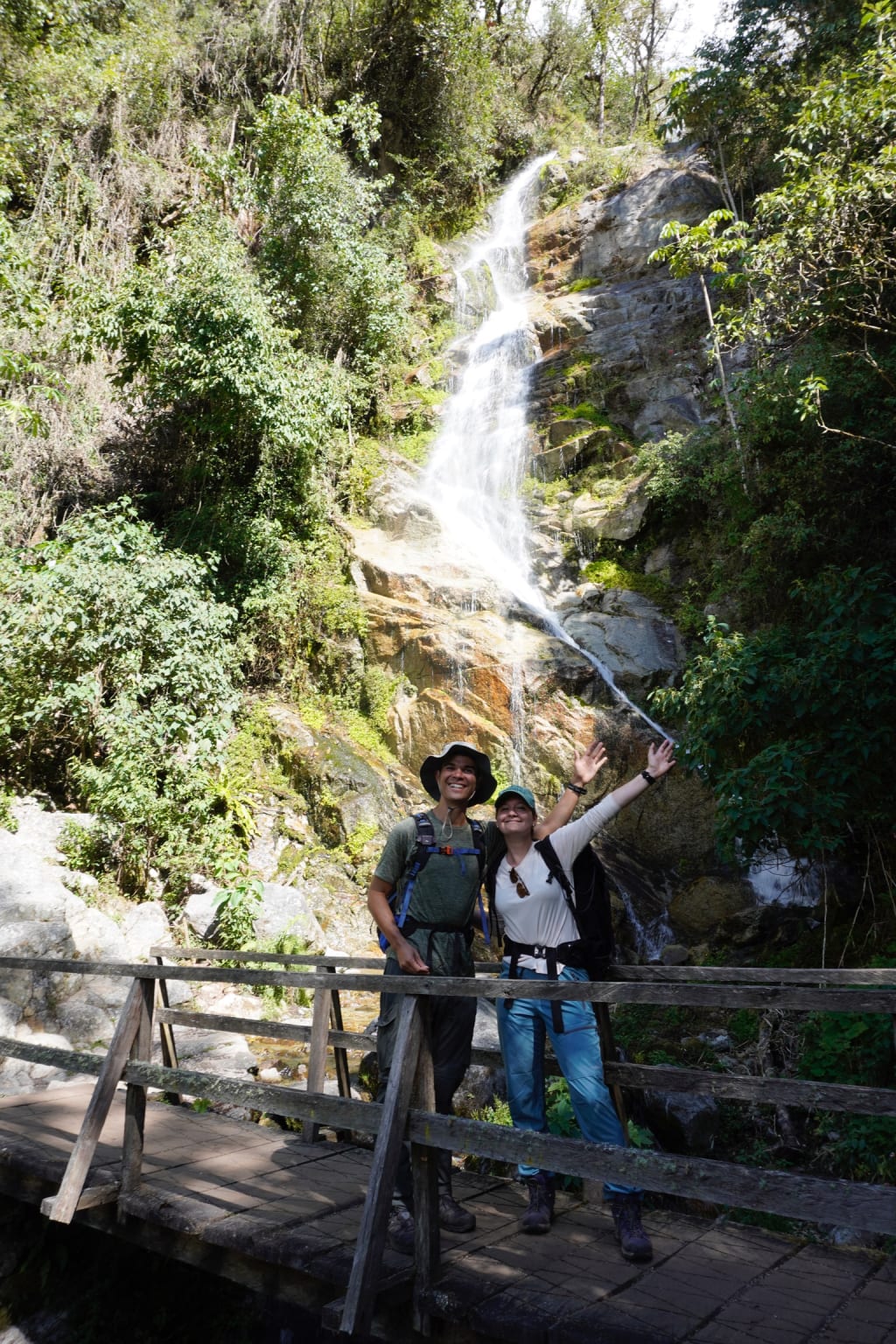
We passed this gorgeous waterfall and made it to the base of the ruins at the three hour mark.
There was a steep uphill push at this point, but we had to keep moving because we had less than an hour until the checkpoint closed.
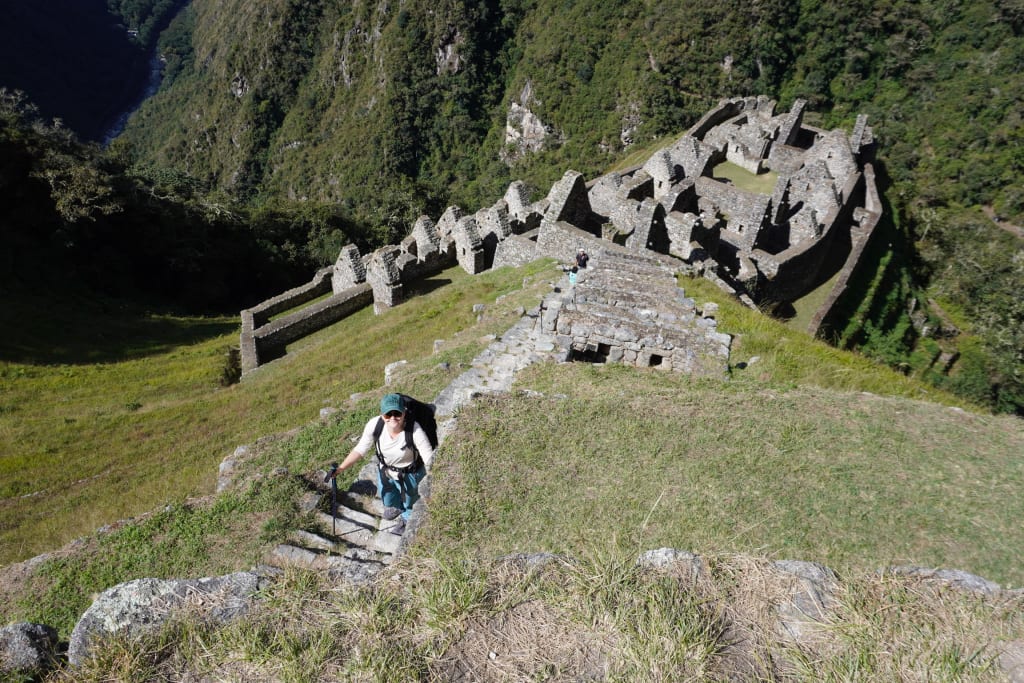
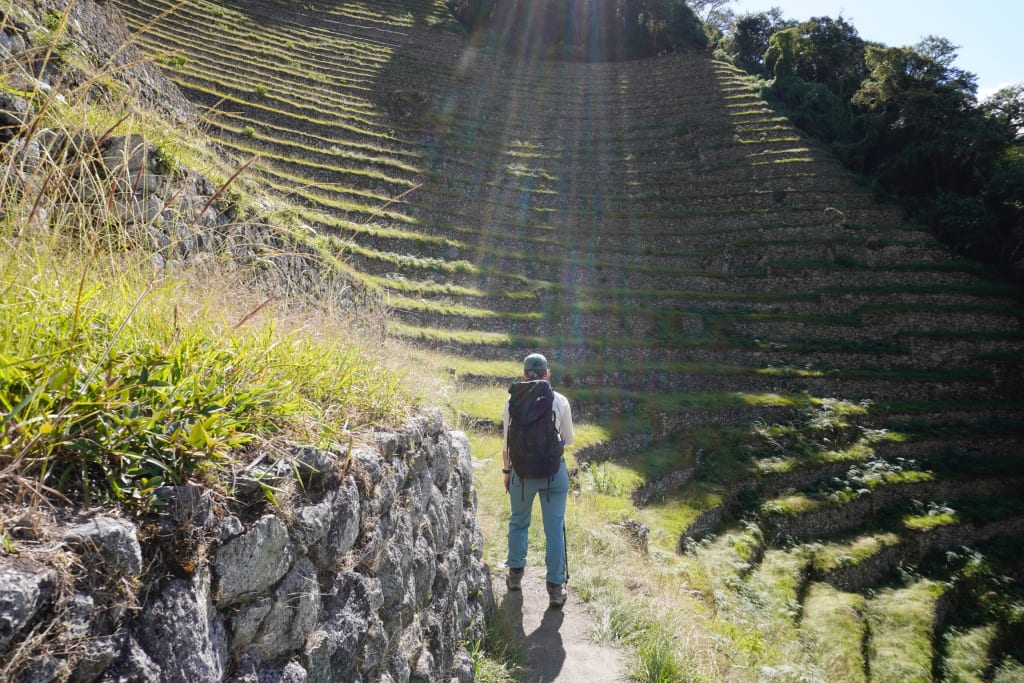
The views from Wiñay Wayna were jaw-dropping. We paused for a minute at the top to take it all in.
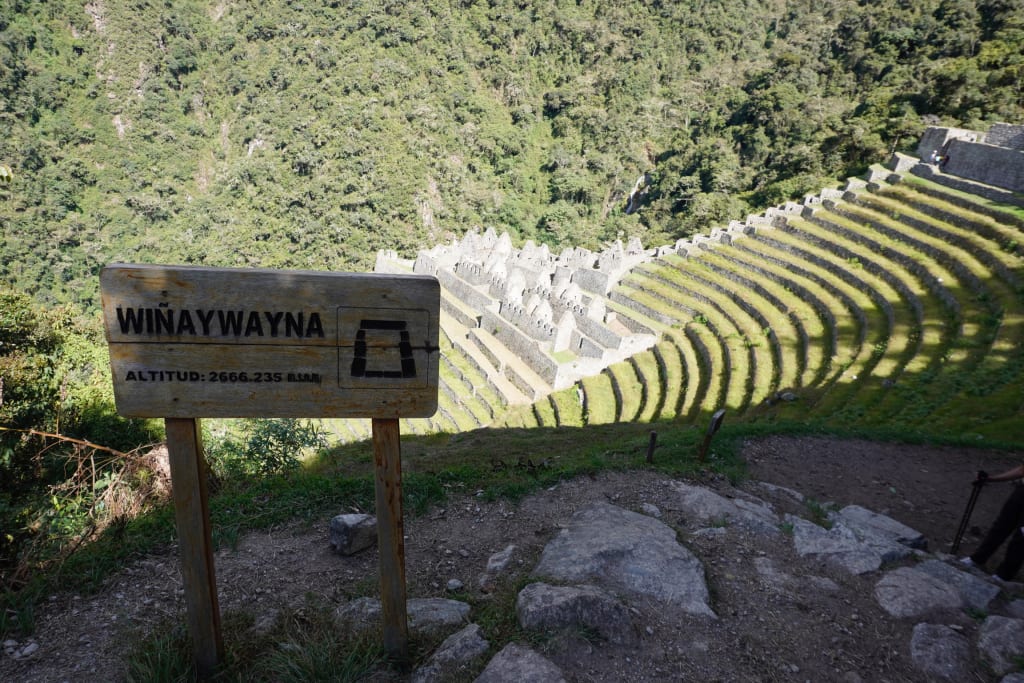
After a quick break, we powered through to the checkpoint and stopped to enjoy our lunch. We made it! I was so relieved.
No time for celebrations yet, though. We still had to make it to Machu Picchu in time to catch the last bus back to Aguas Calientes, where we would be sleeping that night. We carried on.
We were more than 5 hours into the hike when we encountered a steep set of stone stairs. They were extremely narrow and seemingly ascended all the way to the sky.
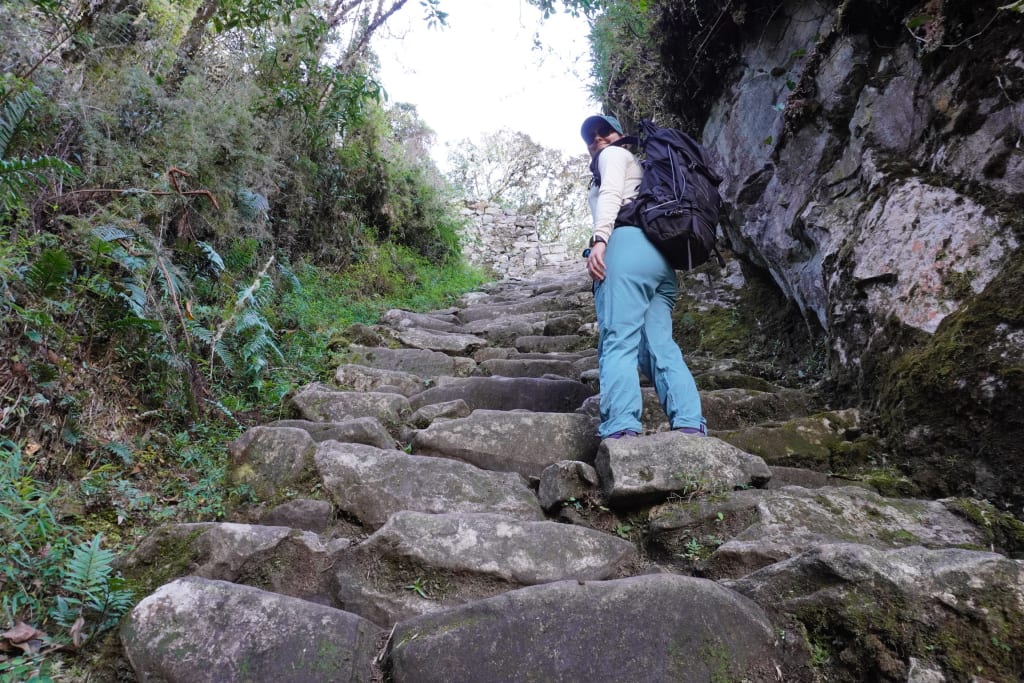
I had been leading the way for Alex and our guide all day so they could match my pace, as I hadn’t been feeling well at the start. At this point, Alex passed me and scurried up the stairs. I hung back and took my time.
I remember hearing Alex gasp and call out my name when he reached the top of the stairs. That gave me the boost of energy I needed to pick up speed and see what he was excited about.
We had reached the sun gate and were staring directly at Machu Picchu!
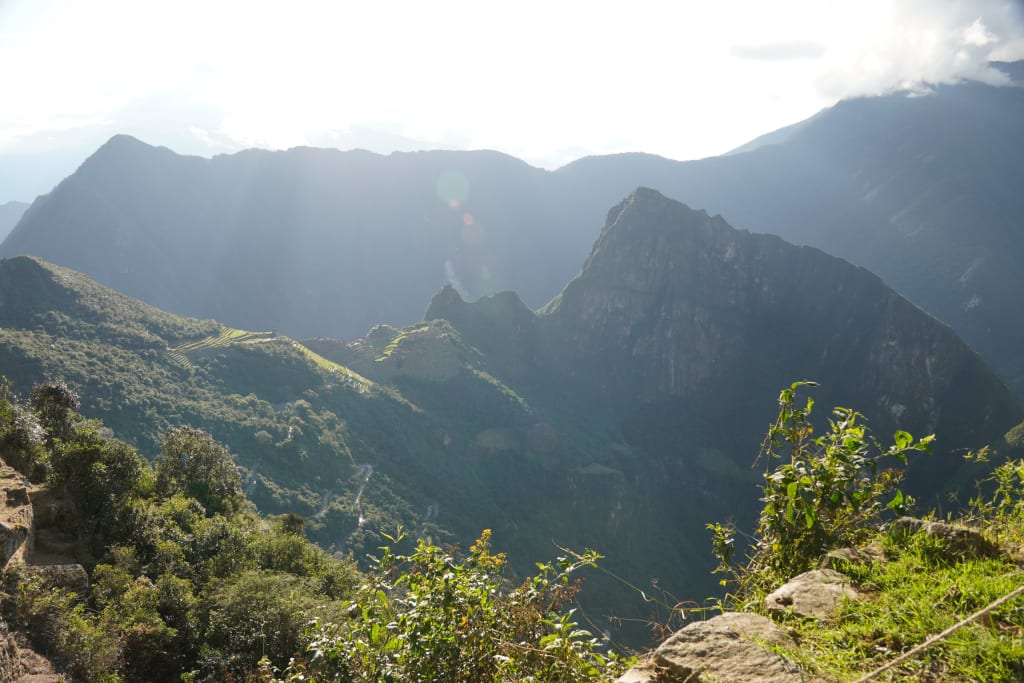
It took another hour at a brisk pace to make it to Machu Picchu. This time, we were moving quickly to snap some photos before the sun set. There were a hundred reasons to hurry today!
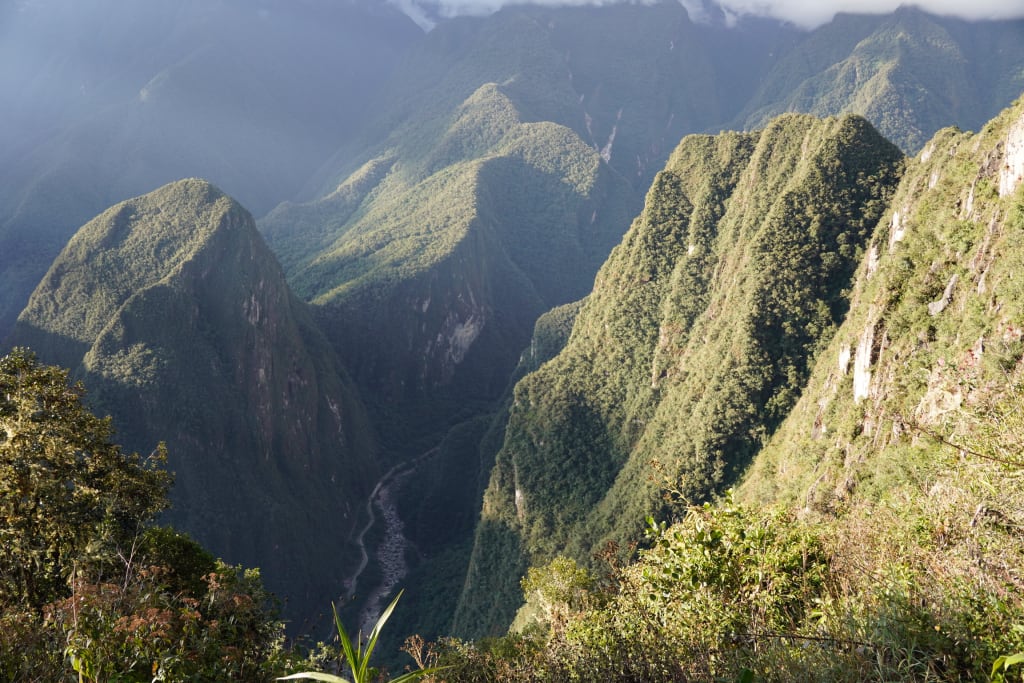
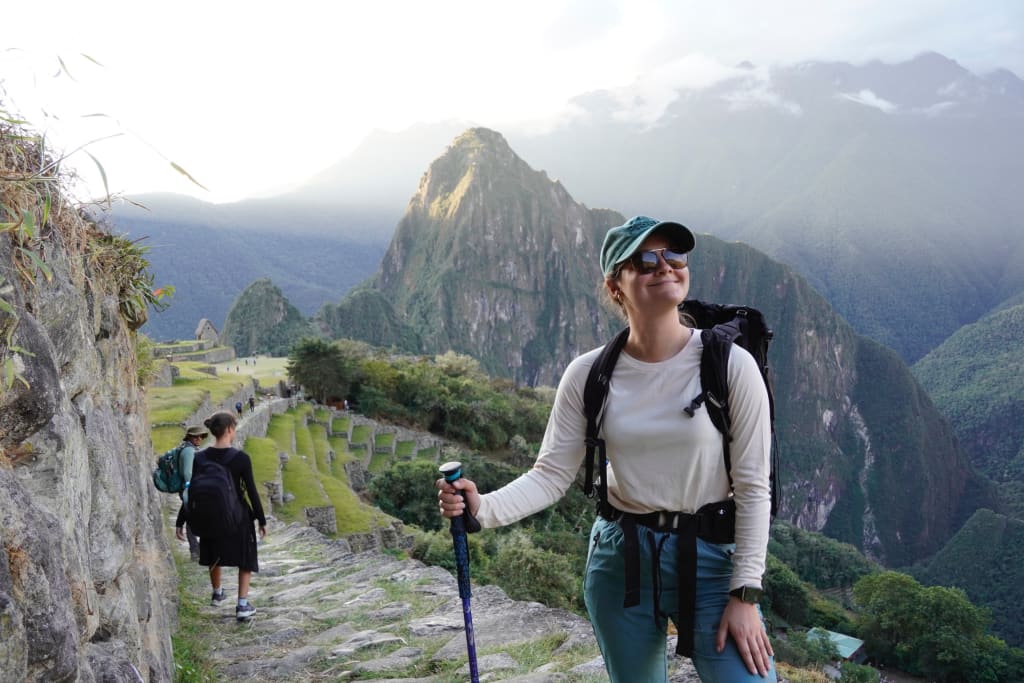
We finally arrived at the Guardian’s House viewpoint by 6pm.

We were over the moon. There were so many moments when I didn’t think I would make it, but here I was standing over Machu Picchu with not a cloud in sight, celebrating this accomplishment.
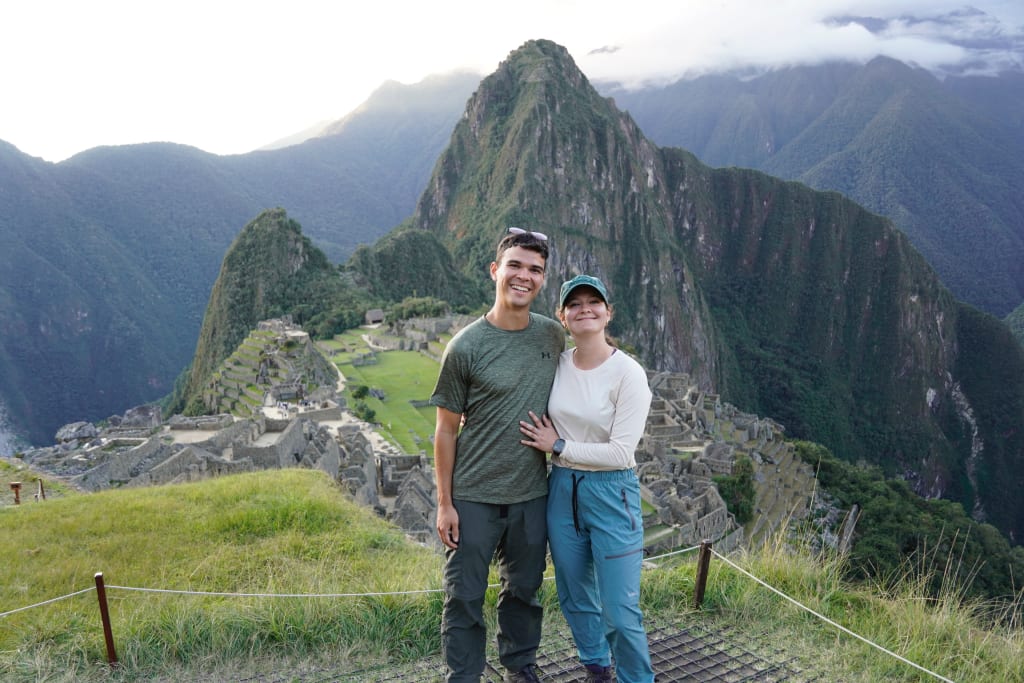
The good news about arriving so late was that the crowds had gone home hours ago, so we had plenty of time to get the perfect photo.
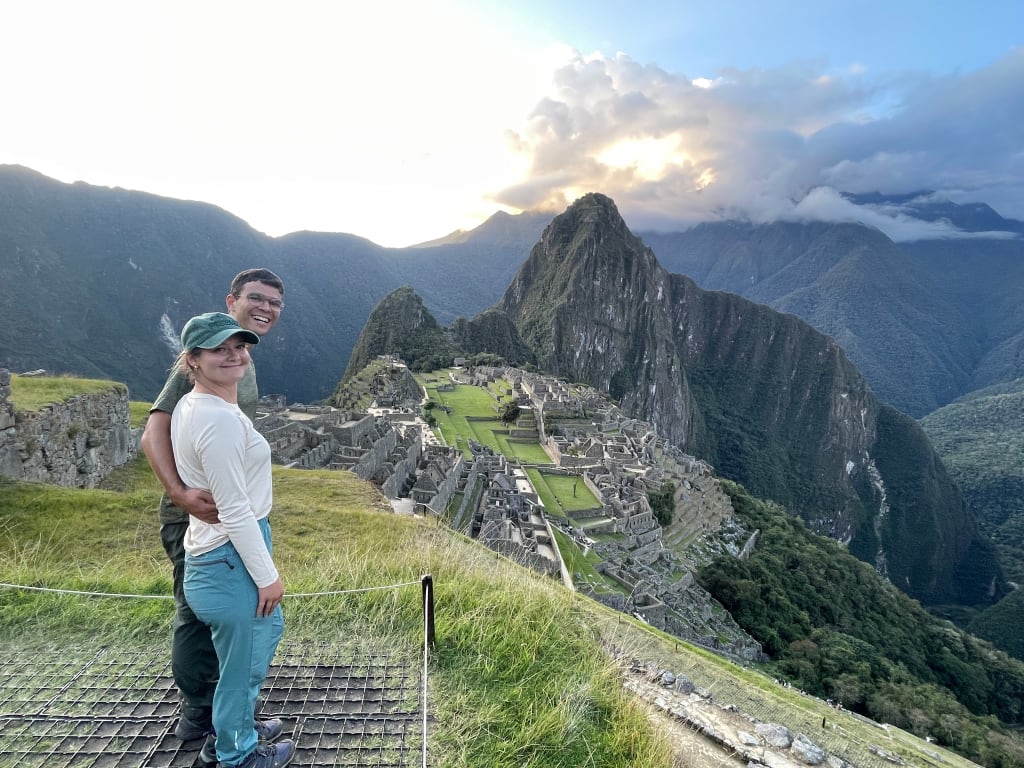
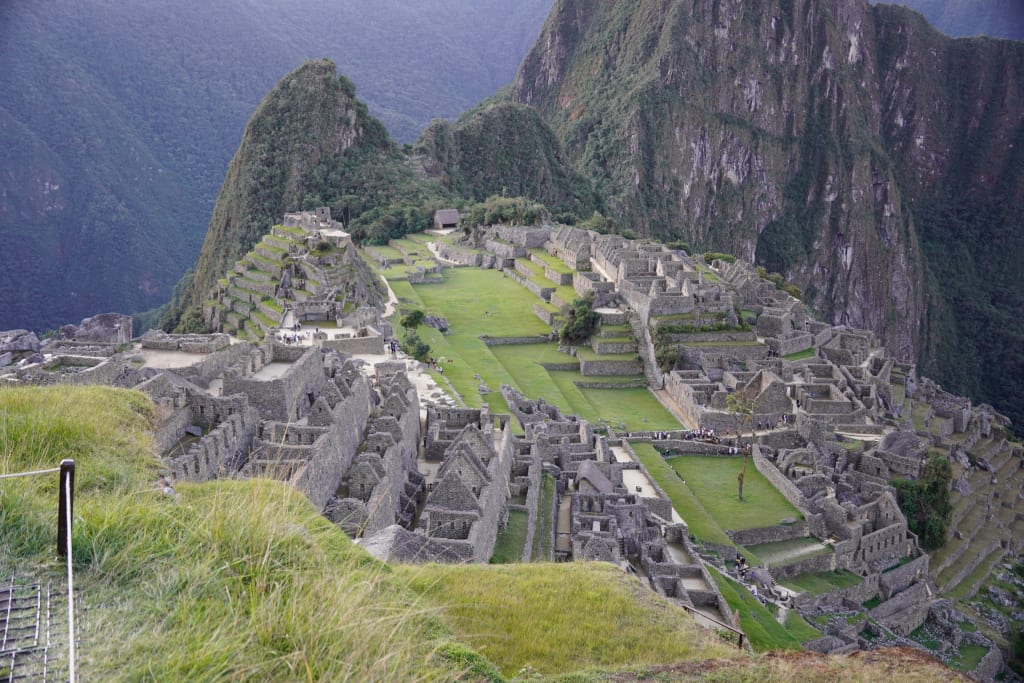
We didn’t get to explore the ruins beyond the viewpoint that day, but we would be back again tomorrow to explore in depth and summit Huayna Picchu for an epic bird’s eye view over the most iconic Incan ruins in the world.
Read about our experience at Machu Picchu here.
HIKING STATS
The hike is 6.5 miles long with 3,000 feet of elevation gain. It’s important to note that this hike is at a high altitude, with a starting elevation of ~6,900 feet above sea level and a maximum elevation of just under 9,000 feet.
I highly recommend spending at least 2 nights (ideally 3) acclimatizing to the altitude in Cusco before attempting this hike. Cusco sits at an elevation of more than 11,000 feet above sea level, so once you acclimatize in Cusco, you’ll actually descend to the Sacred Valley to do this hike and you will not feel the effects of the altitude as acutely. When acclimatizing, I recommend drinking coca tea and avoiding alcohol or strenuous exercise. We also got prescriptions for Acetazolamide in the US and that helped significantly.
The hike typically takes between 6 and 8 hours to complete. It took us 7 hours to get from the 104km point at the start to Machu Picchu at the end, but we stopped several times for bathroom and snack breaks.
Here was our full timeline:
5:00am: Pickup from Cusco
Head to the train station in Ollantaytambo and catch the train to Aguas Calientes.
10:00am: Arrive at 104km Marker
This is the starting point of the hike. We were significantly delayed. Use the restroom and apply sunscreen before you go. There will be a long line for the restroom.
11:40am: Start hiking
1:30pm: Arrive at Wiñay Wayna ruins
4pm: Arrive at Sun Gate
5pm: Arrive at Machu Picchu
You can find more details about this hike along with hundreds of reviews on AllTrails.
DO YOU NEED A GUIDE?
Yes, you are required to hike with a guide. To hike the Inca Trail, you need a permit and permits are only issued to licensed tour operators.
There is a strict cap on the number of permits issued each day to protect the trail and the archeological sites along the way, so it’s crucial to plan your trip in advance (at least 6 months in advance if you plan to hike during peak season from May to September). Permits for the 4 day Inca Trail tend to sell out faster than permits for the 1 day version, so you can try to secure permits for the 1 day hike if the 4 day permits are sold out for your dates.
We went with Machu Picchu Viajes Peru and honestly didn’t have the best experience. Our tour guide didn’t teach us too much at the ruins and Alex got sick off the boxed lunch from the hike, although it probably just sat out in the heat for too long given we were stuck on the train for hours.
We took a private tour and were glad we did. We could go at our own pace and get to know our guide. If you are looking for a cheaper option, I recommend joining a group tour.
ALTERNATIVE ROUTES TO MACHU PICCHU
In recent years, the Salkantay Trek has become quite popular. It’s longer and at a higher altitude than the Inca Trail, but no permits are required, making it an excellent choice for a last minute trip. Another popular alternative is the Lares Trek.
If you’re interested in trying out more adventurous activities, consider the Inca Jungle trek. You hike, mountain bike, raft, and zipline to get to Machu Picchu.
Of course, if you prefer, you can take the train all the way to Machu Picchu. No hiking necessary.
BEST TIME OF YEAR TO HIKE
The best time of year to hike the Inca Trail is during the dry season from May to September, when you have the highest chance of clear skies. The worst time is February since the trail is closed for repairs.
WHERE TO STAY
Before the hike, I recommend staying in Ollantaytambo in the Sacred Valley. I would start my trip in Cusco with two nights in a hotel, then check out of your hotel and spend a day touring the Sacred Valley. Spend your third night in Ollantaytambo and catch the morning train headed to both the 104km mark and Aguas Calientes. We stayed at Hotel Rumi Punku in Cusco the night before the hike, but it was pretty inefficient, since we did tour the Sacred Valley that day, so it involved a lot of driving back and forth. We did like the hotel though.
After the hike, you’ll stay in Aguas Calientes. We stayed at Tierra Viva Cusco Machu Picchu Hotel.
HOW TO GET THERE
You’ll need to fly into Cusco, which often involves a layover in Peru’s capital: Lima. From Cusco, I recommend taking a guided tour to the Sacred Valley and staying overnight in Ollantaytambo.
IS IT WORTH IT?
This hike is absolutely worth it. It’s the #1 recommendation I would give to anyone traveling to Peru. It made our experience visiting Machu Picchu so much richer and the scenery along the way, with the rolling green mountains and ruins dotting the path, was truly unparalleled.
FAQS
Do I need altitude medication?
I highly recommend a prescription for altitude medication such as Acetazolamide to help your body adjust to the effects of being at a higher elevation.
How difficult is the hike?
It was challenging with some steep uphill sections, but it was not grueling. If you exercise regularly, you should have no trouble handling this hike.
Do I have to hike to get to Machu Picchu?
No, you can take the train all the way from Ollantaytambo to Aguas Calientes. From Aguas Calientes, take the bus to Machu Picchu.
Should I do the 1 day Inca Trail or the 4 day Inca Trail?
The 1 Day Inca Trail is a great introduction to the Andes mountains, with phenomenal scenery along the way and an epic view of Machu Picchu from the sun gate at the end of the hike. It’s also a great option if you’re short on time or cash or if you’re not interested in camping. I highly recommend it.
If you have four days to spare, you might like the full Inca Trail. You'll see more Incan ruins, spend more time immersed in the Andes, and enjoy one of the world's most iconic multi-day hikes before arriving at Machu Picchu.
Can I hike it without camping?
Yes, you can do the 1 day Inca Trail. You will sleep at a hotel in Aguas Calientes, the closest town to Machu Picchu, after your hike.
How far in advance should I book?
If you’re hiking in peak season from May to September, make your reservation at least 6 months in advance.
How much does the 1 day hike cost?
We splurged on a private tour so we could go at our own pace and get to know our guide. We paid $486 per person. This included:
- Transportation from Cusco to Ollantaytambo and back
- Train ticket from Ollantaytambo to 104km (starting point of the hike) and from Aguas Calientes back to Ollantaytambo
- Bus tickets to and from Aguas Calientes
- Permit and tickets for the Inca Trail & Machu Picchu
- 1 breakfast, 1 lunch, and 1 dinner
- A hotel room in Aguas Calientes
- Hiking poles (to borrow)
- A private guide
We paid an additional fee of $70 per person for the Huayna Picchu hike.
The prices for Machu Picchu Viajes Tours (the operator we went with) have since gone up to $612 per person for a private tour, $585 per person for a group tour with 4-7 participants, and $558 per person for 8-10 participants.
What should I pack?
Here’s my list:
- Passport (crucial for checkpoints)
- Hiking backpack
- Hiking boots
- Hiking socks
- Hiking pants or shorts
- Short sleeve athletic shirt
- Rain jacket
- Underwear
- Sunglasses
- Hat
- Sunscreen
- Bug spray
- Bandaids (for blisters)
- First aid kit/medicines, including altitude medication (if you have it), anti-diarrhea pills, Advil, etc.
- PJs
- Change of clothes for the next day
- Water bottle/water bladder
- Electrolyte packets (optional but so helpful especially at altitude)
- Protein bars and snacks
- Travel plug adapters (A,B,C)
- Camera and batteries
- Chargers (phone, camera, smart watch, etc)
- Eye mask
- Laundry bag
- Ziploc bag for trash
- Hand sanitizer
- Toilet paper
- Wet wipes
- Hair brush, toothbrush, toothpaste, toiletries
EXPLORE MORE

One Day in Peru's Sacred Valley: Highlights & Honest Thoughts

Machu Picchu: My Complete Guide (+ Why You Should Go Now)

How to Visit Rainbow Mountain (Vinicunca) Without the Crowds

Visiting the Amazon Rainforest in Peru: My Honest Review of Tambopata

Hiking Acatenango: Watching an Active Volcano Erupt Above the Clouds

Hiking the Narrows Without the Crowds (Top Down)
