
Bartolomé: A Penguin Lover’s Paradise in the Galápagos
Penguins rank in my top 5 favorite animals I’ve ever had the privilege to snorkel or scuba dive with. They’re right up there with dolphins, sea lions, sharks, and, perhaps my all time favorite, octopuses (and yes, it’s octopuses, not octopi). Penguins are agile, speedy, and they’re not scared of humans. I had a magical time snorkeling with Galápagos penguins and watching them hop about on volcanic rock on Bartolomé island and I’m here to share all the details.
BARTOLOMÉ
Bartolomé Island is a barren, rocky island famous for its tall, dramatic volcanic cone nicknamed Pinnacle Rock. In fact, the island is so barren that Buzz Aldrin famously claimed that it’s the place on Earth that most closely resembles the moon. Despite its modest size (at just 0.5 square miles) and lack of vegetation, it’s the most visited island in the Galápagos today.

Bartolomé is one of the youngest islands (just a mere 1-2 million years old). It was named after Bartholomew James Sulivan, the second lieutenant onboard the HMS Beagle that brought Charles Darwin to the Galápagos in 1835.
A HISTORY OF PENGUINS IN THE GALÁPAGOS
Not a lot of wildlife can flourish on an island with such a complete lack of vegetation, but the Galápagos penguin is an exception. They live in a cave behind Pinnacle Rock and are commonly found in the waters around the island.
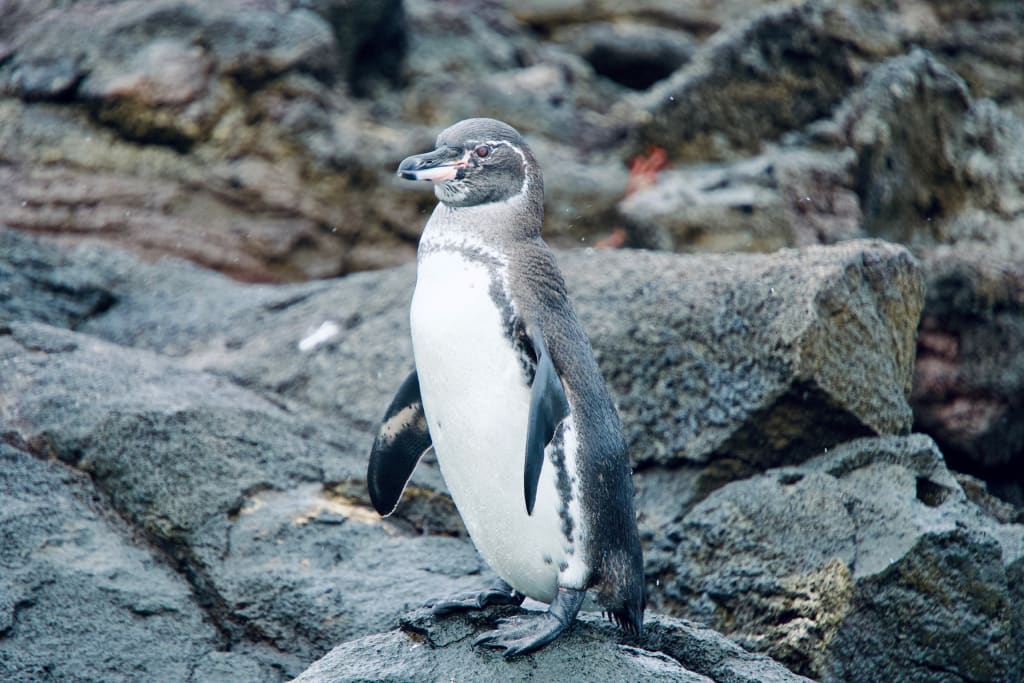
Galápagos penguins are endemic to the Galápagos and can be found on a number of islands including Isabela, Fernandina, and Bartolomé (hosting ~75%, ~15%, and ~5% of the penguin population respectively). They are the second smallest species of penguin in the world and are the only species found north of the Equator (just barely, rarely venturing more than 40 miles into the Northern Hemisphere).
Sadly, these penguins are endangered, with just 2,000 remaining today. A few decades ago, they sustained a healthy population of 15,000, but the El Niño event in 1982 decimated the population. El Niño heated the waters around the Galápagos, destroying the fish populations that the penguins rely on as a food source. To add further strain, scientists discovered a parasite causing avian malaria in the penguin population in 2008. Thankfully, several organizations (including Galápagos Conservancy and the Charles Darwin Foundation) have active initiatives to protect the penguins, ranging from building artificial nests to controlling invasive species.
OUR EXPERIENCE
Our first encounter with the penguins was in the water. I was snorkeling, completely unaware of their presence until a small colony of penguins blitzed by me in a matter of seconds. If I would have blinked I would have missed the whole thing. Thankfully I would bump into a few more.
As I continued to swim, I saw another group of penguins darting this way and that. I was impressed by how quickly they glided through the water and changed direction in an instant. I later learned that they can reach speeds of over 20 miles an hour. I was lucky that they were so unbothered by the presence of humans or I wouldn’t have been able to capture these clips.
Penguins weren’t the only underwater creatures we met during that snorkel. A pod of white tip reef sharks was snoozing under a rock. I dove down to get a better glimpse.
After so many incredible encounters, I didn’t want to get out of the water, but I was lured back to the boat with the promise of a zodiac excursion around the island to see the penguins on land.
As we cruised around the island, I was able to take in the breathtaking views of the rock.

The penguins were far less agile on land, and almost clumsily hopped around on the rocks and belly flopped into the water.


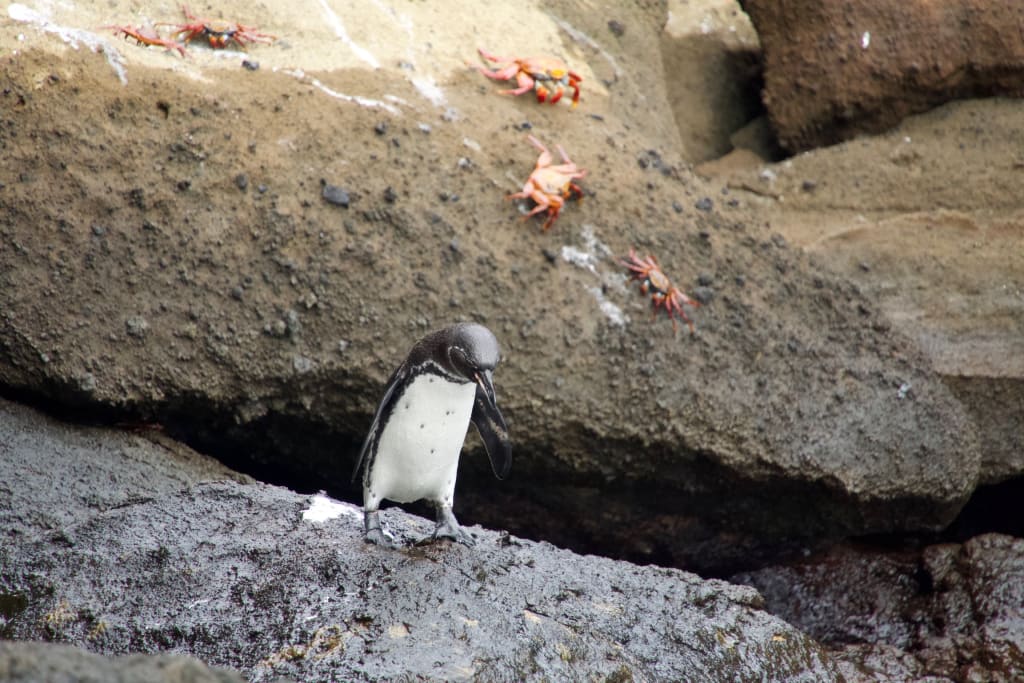


Once again, I could have spent all day with the penguins, but we had a hike to do. The hike consisted of a series of wooden staircases up to a viewpoint of Pinnacle Rock. I’d say there were a few hundred steps in total and it took somewhere between 30 and 40 minutes, depending how often you stopped for photos (or “photos” that are really an excuse for a break).
The landscape was unbelievably barren.


We snapped a few fantastic shots, including the only group shot we took of all the passengers onboard our boat.
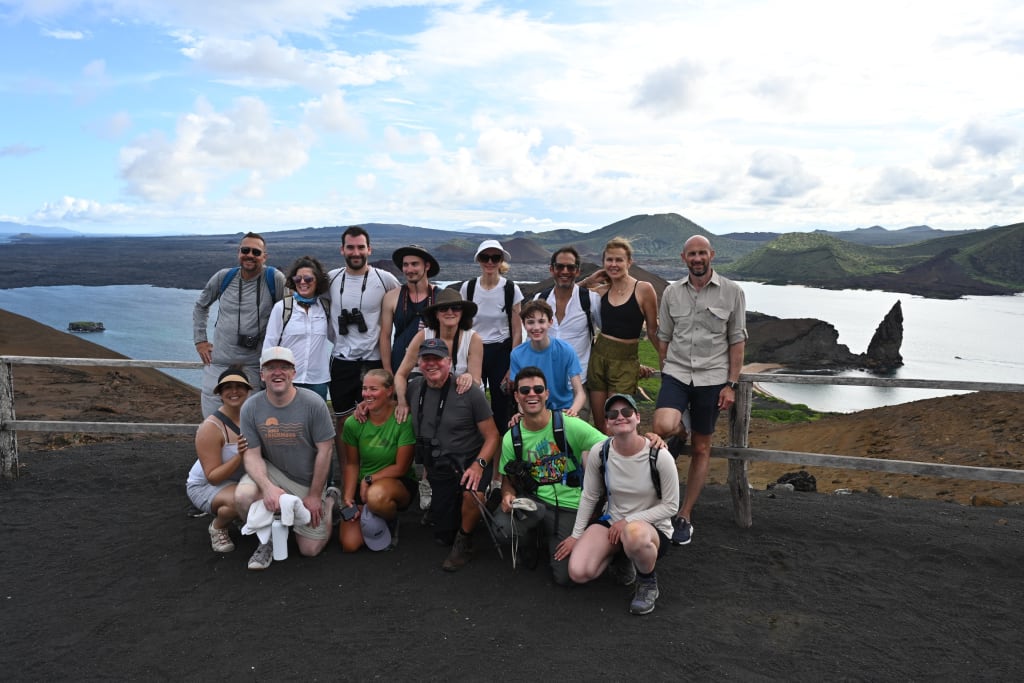
Our visit to Bartolomé was short but exciting. Now it was time to set sail for the next island.

EXPLORE MORE
Planning your own trip? I’ve written detailed guides on the islands we visited, plus roundups on Galápagos wildlife, snorkeling, and the wildest facts I learned along the way.

Cruising the Galápagos with Ecoventura: What You Need to Know

Wildlife in the Galápagos: What You’ll See and Where to Find It

50 Wild Things I Learned in the Galápagos (That Blew My Mind)

Snorkeling in the Galápagos with Sea Lions, Sharks, & More

Saving the Galápagos: Tortoise Conservation on Santa Cruz Island

The Most Magical Moment in the Galápagos (North Seymour & South Plaza Islands)

Española: The Galápagos Island That Completely Won Me Over

First Impressions of the Galápagos in San Cristóbal
