
Floreana Island: Flamingos & Foul Play in the Galápagos
Floreana is the Galápagos island with the most tantalizing history. This, plus the fact that we got to witness a rare wildlife phenomenon that our guide told us he only sees every few years, made our day in Floreana quite a memorable one. Below, I’ll break down the intrigue behind the famous island and the wildlife you can expect to see in present-day.
AN ECOLOGICAL HISTORY OF FLOREANA
Whaling ships frequented Floreana’s shores as early as the 1790s. These ships brought invasive species to the island, including goats, rats, and cats. The goats overgrazed and destroyed habitats, the rats ate birds’ eggs, and the cats preyed on many native species (such as birds and lizards), all of which created ecological imbalance and thus had catastrophic consequences for the native species who were no longer able to flourish on Floreana.
To make matters worse, these whalers soon realized that the native tortoises can live for up to a year without food, making them a fantastic live food source for the sailors. They would frequently bring them onboard, devastating their population to a point where only 14 remained where there were once many thousands. Out of all the islands, Floreana was among the ones that suffered most from the presence of humans.
On another note, Floreana was one of the very few islands that Charles Darwin visited on his voyage in 1835. Darwin noted that the mockingbirds differed from the ones he saw on other islands, lighting a spark in his mind that would one day turn into his famous Theory of Evolution by Natural Selection.
A HUMAN HISTORY OF FLOREANA: MYSTERIOUS DEATHS AND DISAPPEARANCES
Floreana was the first island in the Galápagos that was colonized. The government of Ecuador established a penal colony on the island in 1832, but there was a lack of fresh water which ultimately led to its abandonment.
Exactly a century later, the island was colonized once again, and this attempt was even more intriguing. A German doctor named Friedrich Ritter abandoned his spouse and made a new life for himself with his lover, Dore Strauch, in Floreana. Others soon followed suit: another German couple named the Wittmers and, soon after, an Austrian baroness named Eloise Wehrborn de Wagner-Bosquet and her two male lovers.
The three families notoriously did not get along. The tension boiled over, likely to the point of murder. Overnight, the baroness and her favorite lover disappeared without a trace and their bodies were never found. Some witnesses claim they escaped by boat, but they left all their belongings on the island, and another witness claims to have heard a scream. Many suspected the baroness’ other lover committed the crime. This lover “feared for his life” and tried to escape by boat, and months later his body was found far from where he planned to go.
That’s not even the end of the suspicious list of deaths. The German Doctor Ritter died from “food poisoning from eating spoiled chicken,” according to his lover, Strauch, a dubious story since he was a strict vegetarian. Shortly afterwards, Strauch returned to Germany to write about her life in Floreana and, later, seek help in a mental institution. The Wittmers were the only couple to survive on Floreana and did so for decades after these incidents. They ran a hotel and profited from the island’s bizarre and eerie history.
This story is the subject of a number of films, including the documentary The Galapagos Affair: Satan Came to Eden (2013) and the movie Eden (2024).
OUR EXPERIENCE
We had a rough start to the morning. Alex had an allergic reaction to his breakfast. In Ecuador, they don’t consider peanuts a nut, so when he asked if the food had nuts, the staff told us no. (They are technically correct. Peanuts are legumes, not nuts.)
An hour after popping a Benadryl, Alex decided he was stable enough to participate in this morning’s activity: a visit to Floreana’s resident flamingos.


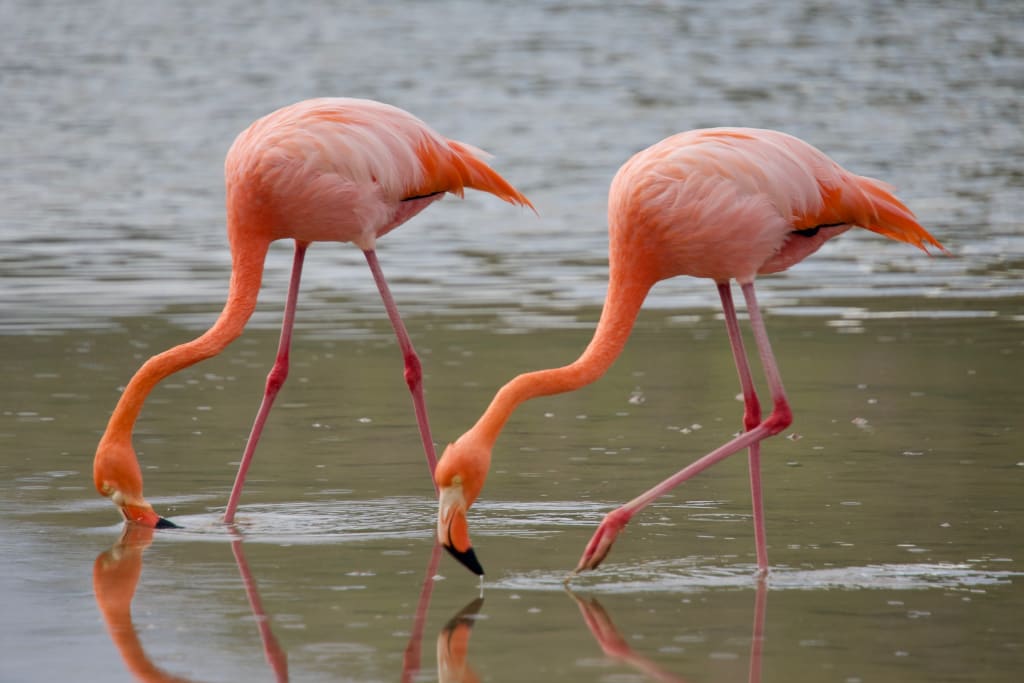
There were dozens of flamingos gathered in a lagoon.
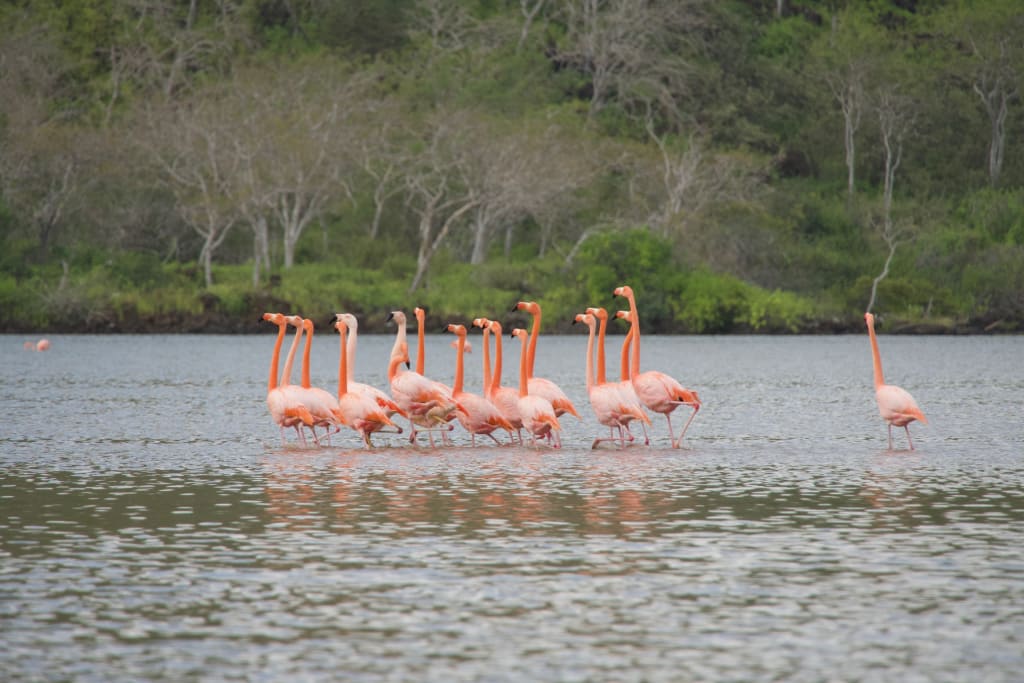
We happened to get incredibly lucky and witness the male flamingos perform their synchronized dance to impress the females. The males stood in a pod in the middle of the lagoon and stepped, gawked, and swung their necks around in unison, hoping to impress the nearby females. Our guide told us he himself only sees this display once every 3-4 years!
The next activity was a snorkel around the island, where we saw a white tipped reef shark, many sea lions, and many fish.
We then had the opportunity to take a zodiac ride around the island, and what a zodiac ride it was! Our first sighting was epic: two eagle rays splashing around near the surface. They were mating! We also caught our first glimpse of Galápagos penguins, the second smallest penguin in the world and the only penguins found north of the equator. We caught glimpses of sea lions, baby sharks, turtles, blue footed boobies, and more before we headed back to the boat.

We ended our day with a trip to the Galápagos’ “post office” (or, more accurately, a barrel with some postcards inside). It was first established by the whalers who would frequent the island in 1793. They would leave letters for their loved ones in an overturned barrel in hopes that other sailors passing by would be heading in the same direction and could pass on their mail. Nowadays, travelers from all over the world write postcards and future travelers pick them up and take them home with them to hand deliver them to the recipient who lives nearby. We wrote ourselves a postcard and “mailed it” at the post office. We still have yet to receive ours (although to be fair, we have yet to deliver the one we picked up either).

EXPLORE MORE
Planning your own trip? I’ve written detailed guides on the islands we visited, plus roundups on Galápagos wildlife, snorkeling, and the wildest facts I learned along the way.

Cruising the Galápagos with Ecoventura: What You Need to Know

Wildlife in the Galápagos: What You’ll See and Where to Find It

50 Wild Things I Learned in the Galápagos (That Blew My Mind)

Snorkeling in the Galápagos with Sea Lions, Sharks, & More

Bartolomé: A Penguin Lover’s Paradise in the Galápagos

Saving the Galápagos: Tortoise Conservation on Santa Cruz Island

The Most Magical Moment in the Galápagos (North Seymour & South Plaza Islands)

Española: The Galápagos Island That Completely Won Me Over
