
The Most Magical Moment in the Galápagos (North Seymour & South Plaza Islands)
I’m the kind of person that plans out every detail of my upcoming trip months in advance, but even I can admit that sometimes the most magical moments are the ones you never planned for. This was exactly the case in the Galápagos. Just after our last activity came to an end, the Galápagos gave us one last parting gift that took my breath away. This moment was, without exaggeration, one of my all time favorite memories from all my travels. You can read all about that moment, and my entire last day in the Galápagos on South Plaza & North Seymour islands, below.
SOUTH PLAZA
South Plaza is the smallest island we visited at a mere 0.05 square miles. The entire island lights up during the months of August through December when the resident succulent Sesuvium turns a vivid bright red, although sadly we didn't get to see this as we visited in April. Today, many land iguanas and sea lions call this island home.
NORTH SEYMOUR
North Seymour is not much larger than its neighbor at just over 1 square mile. It sustains a healthy population of iguanas and the largest colony of the magnificent frigatebirds in the Galápagos (“magnificent” is not my opinion, it’s in their name!).
North Seymour is a fascinating case study in the ethics of conservation. In the 1930s, an expedition team relocated a population of iguanas to North Seymour after recently introduced goats ravaged their home habitat on Baltra Island, driving their numbers down. Along with the iguanas (or more accurately, the humans) came rats. For a while the rats picked up the baton from the goats and controlled the population of iguanas. The rats would eat the iguana’s eggs.
Once scientists eradicated the rats from the island, though, the population of iguanas surged and they began to eat too many cacti. The cacti are critical water sources for other native species on the island, putting their populations at risk.
We debated with our guide, Martín, what should be done. Should the iguanas be allowed to live on North Seymour? Should they be moved to protect these vital water sources for the native species? What is the role that humans should play now when they played a part historically in creating this ecological imbalance?
OUR EXPERIENCE
We started the morning with a walk on South Plaza, an island dotted with giant cacti.

Under many cacti, there stood a lone land iguana. Male iguanas claim a cactus and defend it against their rivals, forbidding any other iguana from coming close. They’ll make an exception for the females, though, and let them sample the fruits of their cactus. Only if she’s interested in mating, that is.


With South Plaza being such a small island, we were able to cover it in just over an hour at a leisurely pace.


For the afternoon excursion, we pivoted to the nearby North Seymour island.

All around, you could hear the chorus of magnificent frigatebirds singing their mating song to attract the attention of the nearby females.

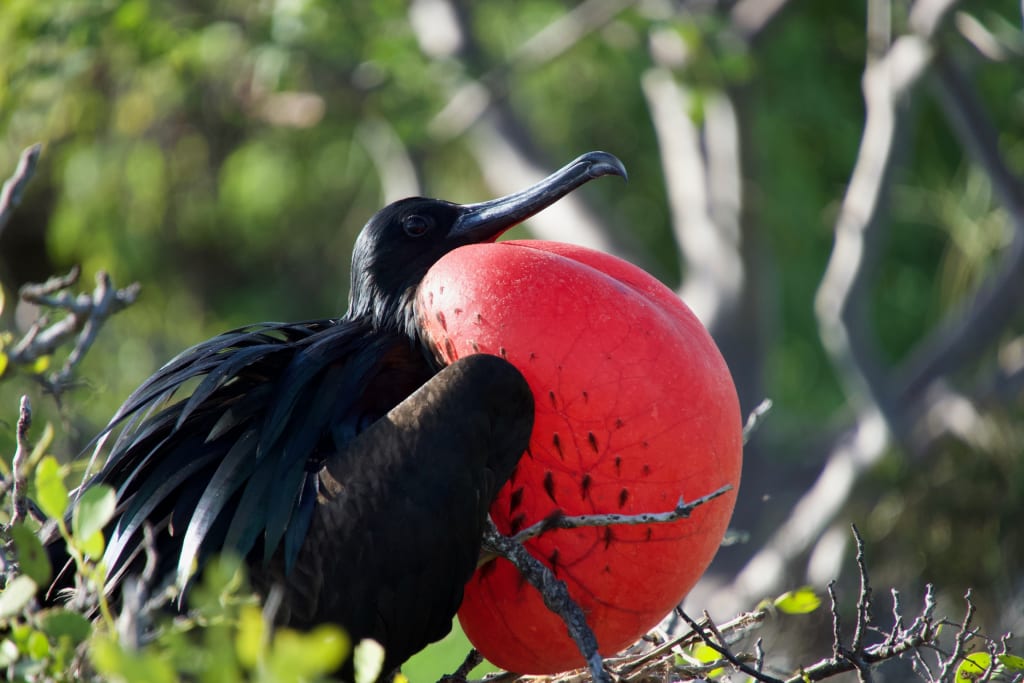

It was a lucky day for this male frigate, who found an enthusiastic match!
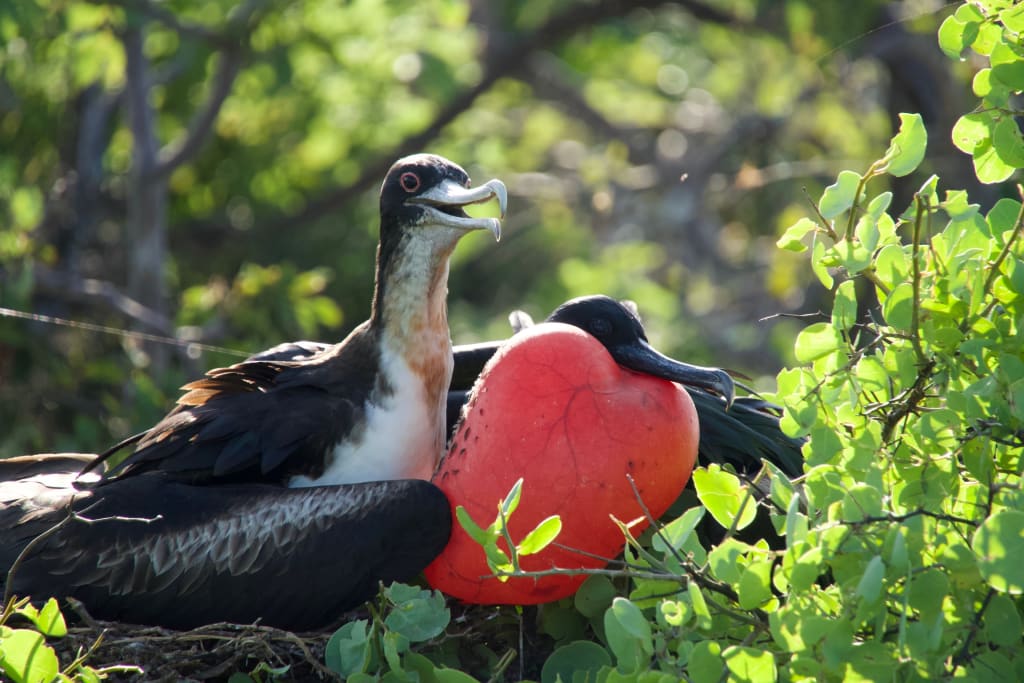
As interesting as the mating interactions were, the most fascinating part was watching a mama feed her baby. She willingly vomited up the contents of her lunch to donate to her chick.


All too soon, our guide announced it was time to make our way back to the boat. Our last excursion in the Galápagos was coming to an end. As I headed back, I stood on the shore watching the giant waves crash violently against the rocks.

I almost didn’t notice that a sea lion emerged from the ocean with her baby and proceeded to breastfeed her just a few paces away from where I was standing. It felt like she personally came to say her goodbyes.

I was soaking up this peaceful moment when Alex ran over to me. “Hurry up!” he said and proceeded to run away. What could possibly be the source of this excitement?
“The captain called over the radio,” our guide explained. “There’s a pod of dolphins!”
We jumped into the zodiac at lightning speed and set off in search of the dolphins. We were driving for so long that I began to lose hope. Surely they were long gone now.
And that’s when I saw them.
Just inches away from the boat, a pod of dolphins emerged and chased alongside us. A new dolphin popped up in every direction and I realized there were dozens of them, if not a hundred!
We were enthralled then, but it was about to get even better. They began leaping out of the water at heights I didn’t know were possible. The whole group on the zodiac erupted into cheers. I could not contain my excitement and I was shouting with glee.

We continued gliding across the water and the dolphins trailed alongside us, dipping under the boat or breaching the surface right next to us.
I would’ve followed them way out to sea but we had already traveled quite far away from the yacht and it was time to leave.
This moment was made all the more special because our captain later told us that he had never seen dolphins near North Seymour before, and he had been sailing the Galápagos for many years.
As hard as I tried, I don’t think my words truly capture how I felt in that moment. It is one of my favorite memories from all my travels and I smile every time I think about it. The dolphins playfully interacted with us and gave us the most perfect farewell to one of the most beautiful places I’ve ever been to.
EXPLORE MORE
Planning your own trip? I’ve written detailed guides on the islands we visited, plus roundups on Galápagos wildlife, snorkeling, and the wildest facts I learned along the way.

Cruising the Galápagos with Ecoventura: What You Need to Know

Wildlife in the Galápagos: What You’ll See and Where to Find It

50 Wild Things I Learned in the Galápagos (That Blew My Mind)

Snorkeling in the Galápagos with Sea Lions, Sharks, & More

Bartolomé: A Penguin Lover’s Paradise in the Galápagos

Saving the Galápagos: Tortoise Conservation on Santa Cruz Island

Española: The Galápagos Island That Completely Won Me Over

First Impressions of the Galápagos in San Cristóbal
