
Wildlife in the Galápagos: What You’ll See and Where to Find It
Nowhere else have I seen wildlife behave like it does in the Galápagos. The animals on these islands are immune to the fear of humans that other animals (who likely have more frequent and negative interactions with humans) tend to have. Because of this lack of fear, you can observe their most unfiltered and quirky behaviors up close.
Not only that, but there are many incredible endemic species in the Galápagos that you can’t find anywhere else on Earth, including the Galápagos penguin, Galápagos giant tortoise, marine iguana, and waved albatross, just to name a few.
These are two of the many reasons you might be interested in planning a trip to the Galápagos and you might be wondering what you’ll see when you get there. Below, I’ve created a list of all the animals you can expect to see in Galápagos.
If you’re interested in what it’s like to swim with these animals, I’ve written a full guide to snorkeling in the Galápagos and described my encounters with sea lions, sharks, penguins, and more in detail.

Snorkeling in the Galápagos with Sea Lions, Sharks, & More
LAND-BASED LEGENDS
Tortoises
The Galápagos giant tortoise is arguably the most iconic animal in the Galápagos. Perhaps that’s because they came dangerously close to disappearing entirely and miraculously recovered.

Centuries ago, there were healthy populations of tortoises thriving on a dozen different islands, until sailors appeared in the 18th and 19th centuries.
These sailors realized that tortoises could survive for up to a year without food, making them an easy source of fresh meat on long voyages. By the early 20th century, tortoises disappeared from multiple islands entirely and had dangerously low populations on others. At one point, there were only 14 tortoises left on Española island (12 females and 2 males), prompting scientists to launch emergency breeding programs.
Those breeding programs continue on to this day. At the Charles Darwin Research Station on Santa Cruz, you can see tortoises of all ages, from tiny hatchlings all the way to full grown adults, being raised until they’re large enough to survive threats from invasive species like rats and cats. There are other breeding centers on Isabela and San Cristóbal islands as well.

Outside of conservation centers, you can visit fully grown tortoises at El Chato Ranch, also in Santa Cruz. We had the chance to stand just a few feet away, marvel at these 400 pound giants, and even watch them mate during our visit. It was hard to believe the tiny pipsqueaks at the Charles Darwin Research Station were the same species as these behemoths we were seeing at the ranch!

Flamingos
With luck, you could witness a rare event in the Galápagos: the courtship display of the flamingos. Luck was clearly on our side when we went to Floreana island and we got to see it for ourselves.
A flamboyance (yes, that’s what it’s called!) of male flamingos gathered in the center of a lagoon. In perfect unison, they squawked and jerked their necks from side to side. They were hoping to get the attention of the nearby females.
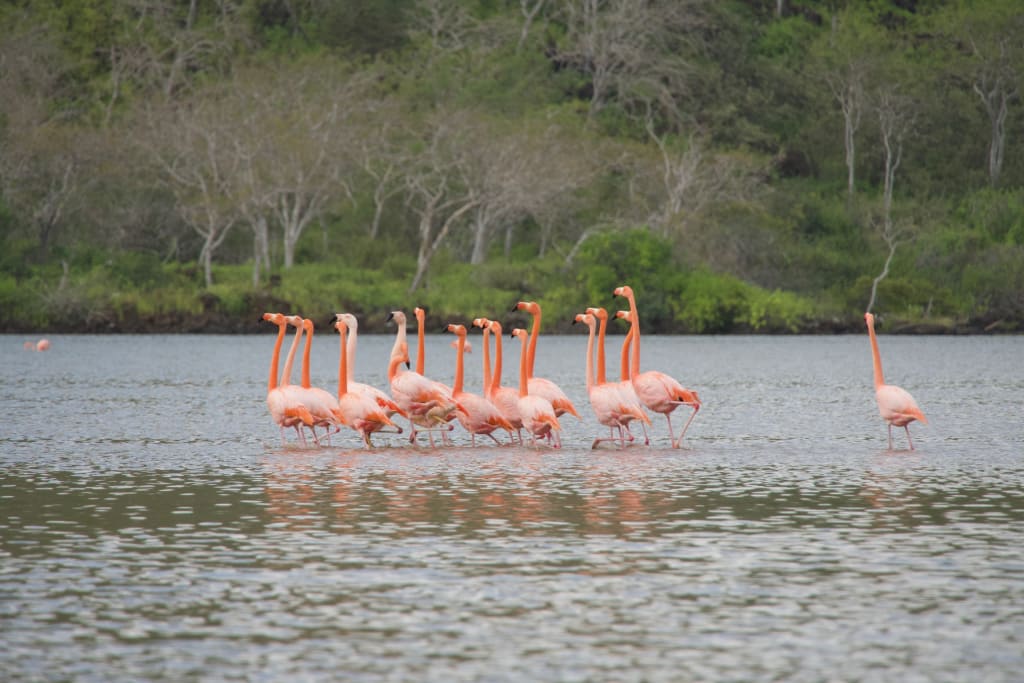
Our guide told us he only sees this display once every few years. Even if you don’t get to witness it, you have a good shot at seeing these elegant birds on Floreana wading in the lagoon or feasting on shrimp. Did you know flamingos get their pink color from pigments in the shrimp they eat?
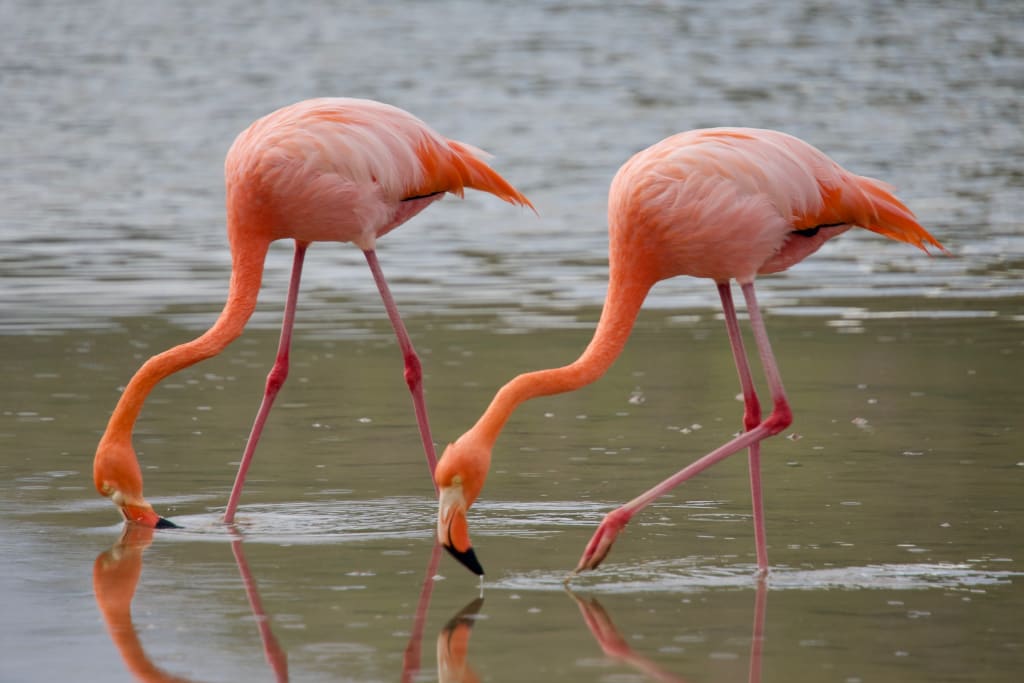
If the courtship dance is your priority, time your visit between December and May. Otherwise, flamingos can be found in the Galápagos year-round.
Land iguanas
Another Galápagos native is the land iguana, which is commonly spotted guarding cacti from their rivals on South Plaza and North Seymour islands. With their scales and spiny backs, they almost look prehistoric (and I suppose they are. They have been roaming the earth for 10 million years).

Land iguanas are an interesting topic on the subject of the ethics of conservation. Humans have historically moved land iguanas to islands in which they weren’t native, upsetting the balance in their new home islands’ ecosystems. There is a question as to what should be done: should these iguanas be returned to their home islands? Should they be allowed to stay where they’re thriving today, even if that comes at the detriment to other species? I’ll leave that for you to ponder.
COASTAL CHARACTERS
Sea lions
A visit to the Galápagos would be incomplete without an encounter with sea lions. You might first run into them on land, where you can find them basking in the sun, showing little interest in your presence.

That attitude completely changes when they’re in the water. Suddenly, these inquisitive creatures are just as interested in getting to know you as you are them! They’ll swim at you at lightning speeds, changing direction just before they’re about to collide with you. They’ll taunt you with flips and spins until you reciprocate. They’ll conduct a thorough investigation on your camera gear. Swimming with sea lions in the Galápagos is such a delight and easily one of the most unforgettable experiences in the Galápagos. I’d highly recommend a visit to San Cristóbal or Santa Fe if you’re interested in snorkeling with these playful characters and a visit to Española to hang out with giant colonies of them on land.

Penguins
Penguins are another species that come to life in the water. On land, they’re almost clumsy, hopping around on volcanic rock and belly flopping into the water when it suits them.
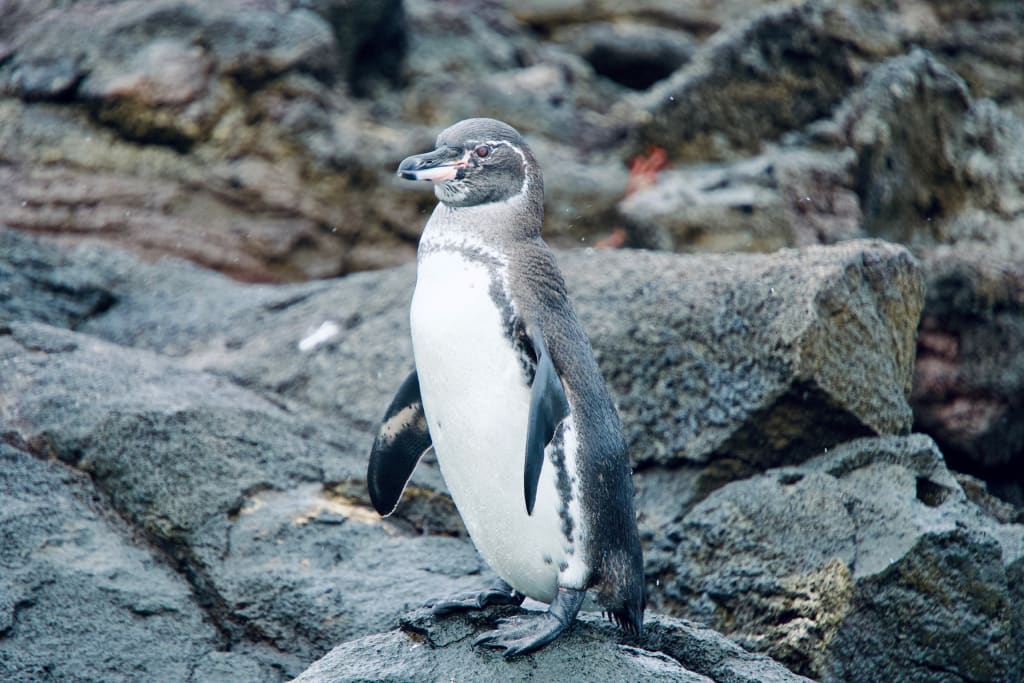
In the water, though, they’ll zip right past you. They’re able to swim much faster than I would have thought, at speeds of up to 22 miles per hour.
Penguin sightings in the Galápagos are extra special for a number of reasons. The Galápagos penguin is endemic to the Galápagos, is the second smallest species of penguin in the world, and the only species found in the Northern Hemisphere.
Like the tortoises, their populations have declined drastically over the past few decades due to climate events like El Niño and diseases such as avian malaria. Thankfully, their numbers have recovered in recent years so you have a great chance to see them in the wild, especially if you visit Isabela, Fernandina, or Bartolomé islands.
Marine Iguanas
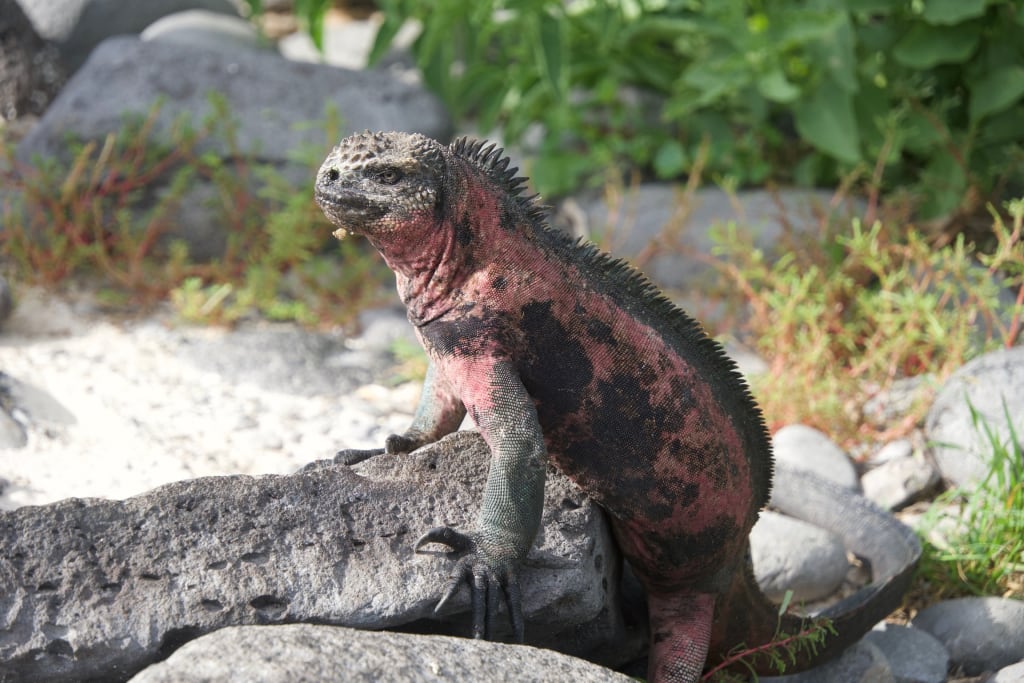
For some, the best encounter with a marine iguana is one where the iguana swims. They are the only lizard that can swim, after all. For others, it’s watching them light up like Christmas trees as their skin turns green and red during mating season.
For me, though, my favorite moment with the marine iguanas was watching the females battle it out over nesting spots on Española Island. They would tumble through the dirt together until one iguana arose as the victor and could claim one of the few nesting spots to lay her eggs.
Whatever your favorite moment is, there is a lot to see where marine iguanas are concerned and there’s no better place to see them than in the Galápagos (probably because they’re endemic to the Galápagos, so there is no other place to see them at all). For the best chances of encountering one, I’d recommend a visit to Española, Fernandina, or Isabela.
Flightless cormorant
I’m sure you were able to piece together that the flightless cormorant can’t fly. The part worth mentioning is why. Without any land predators, the need to fly away became unnecessary. Over time, they “traded” strong wings for strong legs that helped them become more efficient swimmers, to the point where they could hunt for more challenging prey like the octopus or eel.
You can catch a glimpse of these prehistoric-looking birds on land on Isabela or Fernandina. If you’re extra lucky, you can find them in the water. Our itinerary did not include these islands, so we didn’t get to see them. If I get the chance to return to the Galápagos, the flightless cormorant will be high on my list of animals to find.
Crabs
You might be surprised that I featured crabs on the list of wildlife highlights in the Galápagos. I can assure you they are certainly worthy of mention.
The flashy Sally Lightfoot crab can be found scuttling up many cliffs and along many beaches in the Galápagos. They are red, orange, yellow, and baby blue. It’s hard to believe that the little black crabs running around next to the bright ones are a part of the same species, but in fact they are. These crabs transform from black to bright as they mature.

Interestingly, on mainland Ecuador, people have found mature Sally Lightfoot crabs that maintained their black camouflaged appearance for their entire lives. Scientists’ best guess is that it’s an evolutionary adaptation, since brighter crabs are easier to hunt and the black ones can survive by staying hidden.
AIRBORN ANIMALS
Boobies
Possibly one of the most entertaining spectacles in the Galápagos is the courtship dance of the blue footed booby. A male will put on an exaggerated performance, lifting its bright blue feet into the air and spreading its wings, hoping to impress the nearby females. If this is something you’re dying to see, visit North Seymour, Española, or San Cristóbal anytime from June through August, although it’s possible to see year-round. We saw many blue footed boobies, but sadly no performances.
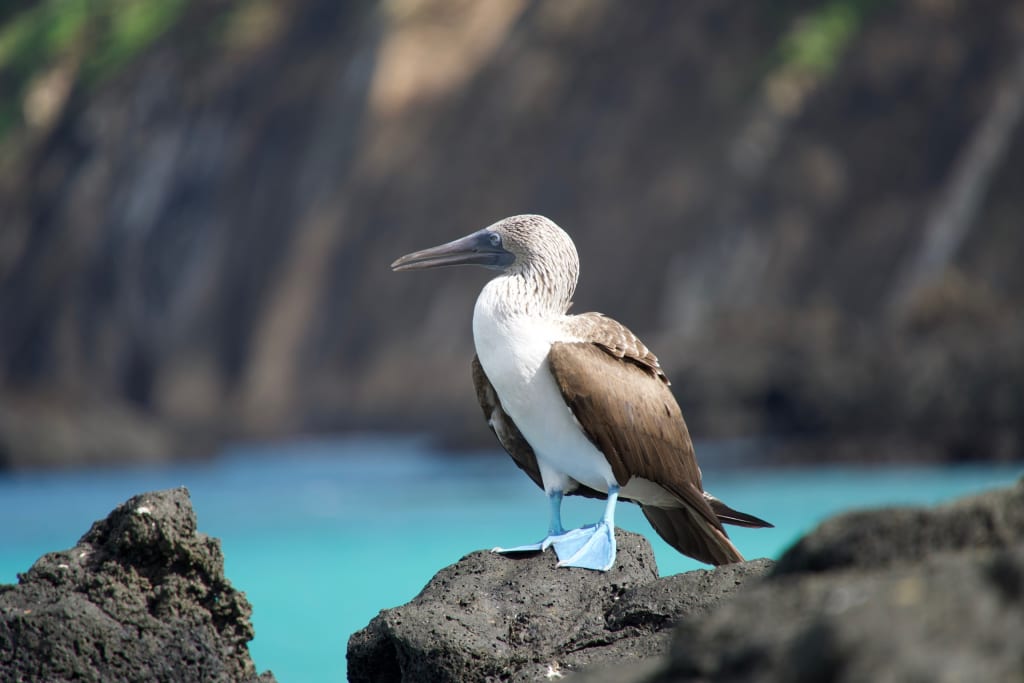
In addition to the blue footed variety, you can also find red footed boobies and Nazca boobies in the Galápagos. I was personally surprised by how different a booby chick looks from its mother (I’m still not entirely convinced the chick I saw was the same species, despite how many times my guide assured me that it was).
You might be wondering how I got through these past two paragraphs without cracking a booby joke. I made the decision to spare you (you’ll see enough jokes on T-shirts and hats in souvenir shops).
Albatross
The albatross is another bird famous for its courtship dance (you might start to notice a theme in this section). Unlike the female blue footed booby, the female albatross will join in on the male’s dance. The male and female albatross will perform a synchronized dance with many intricate movements that the other will mirror. They will bow, clack their bills together, and swing their neck around. The best chance of catching this display is from April to June, although we visited in April and did not see it.

We were able to see the bird itself though. I was astounded at the size, and couldn’t believe this bird could fly! Whether or not you’re able to see the dance, you’ll enjoy seeing the bird itself and it’ll certainly be worth a trip to Española.
Frigates
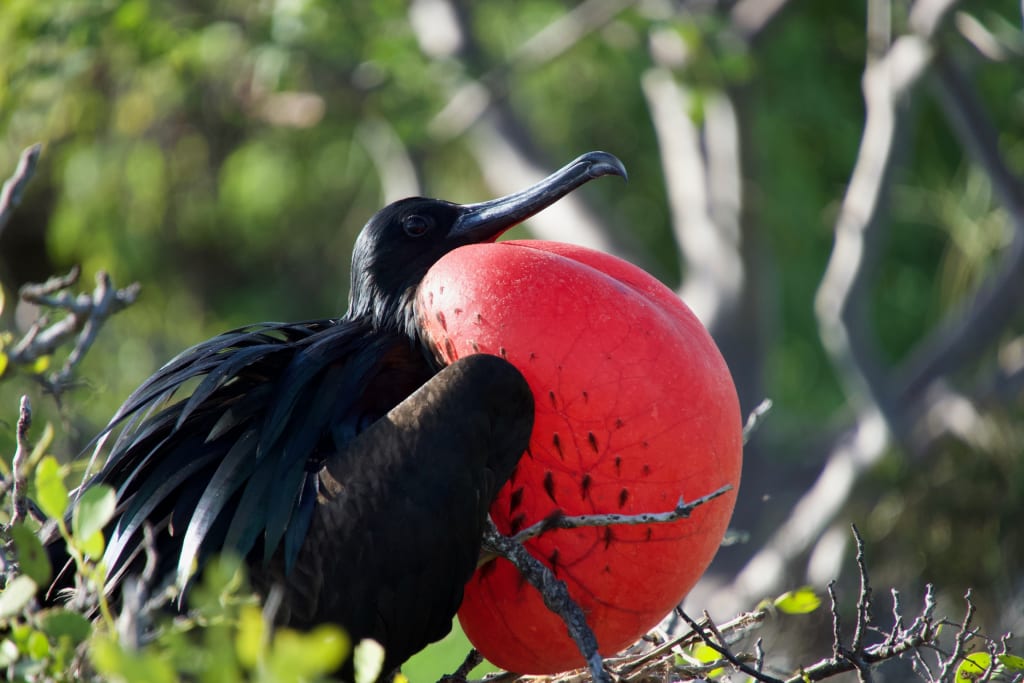
The frigate was one of the few animals I had no idea existed before I started planning my trip to the Galápagos. I had never seen a picture, nor heard the name. I’m not much of a bird enthusiast in general, but really enjoyed watching the frigates inflate their bright red neck pouches and chirp for the nearby females. I highly recommend visiting North Seymour, San Cristóbal, or Genovesa between March and May, when you have the greatest chance of seeing them do this.
DEEP SEA DWELLERS
Dolphins
I’ve been lucky enough to have two incredible encounters with wild dolphins throughout my travels: one in Roatán, Honduras, and the other in the Galápagos. They are among the most playful animals, right up there with the sea lions, and it’s a true delight to watch them glide through the water and (in exceptional cases) fly through the air.

On the zodiac ride back to the yacht after our final excursion of the trip, we found a giant pod of dolphins. There were dozens, possibly even a hundred! After chasing after them for so long trying to find them, we were beyond elated when we did, but it only got better when they started propelling themselves into the air at great heights.
Unlike many other animals in the Galápagos with known hangout locations, encountering a dolphin is always up to chance. They are more commonly seen in the waters further offshore from the islands, especially in the western part of the archipelago, but we spotted them in the waters around North Seymour. Our captain said it’s the first time he ever saw dolphins here and he has been sailing the Galápagos for years! All that to say, you never know when you might find them.
Sharks
Many of you might read that there are sharks in the waters around the Galápagos and take it as bad news. Let me assure you: this is good news! Sharks are incredible creatures, not to mention vital for maintaining balance in their underwater ecosystems.
Sharks have garnered a bad reputation as vicious predators, but did you know that only 3 of the over 500 species of sharks have ever been responsible for more than 10 human fatalities in history? The vast majority of shark species are not aggressive and will swim right by you with barely a glance.
Snorkeling in shallow waters, you might find white tip and black tip reef sharks. We saw both in the waters around multiple islands.
If you’re particularly lucky, you’ll see a Galápagos shark.
The most famous shark species in the Galápagos is the hammerhead, which you’ll only find when scuba diving in deeper waters. The Galápagos is part of the Eastern Tropical Pacific Marine Corridor (CMAR), a chain of remote islands famous for their massive schools of hammerhead sharks. (Other islands in this corridor include Costa Rica’s Cocos Island, Colombia’s Malpelo Island, and Panama’s Coiba Island).
When and if I’m able to dive again in the future, I would love to scuba dive with hammerhead sharks. For now, I’m just grateful to have the chance to swim with any species of shark. It’s a thrill each time I spot one.
Rays
I had no idea so many species of rays existed before I went to the Galápagos. These islands are home to golden rays, eagle rays, marble rays, manta rays, and mobula rays, among others. While snorkeling here, I had my first encounter with a marble ray and saw many eagle rays as well.

Turtles
Sea turtles have many homes around the world in addition to the Galápagos, but that doesn’t make a sighting any less special. They don’t dart around like sea lions or put on a show like dolphins, yet somehow a turtle sighting ends up being just as memorable. Any snorkel that involves sea turtles is a win.
FAQS
How close can I get to the animals?
You will end up getting quite close to many animals in the Galápagos. The official park rule is to maintain at least 2 meters (or 6.5 feet) of distance between yourself and all wildlife at all times. Practically speaking, wildlife will often approach you and they’re unfortunately unaware of the rules. In those cases, you should take a step back and never touch the animals under any circumstances.
What are the odds of seeing all these animals?
I’ll break the animals up into categories based on your likelihood of getting to see them.
Category 1 is “I’ll be shocked if you leave the Galápagos without encountering these guys.” This category would include the sea lion, marine iguana, land iguana, tortoise, crab, frigate, and 2 of the 3 species of booby (blue footed and Nazca). These animals are only in this category if you visit the islands where they can be commonly found. For land iguanas, that means South Plaza and North Seymour. For the tortoise: Santa Cruz, Isabela, or San Cristóbal.
The second category is “you have a good chance, at least 50%.” Penguins, reef sharks, sea turtles, rays, and red footed boobies fall into this category. Penguins only fit here if you visit Isabela, Fernandina, or Bartolomé. You have the best chance at finding a red footed booby in San Cristóbal or Genovesa.
The final bucket would be “no guarantees.” Dolphins, Galápagos sharks, hammerhead sharks, orcas, flamingos, flightless cormorants, and the waved albatross land here. Your best bet at finding flamingos would be on Floreana. For the waved albatross, try Española. For the flightless cormorant: Isabela or Fernandina.
EXPLORE MORE
Planning your own trip? I’ve written detailed guides on each island we visited, along with a deep dive (no pun intended!) into snorkeling in the Galápagos.

Cruising the Galápagos with Ecoventura: What You Need to Know

50 Wild Things I Learned in the Galápagos (That Blew My Mind)
Snorkeling in the Galápagos with Sea Lions, Sharks, & More

Bartolomé: A Penguin Lover’s Paradise in the Galápagos

Saving the Galápagos: Tortoise Conservation on Santa Cruz Island

The Most Magical Moment in the Galápagos (North Seymour & South Plaza Islands)

Española: The Galápagos Island That Completely Won Me Over

First Impressions of the Galápagos in San Cristóbal
